Preparing the current spcent route.
The page shell is online. Shared content and route data are still being assembled.
A game study of how research gates, global panic, squad upgrades, and limited interception windows turn XCOM progression into an escalating systems loop rather than a simple tech tree.
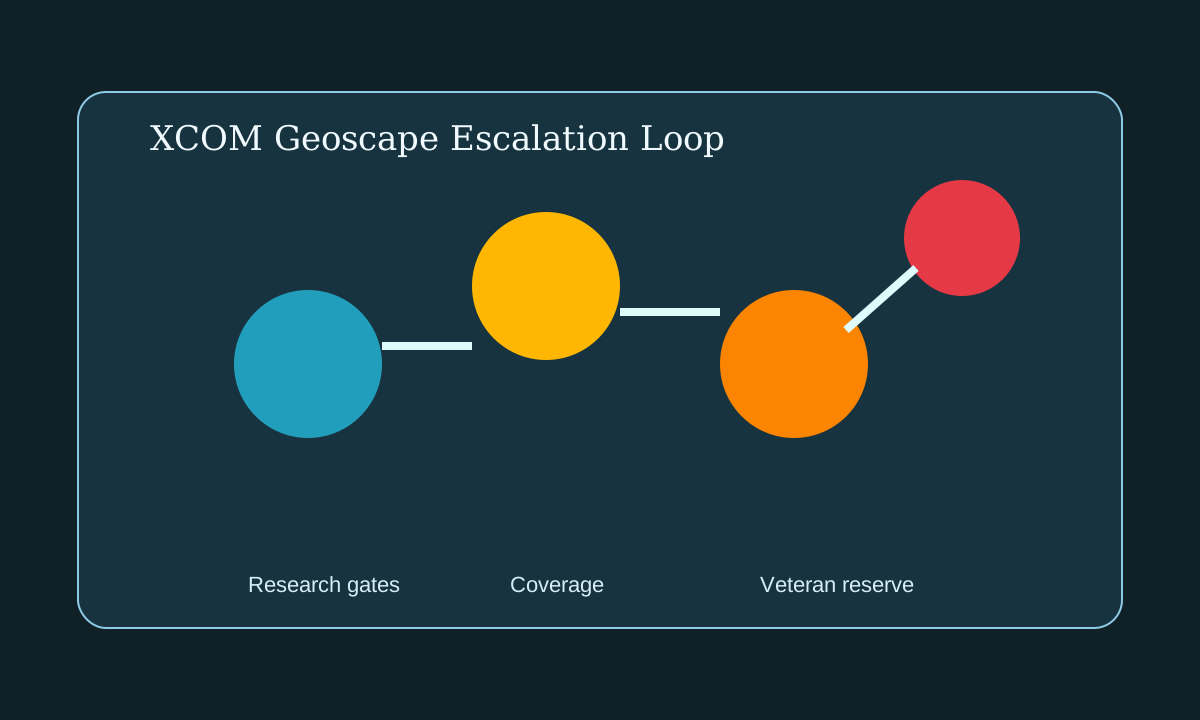
XCOM is most useful when read as an escalation loop rather than as a sequence of upgrades. Research gates, scarce funding, interception coverage, soldier survival, and rising threat all keep changing what counts as an acceptable delay. Progress therefore never arrives on a neutral board.
That makes the case strong for progression proof. The point is not only that the player unlocks stronger tools. The point is that every upgrade is purchased inside a worsening global pressure field that keeps turning progress into triage.
Provides the base lens for why research choices, facilities, and squad upgrades matter as gated branches rather than a flat ladder.
Reinforcement Balancing PairClarifies how technological success reinforces future options while panic, losses, and limited capacity keep pushing back.
Strategic Reserve NetworkShows why aircraft, veteran soldiers, and funding behave like finite reserves that cannot answer every simultaneous crisis.
The escalation loop works because progression never becomes detached from coverage. Research and engineering improve tactical capability, but panic and global spread keep stretching response windows. Veteran units become more valuable, which makes losses hurt more. Resource scarcity turns every growth branch into an exclusion choice.
| Axis | Question | Signal |
|---|---|---|
| Research branching | What new options become possible and which others are delayed by choosing them? | Weapon paths, armor timing, facility unlocks, autopsy chains, aircraft upgrades |
| Coverage window | How much of the globe can the player actually answer before pressure compounds? | Satellite reach, interceptor range, transfer delay, mission overlap, regional gaps |
| Veteran reserve | Why does progress also increase dependence on fragile elite assets? | Experienced squads, aircraft availability, scarce scientists, wounded operators, irreplaceable loadouts |
| Panic escalation | How does the world push back while the player is still progressing? | Regional collapse risk, timed crises, funding loss, enemy scaling, opportunity denial |
Use the toggle to see how the same progression system behaves under stable control, tight triage, or veteran loss.
When coverage and research stay close enough, progression feels empowering because new tools arrive before panic and losses make them immediately insufficient.
The reusable lesson is that progression becomes convincing when every unlock lives inside a worsening pressure field. XCOM is useful because it shows gated growth, balancing drag, and reserve scarcity acting on the same geoscape at once.
Read what should come before it, what relation role matters next, and where this page should hand you off after the local graph is clear.
Start with Progression Gate Graph and then return here once the surrounding concept stack is clear.
These entries clarify the footing underneath the current node before you move outward again. Start with Progression Gate Graph when you want the clearest next role.
Use Guides when the study should feed into a worksheet or structured revision sequence.
2 handoff nodes stay inside Conflict And Operations. No handoff nodes currently share World.
Detail pages now expose the branch and scale of their surrounding graph before showing raw prerequisite and relation shelves, so continuation can stay taxonomy-led instead of adjacency-led.
Explain campaigns, sustainment, force projection, defensive depth, and operational windows as structural systems.
Start with sustainment and projection models, identify the theater cycle, validate through an operational case, then run an operations stress test.
Turn all major programs into creator-operable workflows rather than leaving them as analysis-only content.
Start in Guides with the workflow framework, choose the role route, open the supporting program branches only as needed, and leave with a worksheet or review artifact.
Explain how resources, goods, labor, information, and force circulate, stall, buffer, and break.
Start from the resource-flow loop, trace storage and throughput models, compare one logistics study, then run a flow audit worksheet.
Use this scale when routes, relays, buffers, and linked nodes matter more than territorial bulk.
Use this scale when the region is the main leverage unit for settlement, extraction, governance, or conflict.
Use this scale when the strongest explanation depends on several levels staying visible together.
Use prerequisites when you want the shortest path into the assumptions this page depends on.
A model for mapping progression as a graph of gates, branches, maintenance burdens, and delayed capability unlocks rather than a simple linear ladder.
A loop model for pairing each compounding process with the balancing drag, delay, or exposure that stops it from becoming unbounded.
These groups explain why each neighboring node matters, whether it stabilizes the concept, operationalizes it, proves it, or pushes the lane further.
Use foundation relations when this node depends on a concept, term, or framing layer that should be explicit before you branch further.
A model for mapping progression as a graph of gates, branches, maintenance burdens, and delayed capability unlocks rather than a simple linear ladder.
A model for locating where reserves are stored, who can release them, and how fast they can stabilize the wider system under delay, shock, or surge.
Use operationalizing relations when you want the current abstraction rendered as a cleaner model, loop, or structural device.
A loop model for pairing each compounding process with the balancing drag, delay, or exposure that stops it from becoming unbounded.
Use contrast relations when the difference between two nodes is more useful than simple adjacency or agreement.
A historical study of how remount depth, reconnaissance reach, dispersed foraging, and command tempo turned Mongol warfare into a campaign system rather than a sequence of isolated battles.
These entries still matter, but they currently rely on generic adjacency instead of typed continuation semantics.
A model for how far and how long force can be projected effectively before supply, delay, terrain, and recovery costs collapse performance.
An advanced game study of how alliance overreach, reserve burden, infrastructure concentration, and delayed response make nullsec sovereignty decay structurally uneven.
Studies apply Spcent's lenses to complete cases. Read them to see whether geography, surplus, corridors, and pressure patterns still make sense when placed inside one setting.
The goal is not to retain setting trivia. The goal is to extract reusable patterns and structural habits you can reapply elsewhere.
Studies are strongest when you already know the frameworks and models underneath them, so you can recognize the structural moves being made.
After reading a study, identify which layer of your own draft needs work and go back there with one concrete change in mind.
Keep these collapsed until you want to turn the page into an active reading exercise.
What are the decisive regions, corridors, or chokepoints in this case?
What keeps the studied world stable, and what makes it brittle?
Which model or framework do I need next if I want to reproduce this pattern in my own project?
These routes are tuned to the kind of entry you are currently reading, so you can leave this page with one deliberate next move.
Use Guides when the study should feed into a worksheet or structured revision sequence.
Cross-layer moveReturn to the worlds module when the case highlights a weak worldbuilding layer in your own draft.
Cross-layer moveOpen models when the case reveals a mechanism you want to isolate and reuse directly.