Pulling this page together.
Preparing content, navigation, and supporting references for this route.
Preparing content, navigation, and supporting references for this route.
A model for mapping progression as a graph of gates, branches, maintenance burdens, and delayed capability unlocks rather than a simple linear ladder.
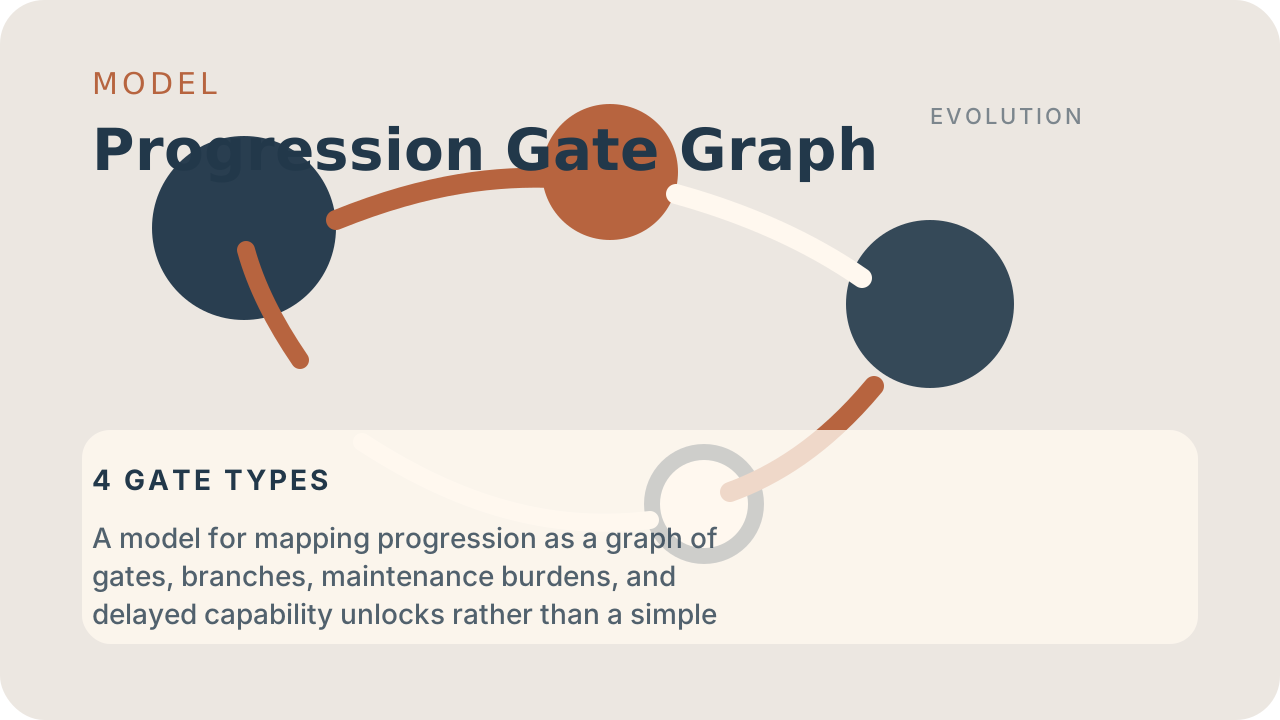
Progression is easier to design when it is treated as a graph of gates instead of a straight ladder. Different unlocks depend on different resources, map positions, institutions, or maintenance burdens.
A graph perspective matters because most systems do not unlock in one universal order. Some capabilities depend on territory, some on stored surplus, some on administration, and some on surviving the upkeep created by previous success. A ladder hides those differences and makes branching systems look simpler than they are.
Identify whether the next unlock depends on material stock, map position, institutional depth, or a previous branch choice.
Ask which later capabilities become available once this gate is crossed so the graph reveals compounding paths.
Treat each unlock as a new operating cost rather than as free permanent power.
| Axis | Question | Signal |
|---|---|---|
| Resource gate | What material base is required? | Currency, supplies, production throughput, stored surplus |
| Territorial gate | What map position or corridor access is required? | Strongholds, transit hubs, region control, adjacency access |
| Knowledge gate | What information or institutional threshold is required? | Research, doctrine, bureaucracy, specialized training |
| Maintenance gate | What new burden arrives after the unlock? | Upkeep, visibility, fragility, staffing, coordination drag |
Progression feels clean only at the start. The graph becomes structurally useful when it also shows when one successful unlock starts taxing the next one.
One new gate opens and the system experiences it mainly as added reach, output, or optionality. The graph still looks generous because maintenance has not caught up.
The graph perspective matters because real progression usually depends on several incompatible kinds of readiness at once. Territory may open one path while bureaucracy opens another. Stored surplus may unlock one branch but then starve maintenance elsewhere. A ladder compresses those differences into one clean sequence and therefore hides why systems feel strategic, political, or brittle in practice.
This makes the model useful far beyond games. Infrastructure rollouts, institutional growth, research systems, and campaign logistics all behave more like graphs than staircases. They branch, reconverge, and impose upkeep in uneven rhythms. The model turns that unevenness into a legible structure instead of treating it as emergent confusion.
Progression usually stalls not because players or actors stop gaining power, but because the graph stops being cheap. New branches compete for the same surplus, territory, or administrative attention. The system therefore needs gates that slow access honestly rather than arbitrary delays that feel disconnected from the world.
This is also why maintenance gates matter so much. A graph with only entry conditions will often produce runaway compounding. A graph that also records upkeep and exposure is much better at producing believable pacing.
Helps check whether progression creates runaway compounding or meaningful drag.
Surplus Capture LadderExplains how growth paths often depend on increasingly governable surplus.
Region GraphShows how some unlocks depend on adjacency, access, and territorial position rather than raw numbers.
When a progression system feels either too linear or too runaway, ask which gate type is missing from the graph. If resource gates dominate, the system may feel grindy but shallow. If territorial gates dominate, the system may feel map-locked without strategic flexibility. If maintenance gates are absent, compounding usually outruns pacing. The model becomes useful when all four gate types can constrain and unlock one another visibly.
The reusable lesson is that progression should be modeled as branching dependency and upkeep, not as a clean staircase. This makes the graph useful for strategy tech trees, institutional growth paths, quest structures, and infrastructure planning alike.