Preparing the current spcent route.
The page shell is online. Shared content and route data are still being assembled.
A loop model for pairing each compounding process with the balancing drag, delay, or exposure that stops it from becoming unbounded.
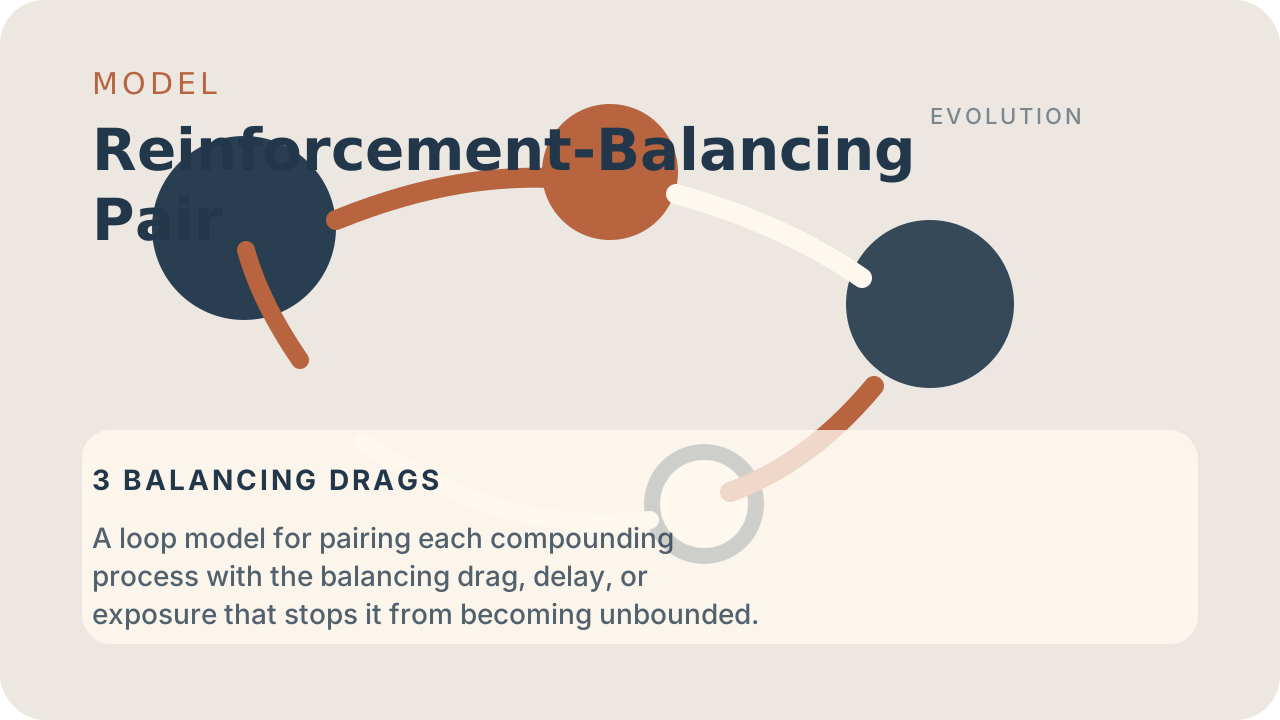
A reinforcing loop is only half a model. The other half is the balancing drag that eventually slows, redirects, or destabilizes the same process.
The reinforcement-balancing pair makes these two halves explicit so designers can see whether a system compounds cleanly, stalls abruptly, or oscillates under delay. Without the balancing side, a loop diagram often explains acceleration but not why the acceleration ever stops or breaks.
Identify what success makes easier, faster, or more attractive the next time around.
Name the capacity ceiling, exposure, or delay that grows with the same success.
Ask whether balancing pressure appears immediately or only after a delay, because delayed drag often creates overshoot.
| Axis | Question | Signal |
|---|---|---|
| Capacity drag | What physical or institutional ceiling slows growth? | Storage limits, staffing caps, route throughput, command span |
| Exposure drag | What new vulnerability appears as the system scales? | Longer lines, more visible hubs, concentrated gateways, insurgent targets |
| Delay drag | What hidden lag makes success arrive late or fail suddenly? | Maintenance backlog, bureaucracy delay, replenishment lag, deferred exhaustion |
Paired loops produce better explanations because they show not only how success compounds but also how success rewrites its own operating conditions. Growth may concentrate risk, visibility, maintenance cost, or coordination burden even while it is still increasing output.
This is especially important in strategy and worldbuilding because many systems feel unrealistic when growth appears free. Once balancing drag is explicit, compounding becomes believable and failure becomes easier to stage coherently.
Provides a clear base loop that can be paired with buffering failure, route drag, and capture exposure.
Progression Gate GraphShows how upgrades may reinforce future growth while also adding new maintenance or exposure burdens.
Topology Stress TestShows how route closure and asymmetry can become the balancing drag on an otherwise successful loop.
The reusable lesson is that every reinforcing story needs a named balancing mechanism. Use this model for economies, ecological systems, campaigns, upgrade trees, or institutions that compound until their own drag becomes decisive.
Read what should come before it, what relation role matters next, and where this page should hand you off after the local graph is clear.
Start with Resource Flow Loop and then return here once the surrounding concept stack is clear.
Use Resource Flow Loop or the linked nodes below when you want to compare this page against neighboring parts of the graph.
Return to broader lenses when this model is too specific for the question you are asking.
1 handoff nodes stay inside Method And Production. 2 handoff nodes share Cross Scale.
Detail pages now expose the branch and scale of their surrounding graph before showing raw prerequisite and relation shelves, so continuation can stay taxonomy-led instead of adjacency-led.
Explain how resources, goods, labor, information, and force circulate, stall, buffer, and break.
Start from the resource-flow loop, trace storage and throughput models, compare one logistics study, then run a flow audit worksheet.
Explain how legitimacy, coercion, administrative reach, frontier bargaining, and elite control are structured.
Start with the pressure map, locate legitimacy and capture mechanisms, validate against a frontier or state case, then run a governance stress test.
Turn all major programs into creator-operable workflows rather than leaving them as analysis-only content.
Start in Guides with the workflow framework, choose the role route, open the supporting program branches only as needed, and leave with a worksheet or review artifact.
Use this scale when the strongest explanation depends on several levels staying visible together.
Use this scale when routes, relays, buffers, and linked nodes matter more than territorial bulk.
Use prerequisites when you want the shortest path into the assumptions this page depends on.
A model for how extraction, transport, storage, transformation, and redistribution create stability or fragility in a world system.
This entry still relies on generic related links. That works as a fallback, but typed relation roles would make continuation clearer.
A model for how extraction, transport, storage, transformation, and redistribution create stability or fragility in a world system.
A model for mapping progression as a graph of gates, branches, maintenance burdens, and delayed capability unlocks rather than a simple linear ladder.
A framework for tracking expansion, consolidation, frontier friction, and institutional fatigue across a civilizational space.
A model for testing how a spatial layout behaves under congestion, disruption, seasonal shifts, and asymmetric pressure.
Models formalize behavior. Use them when you need a concrete chain, loop, stress scenario, or layered mechanism that can be tested and reused.
A model should explain how something behaves over time or under pressure, not just identify a broad topic area.
When a setting feels plausible at rest but still behaves vaguely, models provide the explicit structure needed to test it.
A strong workflow often moves from broad lens to formal model to applied case reading.
Keep these collapsed until you want to turn the page into an active reading exercise.
What mechanism is this model making explicit?
Where does this model break or become most interesting under stress?
Which study would verify whether this model survives in a complete setting?
These routes are tuned to the kind of entry you are currently reading, so you can leave this page with one deliberate next move.
Return to broader lenses when this model is too specific for the question you are asking.
Cross-layer moveMove through the systems module when you want to navigate models by design intent.
Cross-layer moveVerify the model inside applied cases where multiple structures interact at once.