Preparing the current spcent route.
The page shell is online. Shared content and route data are still being assembled.
An advanced game study of how alliance overreach, reserve burden, infrastructure concentration, and delayed response make nullsec sovereignty decay structurally uneven.
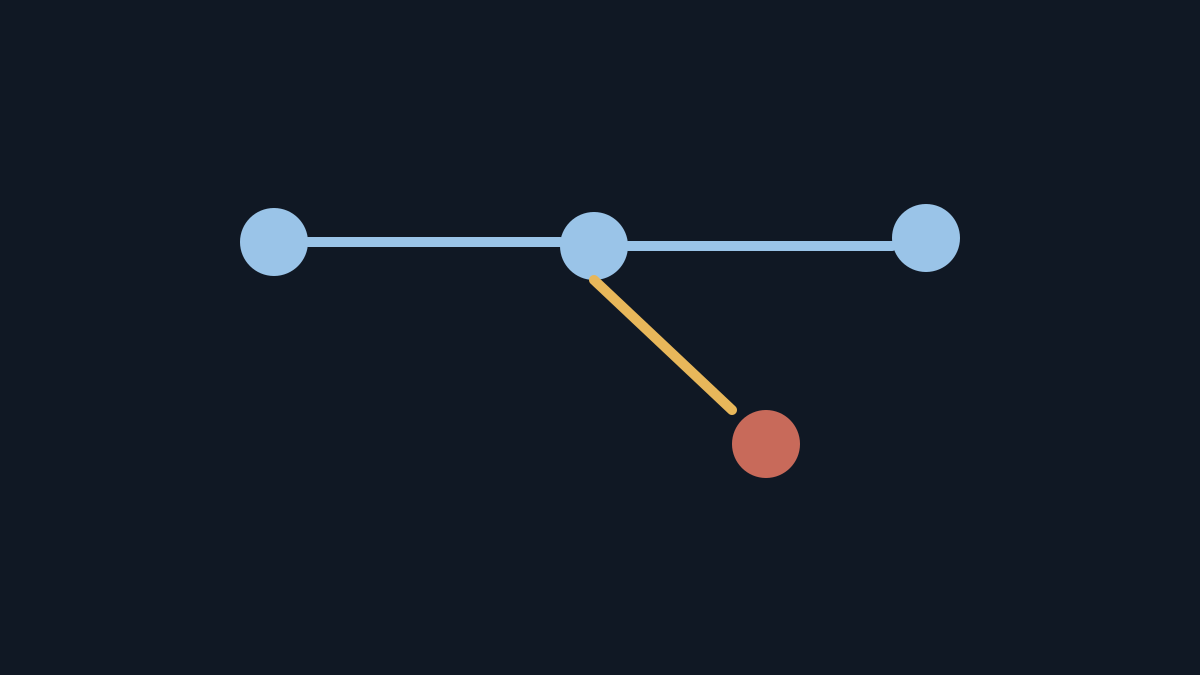
Nullsec sovereignty is a useful advanced case because territorial control is visibly tied to infrastructure, logistics, alliance coordination, and the ability to respond before local losses propagate. Large alliances do not simply lose because enemies appear; they decay when their effective network becomes narrower than their formal footprint.
This makes the case a strong bridge between strategy-game intuition and expert systems analysis.
Frames alliances as multi-center systems whose delegated strength can become a liability under drift.
Cascading Failure TopologyExplains why localized infrastructure loss can widen into strategic unraveling once fallback capacity is thin.
EVE Online Economy SystemProvides the intermediate economic baseline that this sovereignty-decay analysis extends into expert territory.
The most useful comparison is between a wide but coherent sovereignty system and a wide but hollow one. Nullsec decay begins when alliances still own space but can no longer convert ownership into timely defense, reserve concentration, and shared strategic response across the same footprint.
| Axis | Question | Signal |
|---|---|---|
| Overextension drift | When does formal ownership outrun practical defensive response? | Long travel times, thin standing fleets, brittle timers, under-defended flanks |
| Infrastructure concentration | Which hubs become too consequential to lose cleanly? | Industrial clusters, staging systems, jump chains, reserve caches, bridge networks |
| Alliance coherence | How quickly can the coalition still coordinate around the same threat picture? | Participation fatigue, message lag, regional autonomy, delayed mobilization, strategic disagreement |
Nullsec is a strong case because it makes a common failure visible: formal ownership looks complete long after practical coherence has thinned out. The map says one alliance rules an immense space, but the real system depends on whether fleets, infrastructure hubs, jump links, and coalition response can still behave like one coordinated network. Once they cannot, sovereignty has begun decaying even before visible territorial collapse.
The portable lesson is that large territorial systems become brittle when hub concentration and response lag grow faster than the center can compensate. This pattern applies to strategy games, empires, federations, and logistics-heavy fantasy orders alike. The exact tools vary; the underlying drift between nominal extent and practical coherence does not.
The most useful signal is not territorial loss by itself, but the moment alliances start defending timers, routes, and staging hubs selectively because they can no longer treat the whole map as one response field. Once strategic choice narrows into triage, sovereignty is already decaying in operational terms. The collapse may arrive later, but the system has stopped behaving like the empire its border colors still advertise.
The reusable lesson is that sovereignty often decays before it collapses visibly. This case helps expert readers see how large territorial systems lose coherence through response lag, hub concentration, and center-periphery drift even while the map still looks intact. That makes the study useful anywhere scale, map control, and actual response capacity have drifted apart. The surface map is often the last thing to tell the truth. What matters first is whether the network still answers as one system under pressure.
Read what should come before it, what relation role matters next, and where this page should hand you off after the local graph is clear.
Start with Strategic Theater Cycle and then return here once the surrounding concept stack is clear.
These entries clarify the footing underneath the current node before you move outward again. Start with Polycentric Empire Stability Model when you want the clearest next role.
Use Guides when the study should feed into a worksheet or structured revision sequence.
1 handoff nodes stay inside Governance And Power. 2 handoff nodes share Network.
Detail pages now expose the branch and scale of their surrounding graph before showing raw prerequisite and relation shelves, so continuation can stay taxonomy-led instead of adjacency-led.
Explain how technology, magic, infrastructure, communication, and transformation capacity rewrite baseline constraints.
Start with the operating regime, price the capability through diffusion or monopoly models, compare a regime-rewrite case, then run a capability sanity check.
Explain campaigns, sustainment, force projection, defensive depth, and operational windows as structural systems.
Start with sustainment and projection models, identify the theater cycle, validate through an operational case, then run an operations stress test.
Explain transition, disturbance, collapse, recovery, and reassembly across eras and stress cycles.
Start with transformation and failure models, trace residue and recovery paths, compare a collapse or successor-order study, then run a failure-mode review.
Use this scale when the strongest explanation depends on several levels staying visible together.
Use this scale when routes, relays, buffers, and linked nodes matter more than territorial bulk.
Use this scale when the region is the main leverage unit for settlement, extraction, governance, or conflict.
Use prerequisites when you want the shortest path into the assumptions this page depends on.
A macro model for how expansion, consolidation, extraction, defense, and overextension repeat across a large strategic map.
A systems study of how logistics, sovereignty, industrial specialization, and route security make EVE Online's economy behave like a territorial network rather than a simple market.
These groups explain why each neighboring node matters, whether it stabilizes the concept, operationalizes it, proves it, or pushes the lane further.
Use foundation relations when this node depends on a concept, term, or framing layer that should be explicit before you branch further.
An advanced model for comparing how multi-center empires stabilize or fracture through delegated authority, corridor integration, reserve depth, and center-periphery bargaining.
Use operationalizing relations when you want the current abstraction rendered as a cleaner model, loop, or structural device.
An advanced model for tracing how disruption propagates across tightly coupled routes, reserves, institutions, and infrastructures once local failure begins rewriting the wider network.
Use contrast relations when the difference between two nodes is more useful than simple adjacency or agreement.
A systems study of how logistics, sovereignty, industrial specialization, and route security make EVE Online's economy behave like a territorial network rather than a simple market.
These entries still matter, but they currently rely on generic adjacency instead of typed continuation semantics.
An advanced model for explaining how new transport, energy, communication, or logistical substrates reorganize settlement, authority, and strategic tempo across an existing world.
Studies apply Spcent's lenses to complete cases. Read them to see whether geography, surplus, corridors, and pressure patterns still make sense when placed inside one setting.
The goal is not to retain setting trivia. The goal is to extract reusable patterns and structural habits you can reapply elsewhere.
Studies are strongest when you already know the frameworks and models underneath them, so you can recognize the structural moves being made.
After reading a study, identify which layer of your own draft needs work and go back there with one concrete change in mind.
Keep these collapsed until you want to turn the page into an active reading exercise.
What are the decisive regions, corridors, or chokepoints in this case?
What keeps the studied world stable, and what makes it brittle?
Which model or framework do I need next if I want to reproduce this pattern in my own project?
These routes are tuned to the kind of entry you are currently reading, so you can leave this page with one deliberate next move.
Use Guides when the study should feed into a worksheet or structured revision sequence.
Cross-layer moveReturn to the worlds module when the case highlights a weak worldbuilding layer in your own draft.
Cross-layer moveOpen models when the case reveals a mechanism you want to isolate and reuse directly.