Preparing the current spcent route.
The page shell is online. Shared content and route data are still being assembled.
A model for locating where reserves are stored, who can release them, and how fast they can stabilize the wider system under delay, shock, or surge.
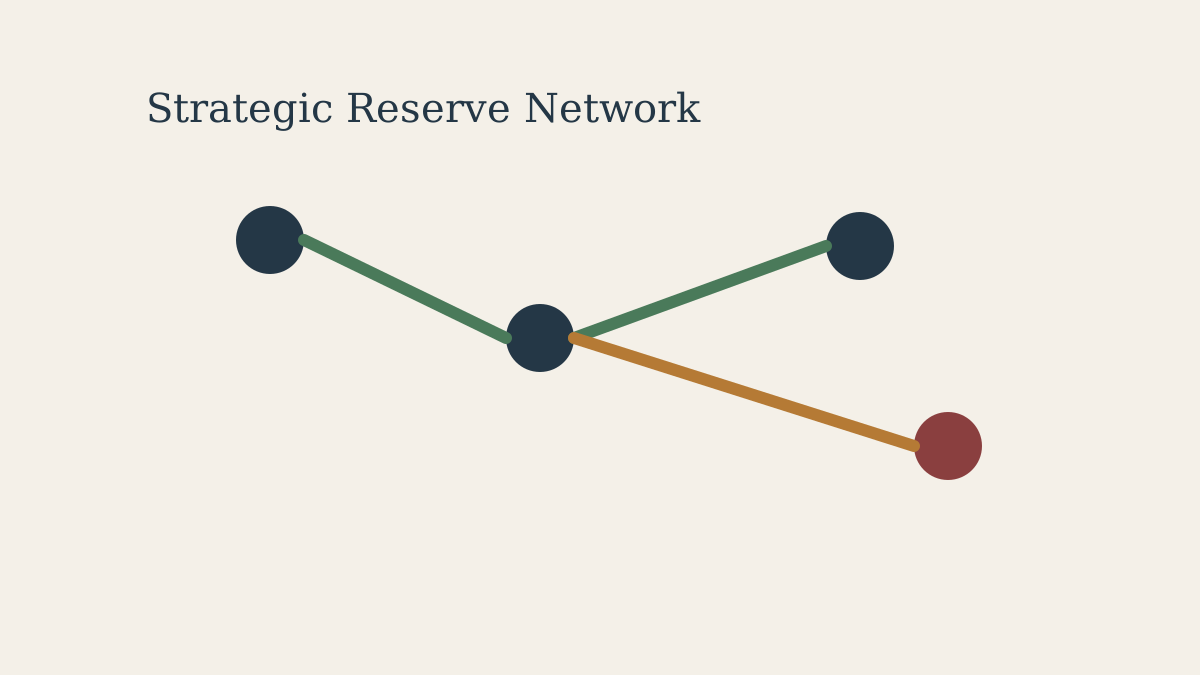
Reserves are rarely one pile in one vault. They are a network problem. The strategic reserve network asks where buffering sits, who can release it, how far it must travel, and whether the stressed system can still see it in time to act.
This matters because a large reserve can still fail structurally. It may be stored in the wrong basin, locked behind delayed authorization, or routed through the same corridor that is already failing.
That is why the model belongs in both Systems and Spatial thinking. Storage depth, release authority, and route survivability are all part of the same answer.
| Axis | Question | Signal |
|---|---|---|
| Reserve placement | Where is buffer capacity actually stored? | Granaries, fuel yards, hospital stock, reserve brigades, spare parts depots |
| Release authority | Who can unlock or redirect the reserve under pressure? | Central decrees, district mandates, convoy keys, local command discretion |
| Delivery path | What route still carries the reserve after shock? | Canal spine, rail branch, convoy arc, courier permission, emergency corridor |
| Stabilization effect | Does the reserve buy enough time for normal flow to recover? | Price stabilization, restored sortie rate, famine avoidance, reduced queue, reopened services |
This model is a useful bridge because reserve effectiveness depends on both system design and route topology. A well-managed stockpile in the wrong node is still a weak reserve if movement, authority, or communication cannot reach it quickly enough.
Defines the buffering capacity whose network placement and release now matter.
Communication Latency RegimeShows why reserves arrive too late when visibility and authorization lag behind the crisis.
Ming Canal Logistics SystemApplies the model to grain buffering, canal delivery, and command timing inside an imperial corridor.
The reusable lesson is that buffering should be modeled as stored capacity plus release path plus timing. That turns reserve writing from a static inventory list into a genuine resilience structure.
Read what should come before it, what relation role matters next, and where this page should hand you off after the local graph is clear.
Start with Strategic Reserve and then return here once the surrounding concept stack is clear.
These entries clarify the footing underneath the current node before you move outward again. Start with Strategic Reserve when you want the clearest next role.
Return to broader lenses when this model is too specific for the question you are asking.
3 handoff nodes stay inside Flow And Logistics. 4 handoff nodes share Network.
Detail pages now expose the branch and scale of their surrounding graph before showing raw prerequisite and relation shelves, so continuation can stay taxonomy-led instead of adjacency-led.
Explain how resources, goods, labor, information, and force circulate, stall, buffer, and break.
Start from the resource-flow loop, trace storage and throughput models, compare one logistics study, then run a flow audit worksheet.
Explain how technology, magic, infrastructure, communication, and transformation capacity rewrite baseline constraints.
Start with the operating regime, price the capability through diffusion or monopoly models, compare a regime-rewrite case, then run a capability sanity check.
Explain transition, disturbance, collapse, recovery, and reassembly across eras and stress cycles.
Start with transformation and failure models, trace residue and recovery paths, compare a collapse or successor-order study, then run a failure-mode review.
Use this scale when routes, relays, buffers, and linked nodes matter more than territorial bulk.
Use this scale when the strongest explanation depends on several levels staying visible together.
Use prerequisites when you want the shortest path into the assumptions this page depends on.
Buffered stock, capacity, or force held back so a system can survive delay, surge, or disruption without immediate collapse.
A location where flow is buffered, accumulated, protected, measured, or redirected strongly enough to change who can control the wider system.
These groups explain why each neighboring node matters, whether it stabilizes the concept, operationalizes it, proves it, or pushes the lane further.
Use foundation relations when this node depends on a concept, term, or framing layer that should be explicit before you branch further.
Buffered stock, capacity, or force held back so a system can survive delay, surge, or disruption without immediate collapse.
A location where flow is buffered, accumulated, protected, measured, or redirected strongly enough to change who can control the wider system.
Use operationalizing relations when you want the current abstraction rendered as a cleaner model, loop, or structural device.
A model for explaining how courier time, relay density, verification delay, and command visibility reshape coordination, legitimacy, and operational response.
Use applied relations when the next useful move is to see the current pattern survive inside a study or assembled world.
A historical study of how canal transport, grain reserves, courier timing, and administrative corridors helped hold a large imperial system together unevenly.
These entries still matter, but they currently rely on generic adjacency instead of typed continuation semantics.
A model for tracing whether disruption pushes a system toward repair, brittle stagnation, or self-amplifying collapse after reserves, coordination, and repair capacity are tested.
Models formalize behavior. Use them when you need a concrete chain, loop, stress scenario, or layered mechanism that can be tested and reused.
A model should explain how something behaves over time or under pressure, not just identify a broad topic area.
When a setting feels plausible at rest but still behaves vaguely, models provide the explicit structure needed to test it.
A strong workflow often moves from broad lens to formal model to applied case reading.
Keep these collapsed until you want to turn the page into an active reading exercise.
What mechanism is this model making explicit?
Where does this model break or become most interesting under stress?
Which study would verify whether this model survives in a complete setting?
These routes are tuned to the kind of entry you are currently reading, so you can leave this page with one deliberate next move.
Return to broader lenses when this model is too specific for the question you are asking.
Cross-layer moveMove through the systems module when you want to navigate models by design intent.
Cross-layer moveVerify the model inside applied cases where multiple structures interact at once.