Preparing the current spcent route.
The page shell is online. Shared content and route data are still being assembled.
A historical study of how remount depth, reconnaissance reach, dispersed foraging, and command tempo turned Mongol warfare into a campaign system rather than a sequence of isolated battles.
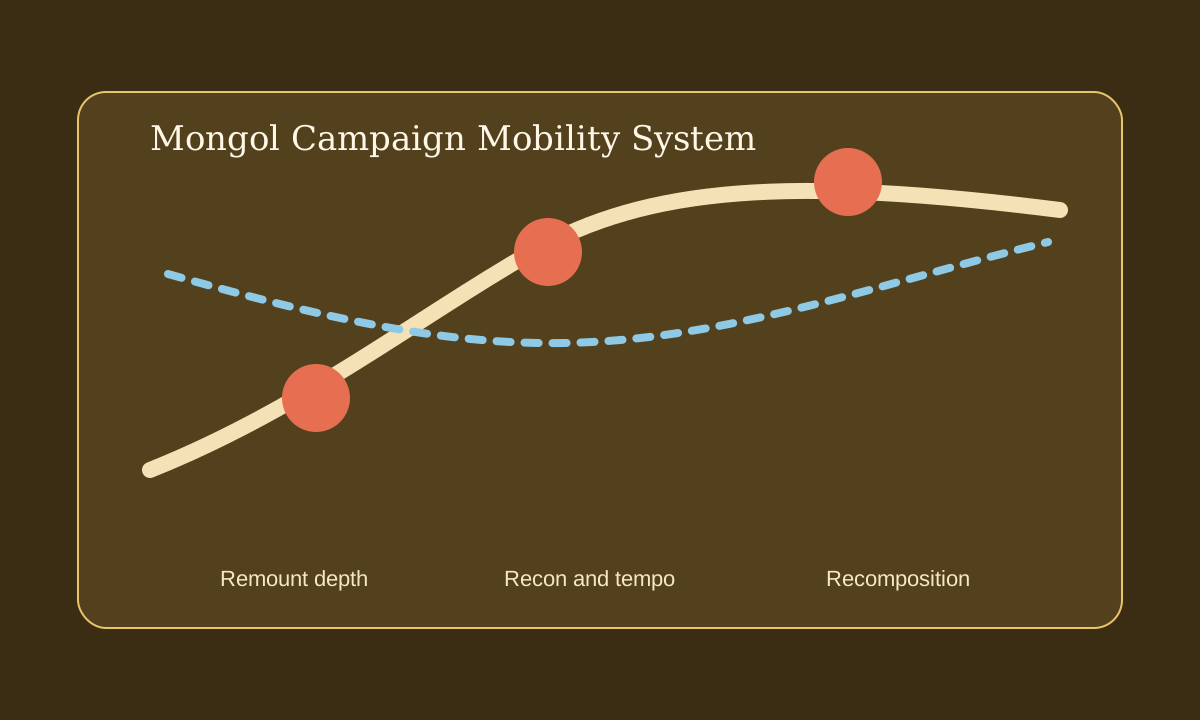
The Mongol case is most useful when read as a mobility system, not merely as a cavalry story. Remount depth, dispersed movement, reconnaissance reach, and command tempo created a campaign structure that could appear, separate, recombine, and keep pressure on opponents across distance.
That makes this a strong combat-proof study. The decisive issue is not only battlefield skill. It is whether a force can keep its movement advantage alive long enough to turn local success into campaign-level control.
Provides the core lens for why campaign reach depends on maintainable time, distance, and route conditions rather than on nominal map radius.
Combat Sustainment LoopClarifies how mobility advantage still depends on recurring replacement, recovery, and supply discipline across several engagements.
Communication Latency RegimeShows why reconnaissance and fast relay matter as much as speed of movement when dispersed columns must still recombine effectively.
The campaign system converts speed into pressure through four linked levers. Remount depth preserves movement over distance. Reconnaissance extends awareness beyond immediate contact. Dispersed sustainment keeps forces from choking one corridor. Command tempo lets separated elements recombine before opponents can stabilize.
| Axis | Question | Signal |
|---|---|---|
| Remount depth | What keeps operational speed from collapsing after the first march or fight? | Horse rotation, herd management, pace discipline, animal endurance, route flexibility |
| Reconnaissance reach | How does the force learn fast enough to use its mobility well? | Scouting screens, relay riders, route intelligence, enemy tracking, timing advantage |
| Dispersed sustainment | Why can the force move without depending on one narrow supply spine alone? | Foraging spread, modular columns, temporary concentration, local capture, reduced baggage drag |
| Recomposition tempo | How do separated forces become concentrated pressure again at the right moment? | Signal timing, preplanned rendezvous, reserve timing, rapid convergence, command trust |
Use the toggle to see which lever matters most under open maneuver, constrained terrain, or extended pursuit.
When terrain and remount depth support wide movement, the force can threaten several routes at once and keep opponents reacting late.
The reusable lesson is that military mobility should be modeled as a campaign system with recoverable speed, awareness, and recomposition, not just as fast units. This case is useful because it shows how sustainment and command keep mobility lethal over time.
Read what should come before it, what relation role matters next, and where this page should hand you off after the local graph is clear.
Start with Force Projection Window and then return here once the surrounding concept stack is clear.
These entries clarify the footing underneath the current node before you move outward again. Start with Force Projection Window when you want the clearest next role.
Use Guides when the study should feed into a worksheet or structured revision sequence.
2 handoff nodes stay inside Conflict And Operations. 3 handoff nodes share Regional.
Detail pages now expose the branch and scale of their surrounding graph before showing raw prerequisite and relation shelves, so continuation can stay taxonomy-led instead of adjacency-led.
Explain how technology, magic, infrastructure, communication, and transformation capacity rewrite baseline constraints.
Start with the operating regime, price the capability through diffusion or monopoly models, compare a regime-rewrite case, then run a capability sanity check.
Explain campaigns, sustainment, force projection, defensive depth, and operational windows as structural systems.
Start with sustainment and projection models, identify the theater cycle, validate through an operational case, then run an operations stress test.
Explain how resources, goods, labor, information, and force circulate, stall, buffer, and break.
Start from the resource-flow loop, trace storage and throughput models, compare one logistics study, then run a flow audit worksheet.
Use this scale when routes, relays, buffers, and linked nodes matter more than territorial bulk.
Use this scale when the region is the main leverage unit for settlement, extraction, governance, or conflict.
Use prerequisites when you want the shortest path into the assumptions this page depends on.
A model for how far and how long force can be projected effectively before supply, delay, terrain, and recovery costs collapse performance.
A model for how supply, reserve depth, reinforcement timing, route security, and recovery windows determine whether force projection remains real or collapses after contact.
These groups explain why each neighboring node matters, whether it stabilizes the concept, operationalizes it, proves it, or pushes the lane further.
Use foundation relations when this node depends on a concept, term, or framing layer that should be explicit before you branch further.
A model for how far and how long force can be projected effectively before supply, delay, terrain, and recovery costs collapse performance.
A model for explaining how courier time, relay density, verification delay, and command visibility reshape coordination, legitimacy, and operational response.
Use operationalizing relations when you want the current abstraction rendered as a cleaner model, loop, or structural device.
A model for how supply, reserve depth, reinforcement timing, route security, and recovery windows determine whether force projection remains real or collapses after contact.
Use contrast relations when the difference between two nodes is more useful than simple adjacency or agreement.
A historical study of how telegraph lines, rail corridors, operator discipline, and maintenance standards compressed command time and rewrote territorial governance.
These entries still matter, but they currently rely on generic adjacency instead of typed continuation semantics.
A model for how repeated displacement, opportunity seeking, and frontier movement consolidate into durable corridors that reshape identity, labor, and political load.
A framework for tracking which passes, ports, narrows, and crossings decide political leverage at the edge of a system.
Studies apply Spcent's lenses to complete cases. Read them to see whether geography, surplus, corridors, and pressure patterns still make sense when placed inside one setting.
The goal is not to retain setting trivia. The goal is to extract reusable patterns and structural habits you can reapply elsewhere.
Studies are strongest when you already know the frameworks and models underneath them, so you can recognize the structural moves being made.
After reading a study, identify which layer of your own draft needs work and go back there with one concrete change in mind.
Keep these collapsed until you want to turn the page into an active reading exercise.
What are the decisive regions, corridors, or chokepoints in this case?
What keeps the studied world stable, and what makes it brittle?
Which model or framework do I need next if I want to reproduce this pattern in my own project?
These routes are tuned to the kind of entry you are currently reading, so you can leave this page with one deliberate next move.
Use Guides when the study should feed into a worksheet or structured revision sequence.
Cross-layer moveReturn to the worlds module when the case highlights a weak worldbuilding layer in your own draft.
Cross-layer moveOpen models when the case reveals a mechanism you want to isolate and reuse directly.