Preparing the current spcent route.
The page shell is online. Shared content and route data are still being assembled.
A durable movement spine where terrain, settlement, exchange, and repeated transit align strongly enough to guide long-run circulation.
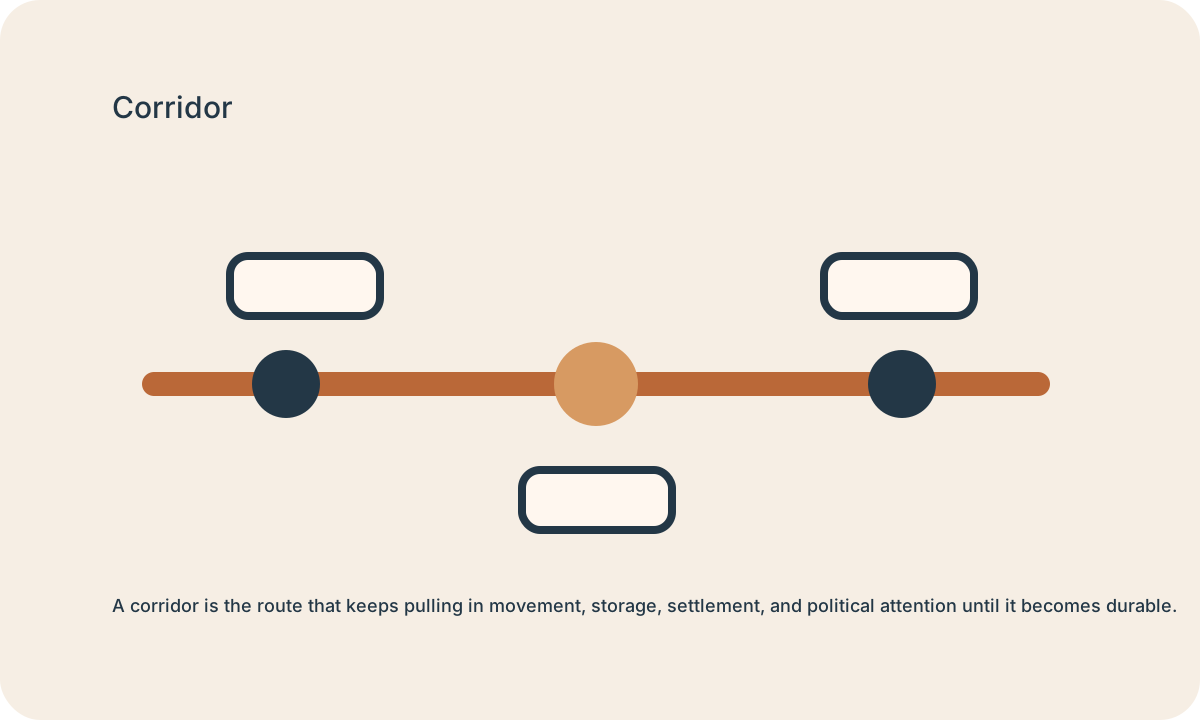
A corridor is not just any route. It is a movement spine that repeatedly attracts transit, storage, settlement, defense, and institutional attention.
Corridors become durable because several forces align at once: terrain permissibility, repeated demand, infrastructure reinforcement, and low enough cost to sustain regular flow.
Once a corridor hardens, it changes the wider world around it. Markets cluster near it, towns thicken along it, and political actors start treating it as something that must be protected, taxed, or contested.
A corridor is not just a line drawn between two cities, and it is not any route that happens to be busy once. Temporary movement can exist without hardening into a corridor if buffering, institutions, and repeated low-friction demand never accumulate around it. In the same way, a dramatic pass or road segment is not automatically a corridor if traffic can disperse elsewhere without major loss.
The term therefore implies persistence. A corridor keeps attracting movement strongly enough that settlement, storage, escort, and governance begin to organize around it. That is what gives it structural weight.
If repeated movement keeps drawing storage, settlements, escorts, and taxation to the same line, you are looking at a corridor rather than an isolated route segment.
Look for clustered relay settlements, recurring protection effort, and unequal route hierarchy. The main corridor is usually the line where delay becomes politically visible: officials monitor it, merchants price around it, and armies care whether it is open. Secondary routes can exist, but they rarely attract the same density of institutional attention.
A river valley with ford chains, market towns, and regular escort duty is usually behaving like a corridor even if no one in the setting names it that way. By contrast, a seasonal trail used only when weather is favorable may matter locally without becoming the durable spine of the region.
Shows how roads, rivers, passes, and market towns align into a durable corridor rather than a temporary path.
Route HierarchyClarifies why some corridors become primary spines while others remain feeder or fallback routes.
Regional Systems MatrixPlaces corridors inside a wider regional field of terrain, settlement, resources, and infrastructure.
Read what should come before it, what relation role matters next, and where this page should hand you off after the local graph is clear.
No prerequisite chain is currently required, which makes this page a valid graph entry point for the current topic.
Use Settlement Corridor Stack or the linked nodes below when you want to compare this page against neighboring parts of the graph.
Many glossary abstractions become richer when viewed inside the spatial module.
1 handoff nodes stay inside Spatial Structures. 1 handoff nodes share Network.
Detail pages now expose the branch and scale of their surrounding graph before showing raw prerequisite and relation shelves, so continuation can stay taxonomy-led instead of adjacency-led.
Explain what the world is materially built from before politics, balance, or style are discussed.
Start in Worlds, read the anchor framework, open one regional model, validate with a complete study, then finish with a world assembly guide pass.
Explain how topology, region graphs, corridors, map abstraction, and scale determine movement and leverage.
Start in Spatial, reduce the map into region graph and corridor logic, test topology under disruption, then return through a spatial design guide.
Use this scale when the region is the main leverage unit for settlement, extraction, governance, or conflict.
Use this scale when routes, relays, buffers, and linked nodes matter more than territorial bulk.
No prerequisite chain is currently required, so you can continue from here into relation paths or cross-layer handoff.
This page has no prerequisite chain yet. Treat it as a start node, then branch outward through typed relation paths or cross-layer handoff below.
This entry still relies on generic related links. That works as a fallback, but typed relation roles would make continuation clearer.
A layered model for understanding how roads, rivers, passes, and market towns align into durable spatial corridors.
The ranked structure by which some routes function as primary spines while others act as feeder, secondary, seasonal, or fallback paths.
A planning frame for mapping how geography, settlement, resources, and transit form a region's structural identity.
Glossary entries define Spcent's shared vocabulary. They are conceptual anchors designed to stabilize how an abstraction is used across pages and modules.
A glossary term should lock down what a phrase means so later reading is not burdened by ambiguity.
When you know the concept but not yet the best framework or model, start here and then move outward through related nodes.
A useful definition points toward the frameworks, models, and studies that actually use the term in context.
Keep these collapsed until you want to turn the page into an active reading exercise.
What question becomes easier once this term is precisely defined?
Which entries in the graph are using this abstraction operationally rather than only naming it?
Do I need a framework, model, or study next to see this concept in action?
These routes are tuned to the kind of entry you are currently reading, so you can leave this page with one deliberate next move.
Many glossary abstractions become richer when viewed inside the spatial module.
Cross-layer moveMove into frameworks when you want a planning lens built on top of the term.
Cross-layer moveSearch across the graph to find every place the concept currently appears.