Pulling this page together.
Preparing content, navigation, and supporting references for this route.
Preparing content, navigation, and supporting references for this route.
A historical study of how sea corridors, grain routes, roads, and layered provincial administration let Rome govern a wide empire through connected basins rather than continuous land uniformity.
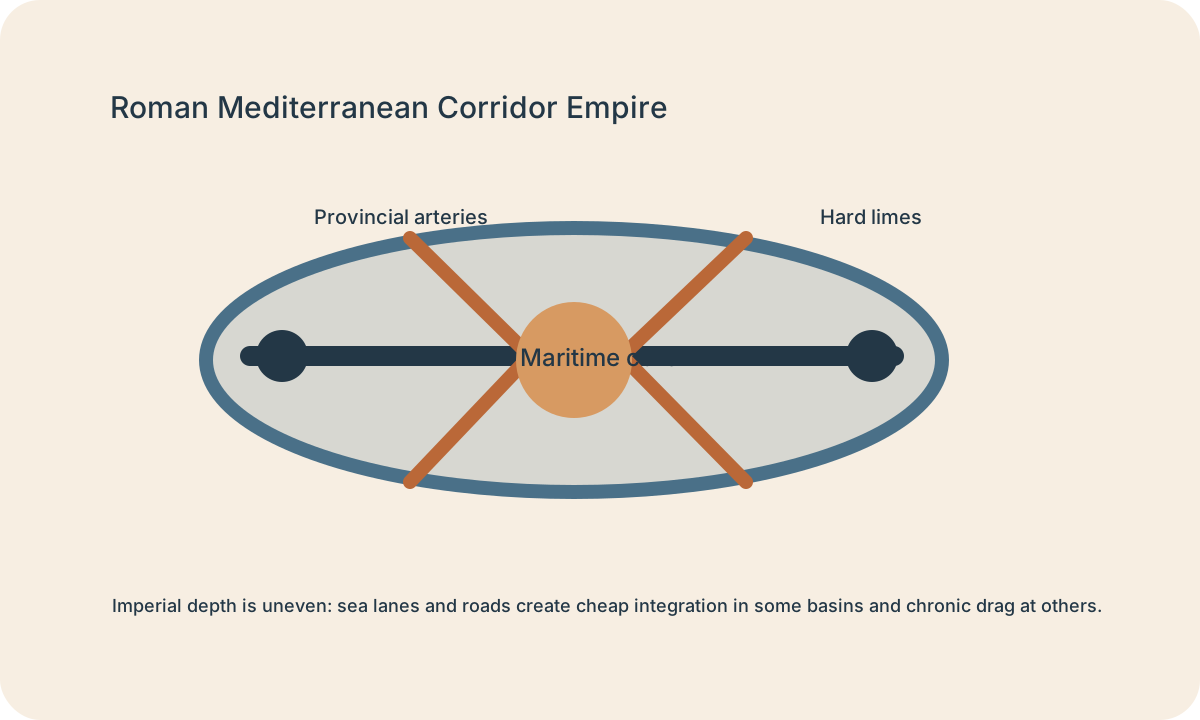
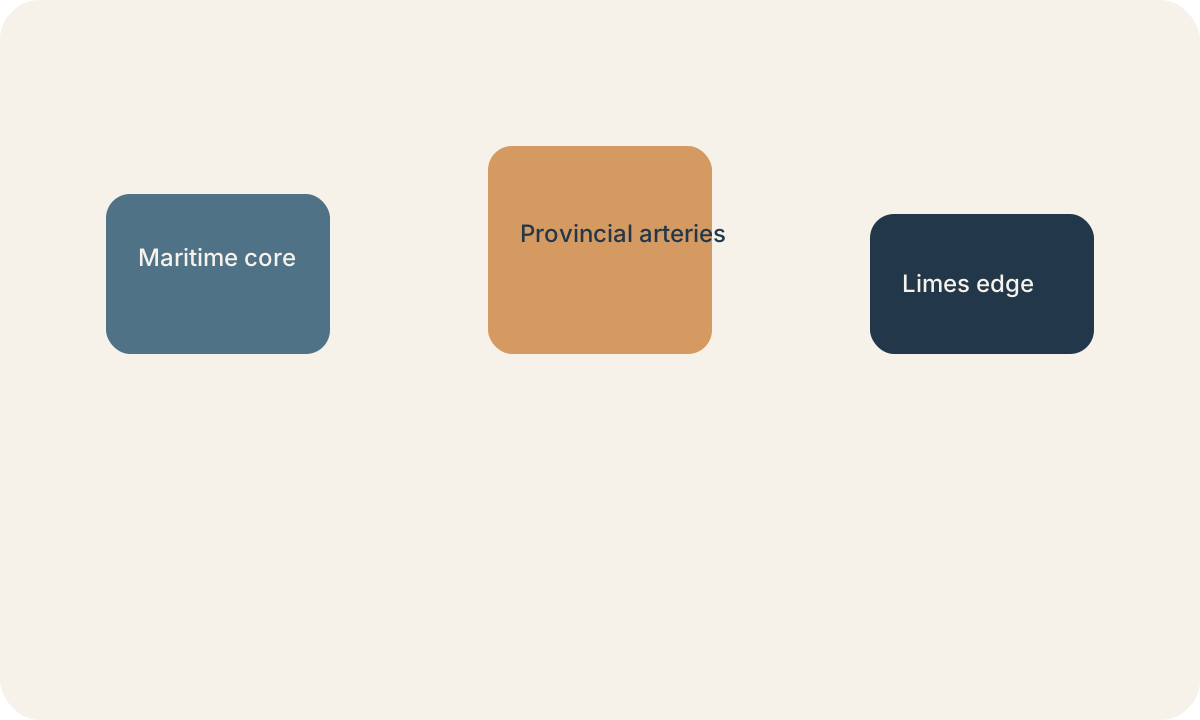
Rome is easiest to understand not as a flat land empire, but as a corridor empire organized around the Mediterranean basin and the road-grain systems that fed it.
Sea transport, provincial extraction, military roads, and urban storage allowed Rome to connect distant territories more cheaply than most inland empires could. Its scale was therefore maritime and administrative at the same time, with moving most effectively where ports, depots, and legal order reinforced one another.
Identify the sea lanes and port basins where integration, taxation, and food security become cheapest.
Track how inland roads and river systems feed grain, troops, and administrative claims back into the imperial basin.
Mark where roads and cities create durable incorporation and where hard limes remain costly military edges.
Explains why imperial cohesion depended on a few decisive sea lanes, ports, and land bridges rather than on uniform control everywhere.
Surplus Capture LadderShows how grain, tribute, taxation, and infrastructure combined into durable imperial leverage.
Institutional Residue MapClarifies why Roman roads, law, and urban hierarchy outlasted the political form that built them.
The strongest pattern is corridor-biased governance. Rome could move military force, tax claims, and food security effectively where roads and sea lanes aligned. It struggled more where mountain edges, desert belts, and long frontier defense consumed disproportionate effort.
That made the empire powerful without making it homogeneous. Different provinces were integrated at different depths depending on route value, storage role, and military necessity.
| Axis | Question | Signal |
|---|---|---|
| Maritime core | Where is integration cheapest and deepest? | Dense ports, grain circulation, legal standardization, tax coordination, naval security |
| Provincial artery | How do inland regions join the imperial system? | Road chains, river transport, fortified depots, market towns, administrative relay |
| Extraction frontier | Where does the empire gain value but pay rising control cost? | Mining zones, tax farms, troop roads, local intermediaries, uneven settlement depth |
| Hard limes | Where does military posture dominate over deep civil integration? | Fort belts, river lines, desert outposts, escort burden, chronic logistics drag |
Use the axis switch to compare where Rome integrated deeply, where it routed value, and where the empire stayed expensive despite military presence.
Ports, grain movement, and legal standardization reinforce one dense imperial basin.
Administration is cheapest and most standardized because movement, grain, and urban hierarchy all align.
Roads and river chains connect inland provinces back into the maritime core.
Rule depends on relay depth, depots, and timely corridor maintenance rather than basin-scale density.
High-value regions contribute revenue and material while remaining shallower politically.
Rule depends on intermediaries, escorts, and the ability to pull value out without fully normalizing the region.
Edges where military timing matters more than deep everyday integration.
Rule depends on forts, patrol timing, and managed deterrence more than civil depth.
Use the toggle to compare how the empire behaves when corridor integration is smooth, logistics are stretched, or the frontier begins consuming the gains.
When grain routes, ports, provincial roads, and depots all work together, Rome can govern a huge space through timing and storage rather than through uniform density everywhere.
Rome did not need every province to look equally Roman in daily life to remain coherent at imperial scale. What it needed was a reliable hierarchy of basins, ports, depots, roads, and administrative relays that kept the core supplied and the most valuable provinces legible. That distinction explains why maritime integration and provincial unevenness could coexist for so long without immediately tearing the empire apart.
This matters because the case is often flattened into simple military conquest. In structural terms, force mattered because it protected and stabilized the corridor map. Grain routes, storage cities, provincial tax extraction, and road-linked reinforcement are what allowed military success to be converted into routine governance rather than into a temporary wave of occupation.
The same architecture that made Rome durable also created exposed thresholds. The empire depended on synchronized movement across sea lanes, depot chains, and provincial corridors that did not all share the same cost profile. Maritime core zones were cheap and dense compared with inland edges and hard frontiers. As soon as frontier defense, convoy burden, or administrative overhead rose faster than basin integration could compensate, the system's unevenness became more visible and more expensive.
That is why Roman durability should not be mistaken for uniform depth. Some provinces were tightly woven into the imperial machine, while others were extracted, patrolled, or symbolically held with much shallower integration. The study becomes more useful once that difference is treated as normal operating logic rather than as evidence that the empire had somehow failed to finish its intended form.
The transferable lesson is not "build roads and conquer widely." It is that very large polities become governable when decisive movement lines, food security, law, and administrative relay reinforce the same map. A creator can reuse that logic in fantasy, science fiction, or alternate history settings without copying Roman names or institutions directly.
The transfer also has limits. Rome is especially instructive for basin-centered empires with mixed maritime and inland depth. It is less useful as a direct analogy for worlds organized around instant communication, universal rail density, portal infrastructure, or very low-friction aerial control. Those settings change the corridor geometry so substantially that the Roman case should be used as contrast as much as template.
The reusable lesson is that very large empires feel believable when their real operating logic is corridor integration plus uneven provincial depth, not continuous uniform control.
Rome works structurally because grain, roads, legal memory, and military logistics all reinforce the same basin-centered map.