Preparing the current spcent route.
The page shell is online. Shared content and route data are still being assembled.
A model for tracing whether disruption pushes a system toward repair, brittle stagnation, or self-amplifying collapse after reserves, coordination, and repair capacity are tested.
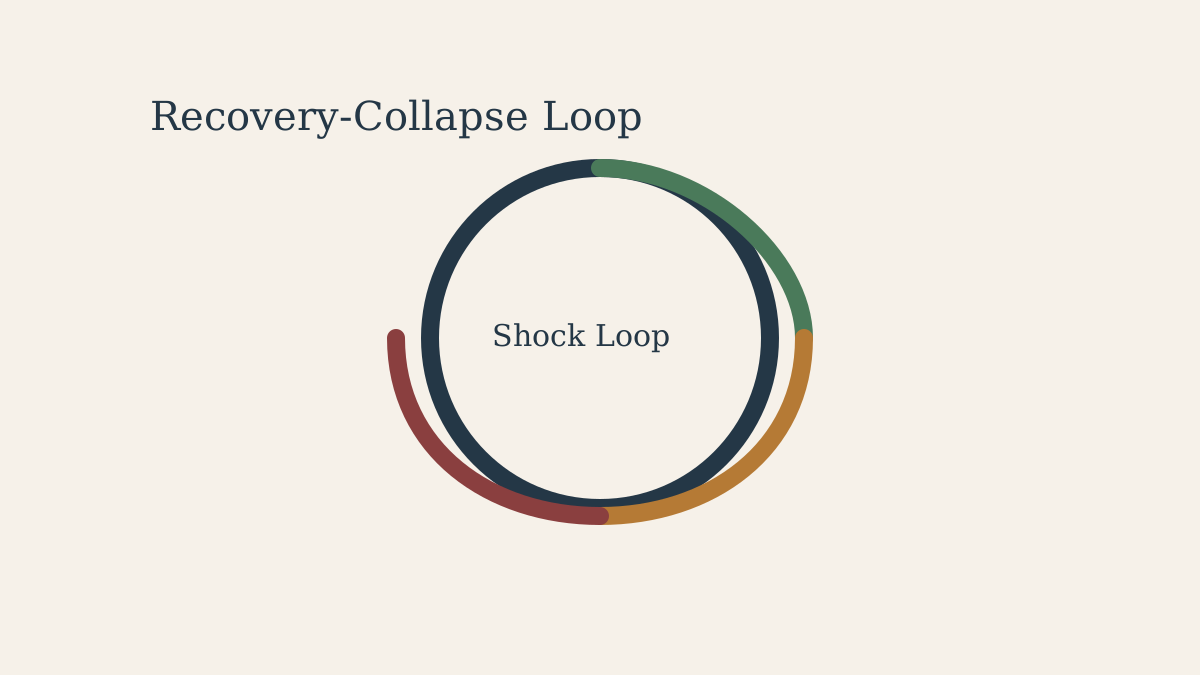
Disruption does not create only two outcomes. Systems often pass through a loop where reserves are released, repairs begin, coordination degrades or stabilizes, and the same shock either gets absorbed or amplified.
The recovery-collapse loop makes that sequence explicit. It is useful when you need to explain why one system rebounds from a blockade, harvest failure, or raid while another enters prolonged brittleness from a shock that looked similar on day one.
Measure what reserves, slack, or local substitution can keep operating immediately after disruption.
Track whether repair crews, reserve release, and coordination arrive fast enough to reopen critical flow.
Ask whether the repair effort itself creates debt, exhaustion, or governance drift that makes the next disruption worse.
| Axis | Question | Signal |
|---|---|---|
| Recovery | Does repair restore key flow before reserve depletion becomes decisive? | Reopened corridors, restocked depots, resumed tax intake, repaired trust, reduced queue |
| Stagnation | Does the system survive but remain weak and exposed? | Chronic rationing, thin reserves, emergency rule, slow repair backlog, partial service only |
| Collapse | Does each repair attempt deepen exposure faster than it restores capacity? | Reserve exhaustion, abandonment, unrest, queue spiral, infrastructure cannibalization |
Use the model for economies, campaigns, city infrastructure, frontier rule, or ecological systems whenever the interesting question is what happens after the first failure, not whether the first failure happens.
It is also a useful antidote to binary writing. Systems often look stable right before they enter drawn-out stagnation, and they often look doomed right before a reserve release or repair corridor gives them enough space to recover.
Shows how buffering capacity reaches the stressed zone and whether it can buy enough time for repair.
Reinforcement-Balancing PairProvides the loop logic for seeing how repair efforts create their own drag and delay.
The Expanse Belt-Core Dependency SystemApplies the model to a dependent network where delayed relief can quickly become political rupture.
The reusable lesson is that resilience should be modeled as a loop of response, repair, and renewed exposure. That keeps recovery believable and prevents collapse from appearing as an arbitrary plot switch.
Read what should come before it, what relation role matters next, and where this page should hand you off after the local graph is clear.
Start with Resource Flow Loop and then return here once the surrounding concept stack is clear.
These entries clarify the footing underneath the current node before you move outward again. Start with Strategic Reserve Network when you want the clearest next role.
Return to broader lenses when this model is too specific for the question you are asking.
No handoff nodes currently stay inside Evolution And Breakdown. 1 handoff nodes share Cross Scale.
Detail pages now expose the branch and scale of their surrounding graph before showing raw prerequisite and relation shelves, so continuation can stay taxonomy-led instead of adjacency-led.
Explain how resources, goods, labor, information, and force circulate, stall, buffer, and break.
Start from the resource-flow loop, trace storage and throughput models, compare one logistics study, then run a flow audit worksheet.
Explain how technology, magic, infrastructure, communication, and transformation capacity rewrite baseline constraints.
Start with the operating regime, price the capability through diffusion or monopoly models, compare a regime-rewrite case, then run a capability sanity check.
Turn all major programs into creator-operable workflows rather than leaving them as analysis-only content.
Start in Guides with the workflow framework, choose the role route, open the supporting program branches only as needed, and leave with a worksheet or review artifact.
Use this scale when routes, relays, buffers, and linked nodes matter more than territorial bulk.
Use this scale when the strongest explanation depends on several levels staying visible together.
Use this scale when city-scale transfer, concentration, or control is doing the main structural work.
Use prerequisites when you want the shortest path into the assumptions this page depends on.
A model for how extraction, transport, storage, transformation, and redistribution create stability or fragility in a world system.
Buffered stock, capacity, or force held back so a system can survive delay, surge, or disruption without immediate collapse.
These groups explain why each neighboring node matters, whether it stabilizes the concept, operationalizes it, proves it, or pushes the lane further.
Use foundation relations when this node depends on a concept, term, or framing layer that should be explicit before you branch further.
A model for locating where reserves are stored, who can release them, and how fast they can stabilize the wider system under delay, shock, or surge.
A loop model for pairing each compounding process with the balancing drag, delay, or exposure that stops it from becoming unbounded.
Use contrast relations when the difference between two nodes is more useful than simple adjacency or agreement.
A game study of how heat radius, labor sacrifice, storage timing, and moral policy turn Frostpunk into a compact model of survival governance under extreme climatic pressure.
These entries still matter, but they currently rely on generic adjacency instead of typed continuation semantics.
Buffered stock, capacity, or force held back so a system can survive delay, surge, or disruption without immediate collapse.
Models formalize behavior. Use them when you need a concrete chain, loop, stress scenario, or layered mechanism that can be tested and reused.
A model should explain how something behaves over time or under pressure, not just identify a broad topic area.
When a setting feels plausible at rest but still behaves vaguely, models provide the explicit structure needed to test it.
A strong workflow often moves from broad lens to formal model to applied case reading.
Keep these collapsed until you want to turn the page into an active reading exercise.
What mechanism is this model making explicit?
Where does this model break or become most interesting under stress?
Which study would verify whether this model survives in a complete setting?
These routes are tuned to the kind of entry you are currently reading, so you can leave this page with one deliberate next move.
Return to broader lenses when this model is too specific for the question you are asking.
Cross-layer moveMove through the systems module when you want to navigate models by design intent.
Cross-layer moveVerify the model inside applied cases where multiple structures interact at once.