Preparing the current spcent route.
The page shell is online. Shared content and route data are still being assembled.
A synthetic study of how a ring-shaped city uses selective permeability, transfer belts, and outward service corridors to govern a fragile surrounding production region.
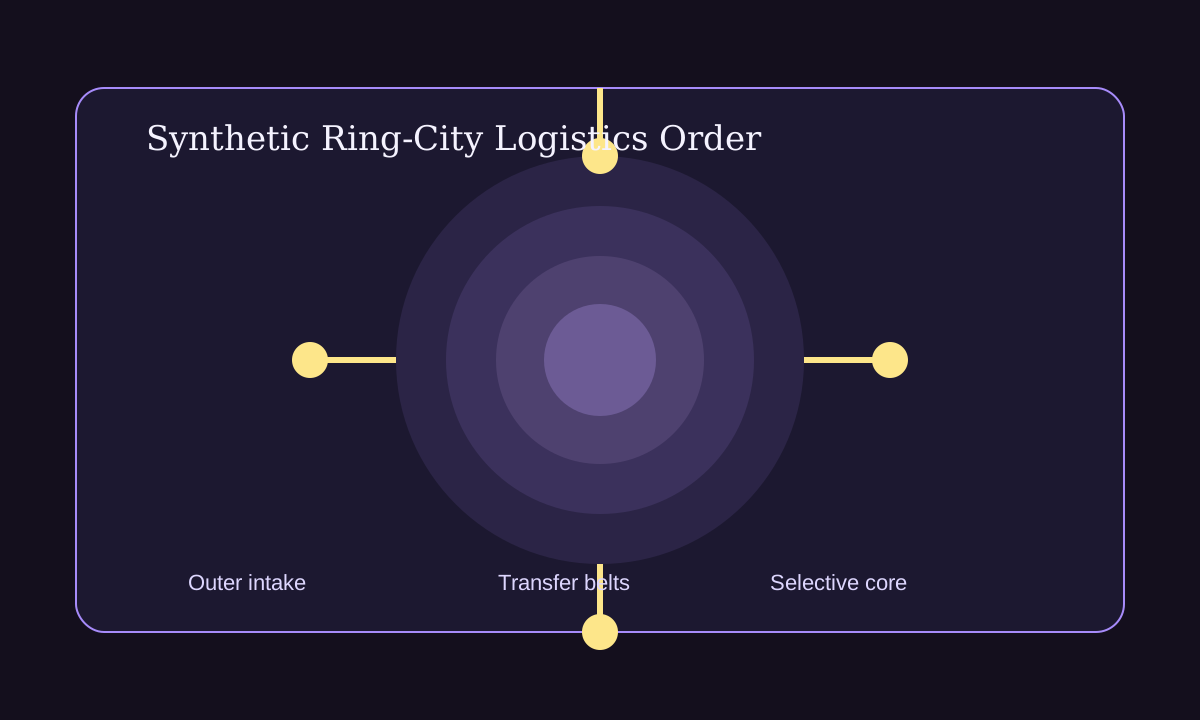
This synthetic case treats the city as a ringed transfer machine. Outer belts absorb arrival, intermediate belts sort and store, inner rings restrict access, and outward service corridors keep the surrounding farms, extraction nodes, and feeder towns tied to the city despite unequal permeability.
That makes the case useful because it shows city-scale order emerging from internal filtering rather than from a single dominant harbor or road junction. The city is governable only because different rings stay open to different actors for different reasons.
Provides the internal filter logic that explains why some rings remain open for cargo while others close quickly under stress.
City-Region Coupling ModelClarifies why the city must return reserve, repair, and market access outward instead of acting as a one-way sink.
Region GraphShows how the city fits into a larger network of feeder basins, extraction nodes, and relief corridors beyond the wall line.
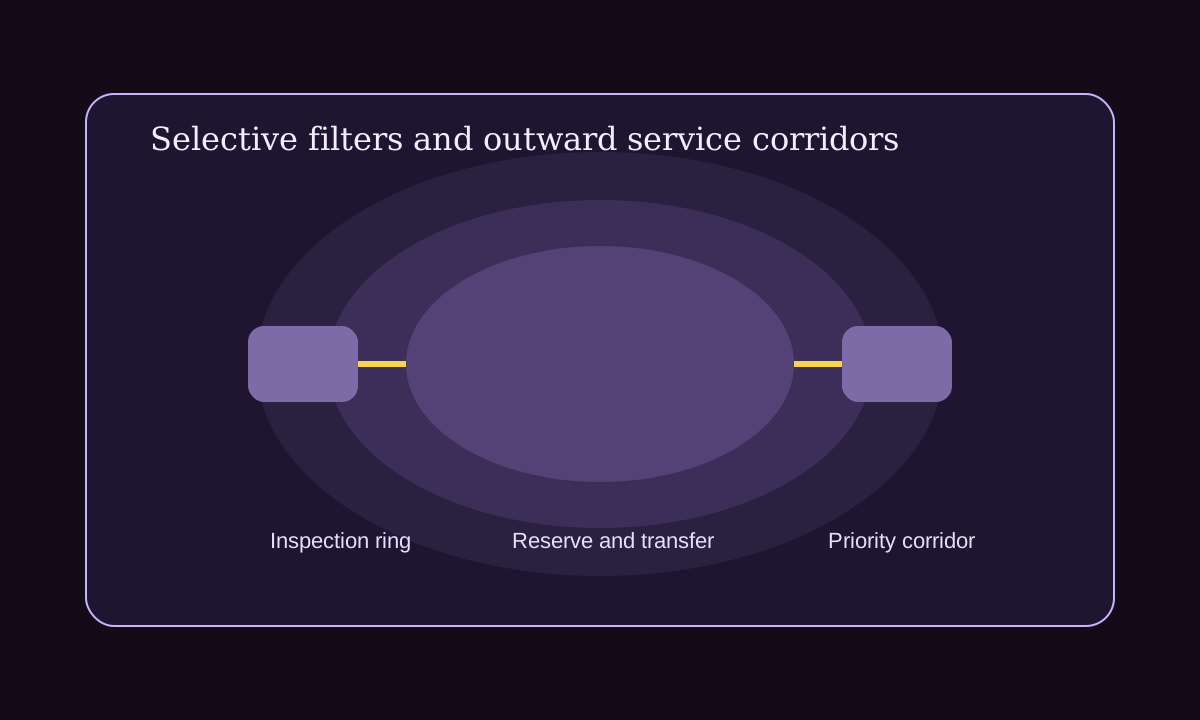
The ring-city survives because it differentiates permeability instead of making every district equally open. Intake gates, bonded belts, ration depots, and inner civic sectors each filter different movement types. At the same time, the city cannot remain stable if those rings only extract. Some corridors must stay reliable for repair crews, reserve release, and labor return to the surrounding region.
| Axis | Question | Signal |
|---|---|---|
| Outer intake ring | How does outside movement first enter without immediately overrunning the core? | Gate yards, inspection strips, canal locks, tally plazas, escorted approach roads |
| Transfer and depot ring | Where is movement buffered and reassigned before it reaches protected districts? | Warehouse crescents, ration depots, market belts, repair courts, convoy holding yards |
| Selective inner core | Which actors, goods, and commands can cross the tighter internal boundary? | Permit lanes, guarded bridges, civic cordons, restricted avenues, ritual or administrative access |
| Outward service corridors | What keeps the surrounding region tied to the city rather than peeling away under unequal control? | Reserve release, repair wagons, escorted caravans, market days, flood relief, wage return |
Use the toggle to see how the same district plan behaves under routine circulation, smuggling stress, or outer-region shock.
The city remains stable because outer rings absorb heavy movement while inner rings stay comparatively clean, filtered, and governable.
The reusable lesson is that urban order often comes from differentiated permeability plus outward service, not from uniform walls or abstract authority. This synthetic case is useful because it makes district filtering and city-region coupling legible inside one deliberately layered city form.
Read what should come before it, what relation role matters next, and where this page should hand you off after the local graph is clear.
Start with District Permeability Model and then return here once the surrounding concept stack is clear.
These entries clarify the footing underneath the current node before you move outward again. Start with District Permeability Model when you want the clearest next role.
Use Guides when the study should feed into a worksheet or structured revision sequence.
3 handoff nodes stay inside Urban And Regional Coupling. 1 handoff nodes share Urban.
Detail pages now expose the branch and scale of their surrounding graph before showing raw prerequisite and relation shelves, so continuation can stay taxonomy-led instead of adjacency-led.
Explain how cities work as filters, gateways, relays, conversion surfaces, and regional control machines.
Start with the urban logistics surface, step into gateway and throughput models, compare a port or capital study, then run a city-region worksheet.
Explain how resources, goods, labor, information, and force circulate, stall, buffer, and break.
Start from the resource-flow loop, trace storage and throughput models, compare one logistics study, then run a flow audit worksheet.
Explain how legitimacy, coercion, administrative reach, frontier bargaining, and elite control are structured.
Start with the pressure map, locate legitimacy and capture mechanisms, validate against a frontier or state case, then run a governance stress test.
Use this scale when routes, relays, buffers, and linked nodes matter more than territorial bulk.
Use this scale when the strongest explanation depends on several levels staying visible together.
Use this scale when internal city geometry or gateway-district filtering is the level that matters most.
Use this scale when the region is the main leverage unit for settlement, extraction, governance, or conflict.
Use prerequisites when you want the shortest path into the assumptions this page depends on.
A model for how walls, canals, customs lines, policing regimes, class barriers, and street hierarchy make some urban districts easy to cross and others selectively closed.
A model for tracing the two-way dependence between a city and its surrounding production, service, labor, and reserve network instead of treating the city as a self-contained center.
These groups explain why each neighboring node matters, whether it stabilizes the concept, operationalizes it, proves it, or pushes the lane further.
Use foundation relations when this node depends on a concept, term, or framing layer that should be explicit before you branch further.
A model for how walls, canals, customs lines, policing regimes, class barriers, and street hierarchy make some urban districts easy to cross and others selectively closed.
A framework for reading cities as transfer surfaces where gateways, districts, depots, servicing radius, and hinterland demand converge into one operational field.
Use operationalizing relations when you want the current abstraction rendered as a cleaner model, loop, or structural device.
A model for tracing the two-way dependence between a city and its surrounding production, service, labor, and reserve network instead of treating the city as a self-contained center.
Use contrast relations when the difference between two nodes is more useful than simple adjacency or agreement.
A synthetic study of a route-control empire where licensed desert crossings, port relays, and selective border openness turn movement into administrative leverage.
These entries still matter, but they currently rely on generic adjacency instead of typed continuation semantics.
A spatial abstraction that represents regions as connected nodes so adjacency, flow, and chokepoints can be reasoned about systematically.
A model for comparing how borders change crossing cost, asymmetry, inspection burden, and rerouting behavior for different actors and flows.
Studies apply Spcent's lenses to complete cases. Read them to see whether geography, surplus, corridors, and pressure patterns still make sense when placed inside one setting.
The goal is not to retain setting trivia. The goal is to extract reusable patterns and structural habits you can reapply elsewhere.
Studies are strongest when you already know the frameworks and models underneath them, so you can recognize the structural moves being made.
After reading a study, identify which layer of your own draft needs work and go back there with one concrete change in mind.
Keep these collapsed until you want to turn the page into an active reading exercise.
What are the decisive regions, corridors, or chokepoints in this case?
What keeps the studied world stable, and what makes it brittle?
Which model or framework do I need next if I want to reproduce this pattern in my own project?
These routes are tuned to the kind of entry you are currently reading, so you can leave this page with one deliberate next move.
Use Guides when the study should feed into a worksheet or structured revision sequence.
Cross-layer moveReturn to the worlds module when the case highlights a weak worldbuilding layer in your own draft.
Cross-layer moveOpen models when the case reveals a mechanism you want to isolate and reuse directly.