Preparing the current spcent route.
The page shell is online. Shared content and route data are still being assembled.
A synthetic study of how mandate legitimacy, theater expansion, tax extraction, and frontier drag turn macro strategy into a cycle of growth and overextension rather than steady accumulation.
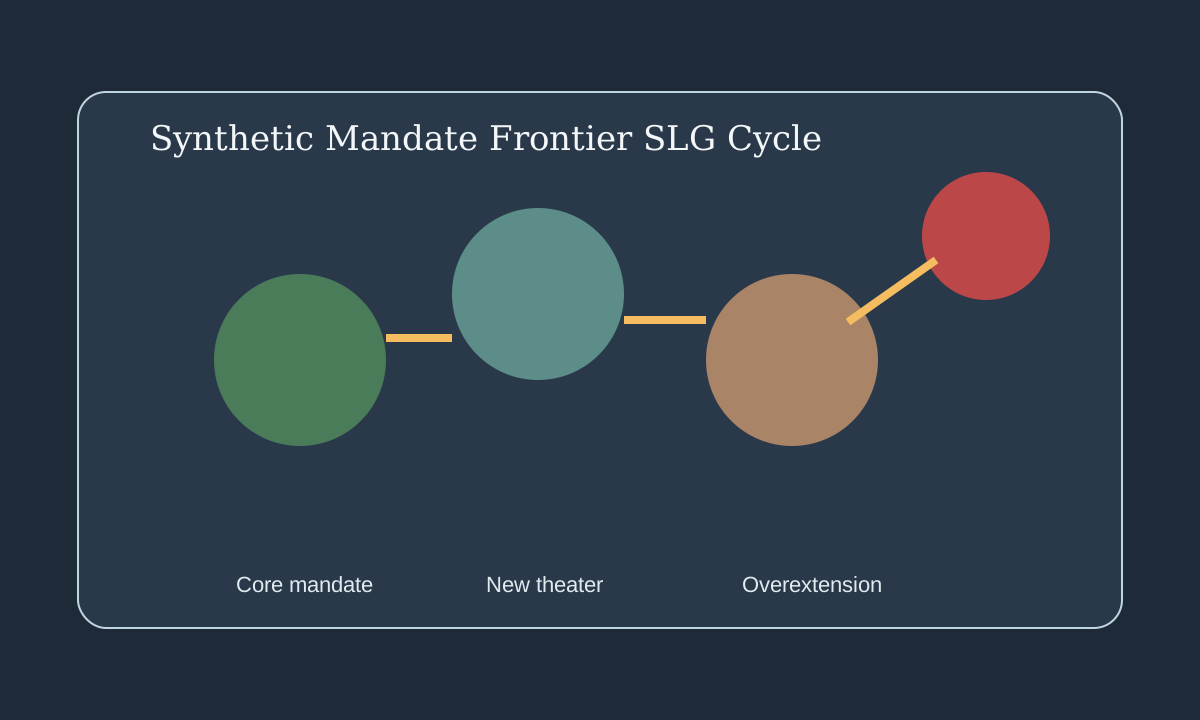
This synthetic case treats macro strategy as a mandate cycle. A core polity expands into adjacent theaters, converts those gains into tax and reserve depth, then discovers that frontier drag, legitimacy strain, and relief burden keep rising with every new perimeter.
That makes the case useful for SLG proof. The key issue is not only whether expansion succeeds. It is whether the growing theater can be consolidated fast enough that new territory stops behaving like a future liability.
Provides the base macro lens for why strategic expansion repeats through acquisition, consolidation, extraction, defense, and overextension.
Civilization Pressure MapClarifies how administrative strain, frontier resistance, and legitimacy fatigue accumulate once the theater grows wider than its governing core.
Frontier Chokepoint LedgerShows why a few corridor hinges decide whether theaters remain linked to the core or peel into expensive autonomy.
The cycle becomes structurally legible through five phases. The core secures a governable heartland. Expansion opens a new theater. Extraction turns conquest into useful value. Defensive burden rises as fortresses, depots, and officials must cover more edge. Overextension appears when those burdens outgrow the reserve and legitimacy that were supposed to justify expansion in the first place.
| Axis | Question | Signal |
|---|---|---|
| Core mandate | What makes expansion initially possible and politically acceptable? | Tax depth, reserve confidence, stable capitals, elite buy-in, coordinated command |
| New theater | Which adjoining region becomes the next target for strategic growth? | Frontier corridor, weak rival, rich basin, exposed pass, relay coast |
| Extraction turn | How does victory become ongoing strategic value? | Granary capture, tariff control, labor levy, mine access, route taxation, depot buildout |
| Defensive burden | What new drag appears once the theater must be held rather than taken? | Garrisons, relief routes, frontier forts, rebel suppression, repair lines, administrative spread |
| Overextension gate | When does the theater stop returning more than it costs? | Reserve drain, mandate fatigue, autonomy drift, corridor saturation, tax lag, regional fragmentation |
The theater only feels strategic when success changes the next turn's burden instead of only increasing income.
The state sees a new theater as a chance to widen surplus, prestige, and strategic depth while the frontier burden is still abstract.
The reusable lesson is that SLG scale becomes coherent when expansion and overextension are one loop. This case is useful because it shows how theater growth, legitimacy, and frontier drag keep rewriting one another over time.
Read what should come before it, what relation role matters next, and where this page should hand you off after the local graph is clear.
Start with Strategic Theater Cycle and then return here once the surrounding concept stack is clear.
These entries clarify the footing underneath the current node before you move outward again. Start with Strategic Theater Cycle when you want the clearest next role.
Use Guides when the study should feed into a worksheet or structured revision sequence.
2 handoff nodes stay inside Conflict And Operations. 3 handoff nodes share Regional.
Detail pages now expose the branch and scale of their surrounding graph before showing raw prerequisite and relation shelves, so continuation can stay taxonomy-led instead of adjacency-led.
Explain how legitimacy, coercion, administrative reach, frontier bargaining, and elite control are structured.
Start with the pressure map, locate legitimacy and capture mechanisms, validate against a frontier or state case, then run a governance stress test.
Explain campaigns, sustainment, force projection, defensive depth, and operational windows as structural systems.
Start with sustainment and projection models, identify the theater cycle, validate through an operational case, then run an operations stress test.
Explain how resources, goods, labor, information, and force circulate, stall, buffer, and break.
Start from the resource-flow loop, trace storage and throughput models, compare one logistics study, then run a flow audit worksheet.
Use this scale when the region is the main leverage unit for settlement, extraction, governance, or conflict.
Use this scale when the strongest explanation depends on several levels staying visible together.
Use this scale when routes, relays, buffers, and linked nodes matter more than territorial bulk.
Use prerequisites when you want the shortest path into the assumptions this page depends on.
A macro model for how expansion, consolidation, extraction, defense, and overextension repeat across a large strategic map.
A framework for tracking expansion, consolidation, frontier friction, and institutional fatigue across a civilizational space.
These groups explain why each neighboring node matters, whether it stabilizes the concept, operationalizes it, proves it, or pushes the lane further.
Use foundation relations when this node depends on a concept, term, or framing layer that should be explicit before you branch further.
A macro model for how expansion, consolidation, extraction, defense, and overextension repeat across a large strategic map.
A framework for tracking which passes, ports, narrows, and crossings decide political leverage at the edge of a system.
Use operationalizing relations when you want the current abstraction rendered as a cleaner model, loop, or structural device.
A framework for tracking expansion, consolidation, frontier friction, and institutional fatigue across a civilizational space.
Use extension relations when the next move is not prerequisite or proof, but a deeper neighboring step in the same graph lane.
A synthetic study of how fortress belts, granary release, garrison rotation, and corridor choke points turn frontier warfare into a reserve and timing problem.
These entries still matter, but they currently rely on generic adjacency instead of typed continuation semantics.
A model for locating where reserves are stored, who can release them, and how fast they can stabilize the wider system under delay, shock, or surge.
An advanced model for comparing how multi-center empires stabilize or fracture through delegated authority, corridor integration, reserve depth, and center-periphery bargaining.
Studies apply Spcent's lenses to complete cases. Read them to see whether geography, surplus, corridors, and pressure patterns still make sense when placed inside one setting.
The goal is not to retain setting trivia. The goal is to extract reusable patterns and structural habits you can reapply elsewhere.
Studies are strongest when you already know the frameworks and models underneath them, so you can recognize the structural moves being made.
After reading a study, identify which layer of your own draft needs work and go back there with one concrete change in mind.
Keep these collapsed until you want to turn the page into an active reading exercise.
What are the decisive regions, corridors, or chokepoints in this case?
What keeps the studied world stable, and what makes it brittle?
Which model or framework do I need next if I want to reproduce this pattern in my own project?
These routes are tuned to the kind of entry you are currently reading, so you can leave this page with one deliberate next move.
Use Guides when the study should feed into a worksheet or structured revision sequence.
Cross-layer moveReturn to the worlds module when the case highlights a weak worldbuilding layer in your own draft.
Cross-layer moveOpen models when the case reveals a mechanism you want to isolate and reuse directly.