Preparing the current spcent route.
The page shell is online. Shared content and route data are still being assembled.
A synthetic study of how licensed ley access, ward maintenance, training monopolies, and district filtering turn magic into a durable urban operating regime.
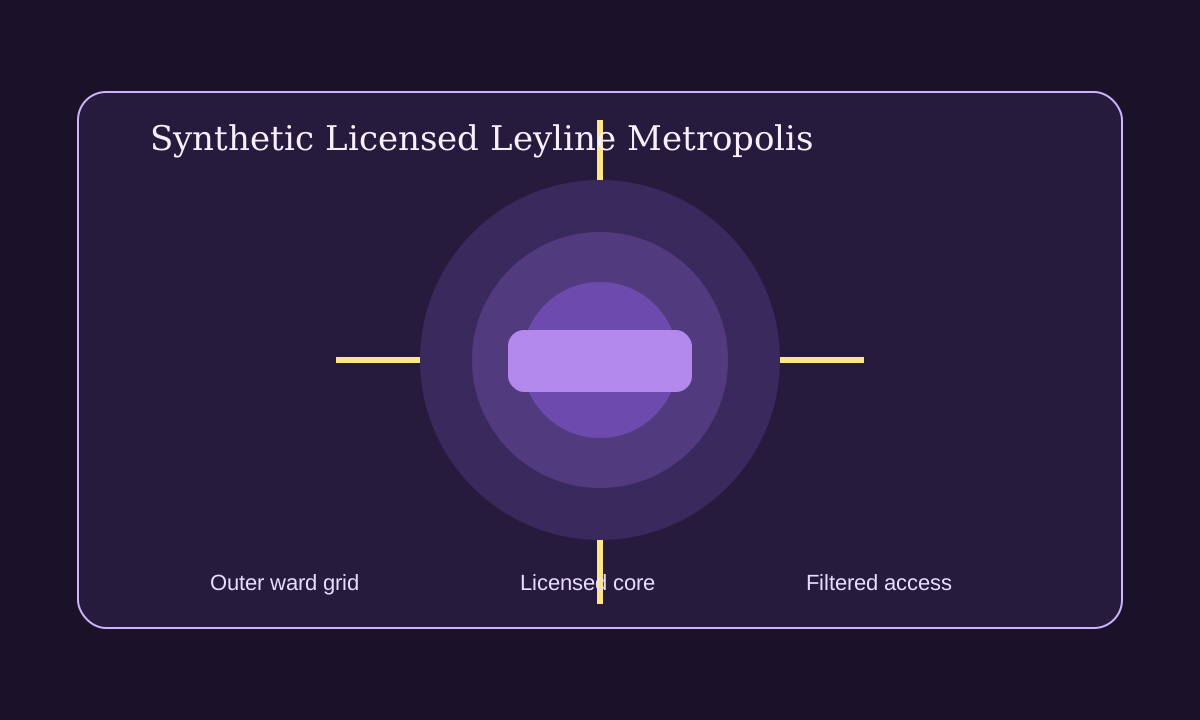
This synthetic metropolis is built on a dense underground ley grid that can only be tapped safely through licensed wards, regulated conduits, and specialist maintenance crews. Magic is therefore not a free-floating cultural layer. It is a city infrastructure stack with access rules, upkeep debt, and district hierarchy.
That makes the case a useful capability-proof study. The city does not become magical merely because spells exist. It becomes structurally distinct because magical power is routinized through licenses, ward servicing, and selective urban permeability.
Provides the base lens for reading source, access, cost, and scope as stable constraints rather than as scene-by-scene exceptions.
Magic Monopoly StructureClarifies why licensed guilds, ritual courts, and urban ward authorities can turn capability control into durable political leverage.
District Permeability ModelShows how magical access is filtered spatially, with some districts open to traffic while inner wards remain tightly regulated.
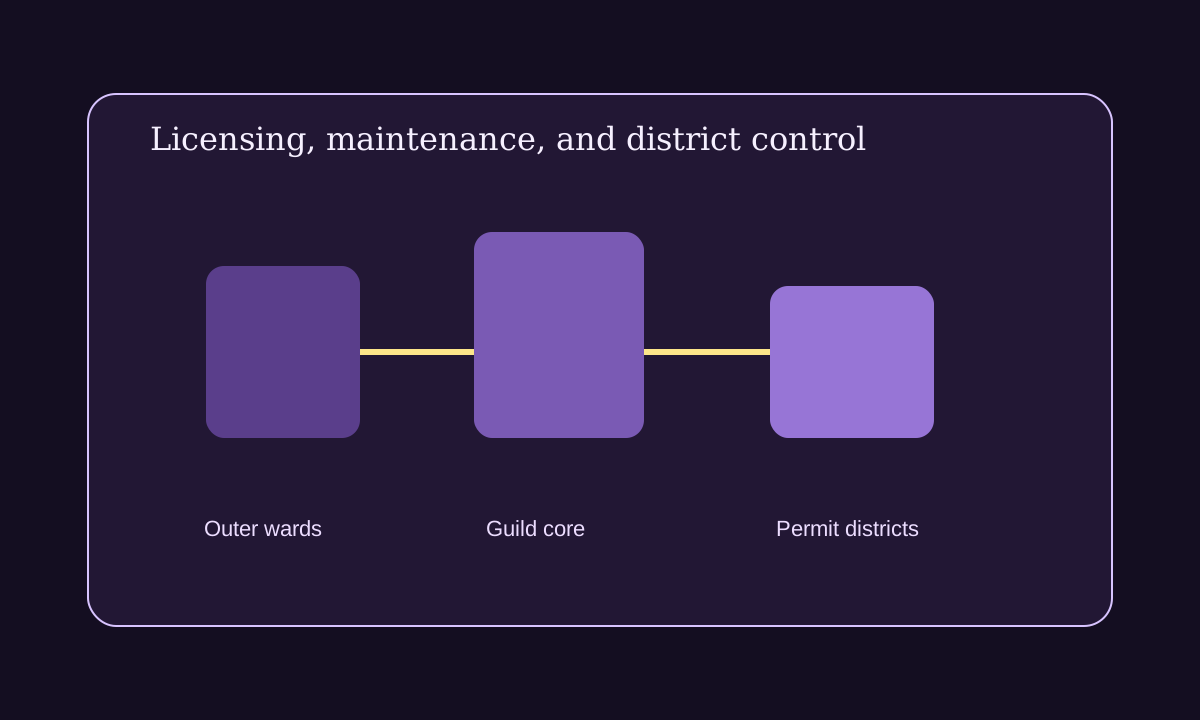
The metropolis works by keeping magical power ordinary but gated. Guild operators calibrate ward flows. Courts and inspectors license who can tap which conduit. Repair crews maintain ward continuity. Inner districts filter who may cross with charged goods, active charms, or ritual authority. The result is a city where magic functions like an infrastructural monopoly rather than a universal human ability.
| Axis | Question | Signal |
|---|---|---|
| Source control | Where does reliable magical capacity actually enter the city system? | Ley intersections, sealed conduits, ward cores, ritual pumping halls, monitored junctions |
| Licensed operator base | Who can use, maintain, or legally expand the system? | Guild exams, court charters, apprenticeship quotas, operator rosters, sanctioned ritual teams |
| Maintenance and drift | What ongoing burden keeps the magical grid from degrading into danger or local improvisation? | Ward repair, conduit clearing, calibration cycles, reagent supply, outage windows, inspection routes |
| District filtering | How does the city decide where magical traffic remains open, delayed, or forbidden? | Charged cargo lanes, sealed inner wards, permit gates, ritual checkpoints, protected civic cores |
Use the toggle to see which burden dominates under stable licensing, ward outage, or black-market bypass.
Under normal conditions, licensed operators and maintenance crews make magical services seem almost infrastructural, which strengthens the institutions that control them.
The reusable lesson is that powerful magic becomes believable when it behaves like a licensed urban utility with unequal access and constant maintenance debt. This metropolis is useful because monopoly, repair burden, and district filtering all express the same operating regime.
Read what should come before it, what relation role matters next, and where this page should hand you off after the local graph is clear.
Start with Magic Operating Regime and then return here once the surrounding concept stack is clear.
These entries clarify the footing underneath the current node before you move outward again. Start with Magic Operating Regime when you want the clearest next role.
Use Guides when the study should feed into a worksheet or structured revision sequence.
2 handoff nodes stay inside Capability Regimes. 2 handoff nodes share Urban.
Detail pages now expose the branch and scale of their surrounding graph before showing raw prerequisite and relation shelves, so continuation can stay taxonomy-led instead of adjacency-led.
Explain how cities work as filters, gateways, relays, conversion surfaces, and regional control machines.
Start with the urban logistics surface, step into gateway and throughput models, compare a port or capital study, then run a city-region worksheet.
Explain how technology, magic, infrastructure, communication, and transformation capacity rewrite baseline constraints.
Start with the operating regime, price the capability through diffusion or monopoly models, compare a regime-rewrite case, then run a capability sanity check.
Explain how legitimacy, coercion, administrative reach, frontier bargaining, and elite control are structured.
Start with the pressure map, locate legitimacy and capture mechanisms, validate against a frontier or state case, then run a governance stress test.
Use this scale when the strongest explanation depends on several levels staying visible together.
Use this scale when city-scale transfer, concentration, or control is doing the main structural work.
Use this scale when internal city geometry or gateway-district filtering is the level that matters most.
Use this scale when the region is the main leverage unit for settlement, extraction, governance, or conflict.
Use prerequisites when you want the shortest path into the assumptions this page depends on.
A model for how magical capability is sourced, gated, trained, costed, and monopolized so it behaves like a real operating layer instead of selective plot permission.
A model for how orders, temples, state bureaus, or chartered houses monopolize magical capability through licensing, site control, doctrine, and rationed access.
These groups explain why each neighboring node matters, whether it stabilizes the concept, operationalizes it, proves it, or pushes the lane further.
Use foundation relations when this node depends on a concept, term, or framing layer that should be explicit before you branch further.
A model for how magical capability is sourced, gated, trained, costed, and monopolized so it behaves like a real operating layer instead of selective plot permission.
Use operationalizing relations when you want the current abstraction rendered as a cleaner model, loop, or structural device.
A model for how orders, temples, state bureaus, or chartered houses monopolize magical capability through licensing, site control, doctrine, and rationed access.
Use extension relations when the next move is not prerequisite or proof, but a deeper neighboring step in the same graph lane.
A model for how walls, canals, customs lines, policing regimes, class barriers, and street hierarchy make some urban districts easy to cross and others selectively closed.
Use contrast relations when the difference between two nodes is more useful than simple adjacency or agreement.
An assembled example world showing how deep water access, ritual infrastructure, and magical monopoly can produce a theocratic basin state that is rich in control but brittle at its hidden sources.
These entries still matter, but they currently rely on generic adjacency instead of typed continuation semantics.
A framework for reading cities as transfer surfaces where gateways, districts, depots, servicing radius, and hinterland demand converge into one operational field.
A synthetic study of how a ring-shaped city uses selective permeability, transfer belts, and outward service corridors to govern a fragile surrounding production region.
Studies apply Spcent's lenses to complete cases. Read them to see whether geography, surplus, corridors, and pressure patterns still make sense when placed inside one setting.
The goal is not to retain setting trivia. The goal is to extract reusable patterns and structural habits you can reapply elsewhere.
Studies are strongest when you already know the frameworks and models underneath them, so you can recognize the structural moves being made.
After reading a study, identify which layer of your own draft needs work and go back there with one concrete change in mind.
Keep these collapsed until you want to turn the page into an active reading exercise.
What are the decisive regions, corridors, or chokepoints in this case?
What keeps the studied world stable, and what makes it brittle?
Which model or framework do I need next if I want to reproduce this pattern in my own project?
These routes are tuned to the kind of entry you are currently reading, so you can leave this page with one deliberate next move.
Use Guides when the study should feed into a worksheet or structured revision sequence.
Cross-layer moveReturn to the worlds module when the case highlights a weak worldbuilding layer in your own draft.
Cross-layer moveOpen models when the case reveals a mechanism you want to isolate and reuse directly.