Preparing the current spcent route.
The page shell is online. Shared content and route data are still being assembled.
A model for how supply, reserve depth, reinforcement timing, route security, and recovery windows determine whether force projection remains real or collapses after contact.
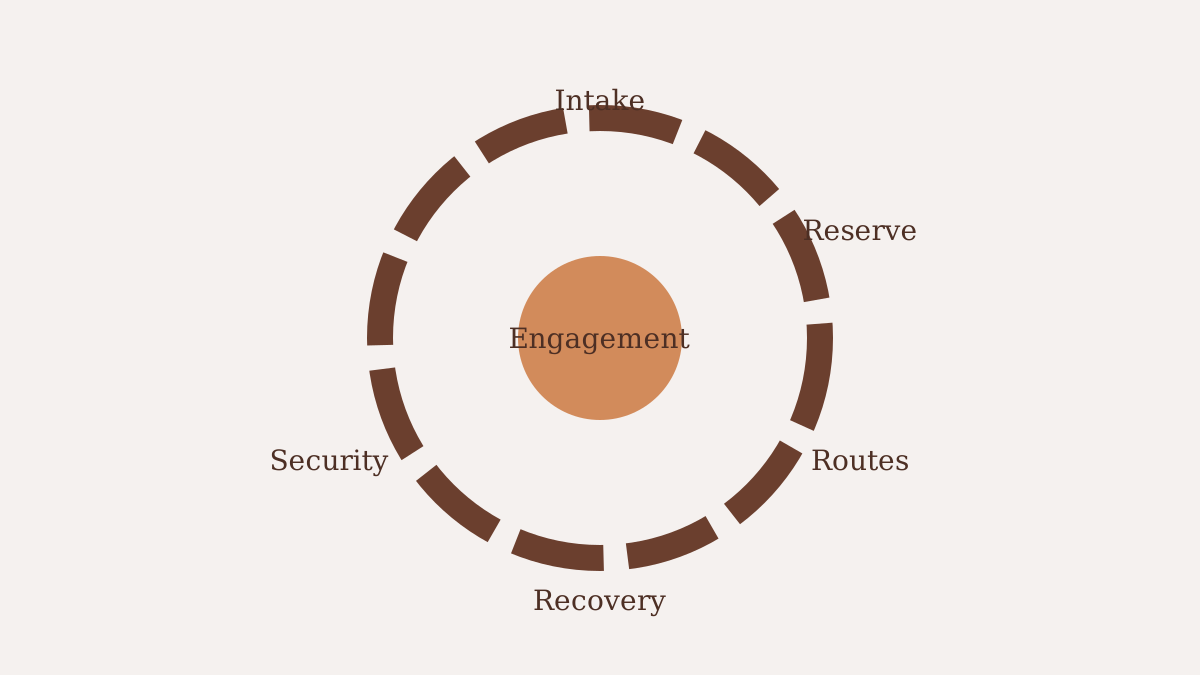
Combat systems often overfocus on contact and underexplain what keeps contact possible. The sustainment loop fixes that by modeling force as a recurring chain: intake, reserve staging, route protection, engagement, and recovery.
If any part of the loop stalls, armies, fleets, or strike groups begin lying about their real power. They may still win locally, but they lose the ability to repeat, exploit, or survive those wins.
Identify where food, fuel, ammunition, mounts, or replacement personnel enter the combat system.
Show where the system stores and organizes enough buffered force to survive delay or attrition.
Map the corridors, escorts, depots, and crossings that keep the combat edge connected to its base.
Track what contact actually consumes: morale, ammunition, transport capacity, officer attention, and time.
Measure how quickly force can re-form after fighting rather than pretending every battle ends at the moment of victory.
| Axis | Question | Signal |
|---|---|---|
| Intake base | What external flow keeps the force alive? | Granary chain, fuel depot, levy stream, factory output, shipyard feed |
| Reserve depth | How much delay or attrition can the system absorb? | Stored rations, spare mounts, reserve battalions, fleet readiness, repair stock |
| Route security | What has to stay open between base and front? | Pass control, convoy escort, bridgehead, rail corridor, sea lane cover |
| Engagement burn | Which resource depletes fastest under pressure? | Ammunition, morale, food, mobility, officer coordination, medical load |
| Recovery lag | How long before usable force returns? | Rest period, refit time, casualty replacement, route reopening, morale reset |
The usual design error is to give factions or states combat power without making them pay repeated sustainment costs. That creates armies that can fight everywhere, fleets that never need route security, and local victories that magically scale into regional control.
The reusable lesson is that combat strength is really loop strength. Once sustainment is visible, you can explain why a faction dominates one theater, stalls at another, and collapses after winning too many expensive victories in sequence.
Read what should come before it, what relation role matters next, and where this page should hand you off after the local graph is clear.
Start with Force Projection Window and then return here once the surrounding concept stack is clear.
These entries clarify the footing underneath the current node before you move outward again. Start with Force Projection Window when you want the clearest next role.
Return to broader lenses when this model is too specific for the question you are asking.
1 handoff nodes stay inside Conflict And Operations. 3 handoff nodes share Regional.
Detail pages now expose the branch and scale of their surrounding graph before showing raw prerequisite and relation shelves, so continuation can stay taxonomy-led instead of adjacency-led.
Explain how resources, goods, labor, information, and force circulate, stall, buffer, and break.
Start from the resource-flow loop, trace storage and throughput models, compare one logistics study, then run a flow audit worksheet.
Explain how legitimacy, coercion, administrative reach, frontier bargaining, and elite control are structured.
Start with the pressure map, locate legitimacy and capture mechanisms, validate against a frontier or state case, then run a governance stress test.
Explain campaigns, sustainment, force projection, defensive depth, and operational windows as structural systems.
Start with sustainment and projection models, identify the theater cycle, validate through an operational case, then run an operations stress test.
Use this scale when the region is the main leverage unit for settlement, extraction, governance, or conflict.
Use this scale when routes, relays, buffers, and linked nodes matter more than territorial bulk.
Use this scale when the strongest explanation depends on several levels staying visible together.
Use prerequisites when you want the shortest path into the assumptions this page depends on.
A model for how far and how long force can be projected effectively before supply, delay, terrain, and recovery costs collapse performance.
A location where flow is buffered, accumulated, protected, measured, or redirected strongly enough to change who can control the wider system.
These groups explain why each neighboring node matters, whether it stabilizes the concept, operationalizes it, proves it, or pushes the lane further.
Use foundation relations when this node depends on a concept, term, or framing layer that should be explicit before you branch further.
A model for how far and how long force can be projected effectively before supply, delay, terrain, and recovery costs collapse performance.
A model for how extraction, transport, storage, transformation, and redistribution create stability or fragility in a world system.
Use applied relations when the next useful move is to see the current pattern survive inside a study or assembled world.
A sample systems study showing how basin agriculture, defensive ridges, and narrow passes produce a dense but brittle civilization pattern.
These entries still matter, but they currently rely on generic adjacency instead of typed continuation semantics.
A framework for mapping how flow, capture, legitimacy, coalition strain, and force sustainment combine into one escalating system rather than separate mechanics.
A framework for tracking which passes, ports, narrows, and crossings decide political leverage at the edge of a system.
A location where flow is buffered, accumulated, protected, measured, or redirected strongly enough to change who can control the wider system.
Models formalize behavior. Use them when you need a concrete chain, loop, stress scenario, or layered mechanism that can be tested and reused.
A model should explain how something behaves over time or under pressure, not just identify a broad topic area.
When a setting feels plausible at rest but still behaves vaguely, models provide the explicit structure needed to test it.
A strong workflow often moves from broad lens to formal model to applied case reading.
Keep these collapsed until you want to turn the page into an active reading exercise.
What mechanism is this model making explicit?
Where does this model break or become most interesting under stress?
Which study would verify whether this model survives in a complete setting?
These routes are tuned to the kind of entry you are currently reading, so you can leave this page with one deliberate next move.
Return to broader lenses when this model is too specific for the question you are asking.
Cross-layer moveMove through the systems module when you want to navigate models by design intent.
Cross-layer moveVerify the model inside applied cases where multiple structures interact at once.