Preparing the current spcent route.
The page shell is online. Shared content and route data are still being assembled.
A settlement whose main structural role is to pass movement onward by offering storage, handoff, repair, taxation, escort, or communication continuity.
A relay settlement exists less to dominate its hinterland than to keep movement continuous across longer distances.
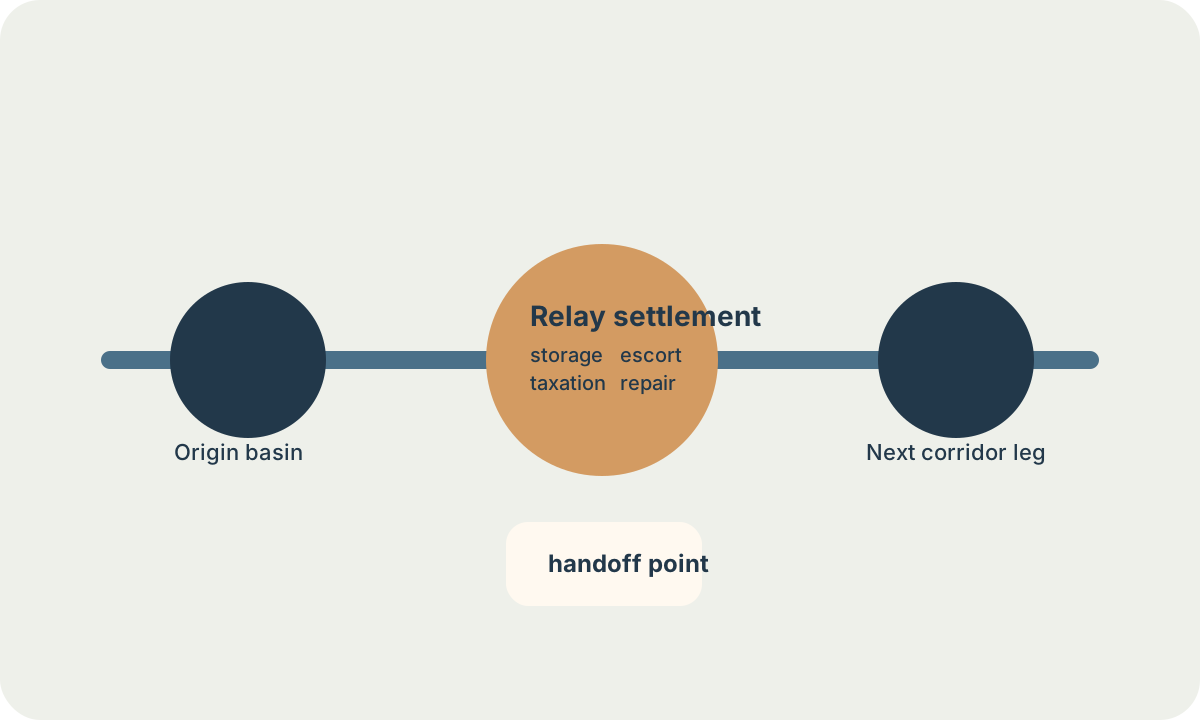
Its structural value comes from handoff. It provides rest, storage, pricing, escort change, taxation, communication refresh, or mechanical repair at exactly the point where uninterrupted motion would otherwise become too costly.
| Axis | Question | Signal |
|---|---|---|
| Handoff | Does movement routinely change phase here? | Escort swaps, cargo transfer, fresh animals, crew rotation |
| Buffer | Does the place absorb timing mismatch? | Warehousing, inns, yard space, reserve supplies, queue tolerance |
| Service | What keeps onward movement viable? | Repair, navigation advice, market pricing, paperwork, dispatch refresh |
| Control | Who captures the value of the handoff? | Tolls, customs, guards, guild rights, harbor dues |
Relay settlements explain why some towns matter far more than their local population or farmland would suggest. Their importance comes from continuity: they are the points where long-distance movement can pause, reorganize, and resume without collapsing.
This makes them structurally different from simple market towns or fortress capitals. A relay settlement can be strategically decisive even when it does not dominate the region politically, because it stabilizes the corridor that larger powers depend on.
A relay settlement is not any settlement that happens to sit near a road. It deserves the term only when repeated handoff, buffering, or service there changes whether long-distance movement can continue at all.
Shows how relay settlements often become valuable because they buffer and redistribute flow rather than merely hosting population.
CorridorExplains why relay settlements tend to thicken along repeated movement spines.
Monsoon Archipelago CommonwealthProvides an applied case where relay harbors are the real operating skeleton of the polity.
If the town disappeared, would the route still work at the same rhythm and scale? If the answer is no, you are probably looking at a relay settlement rather than a merely adjacent settlement.
Queue yards, inns, repair services, fresh animals, and customs or escort changes are the main signs that the settlement is functioning as a relay rather than only as a local market.
A pass-town where caravans change animals, store loads overnight, pay tolls, and reorganize escorts is acting as a relay settlement even if it commands very little hinterland.
Read what should come before it, what relation role matters next, and where this page should hand you off after the local graph is clear.
Start with Corridor and then return here once the surrounding concept stack is clear.
Use Corridor or the linked nodes below when you want to compare this page against neighboring parts of the graph.
Many glossary abstractions become richer when viewed inside the spatial module.
1 handoff nodes stay inside Flow And Logistics. 3 handoff nodes share Network.
Detail pages now expose the branch and scale of their surrounding graph before showing raw prerequisite and relation shelves, so continuation can stay taxonomy-led instead of adjacency-led.
Explain how topology, region graphs, corridors, map abstraction, and scale determine movement and leverage.
Start in Spatial, reduce the map into region graph and corridor logic, test topology under disruption, then return through a spatial design guide.
Explain how resources, goods, labor, information, and force circulate, stall, buffer, and break.
Start from the resource-flow loop, trace storage and throughput models, compare one logistics study, then run a flow audit worksheet.
Use this scale when routes, relays, buffers, and linked nodes matter more than territorial bulk.
Use prerequisites when you want the shortest path into the assumptions this page depends on.
A durable movement spine where terrain, settlement, exchange, and repeated transit align strongly enough to guide long-run circulation.
This entry still relies on generic related links. That works as a fallback, but typed relation roles would make continuation clearer.
A durable movement spine where terrain, settlement, exchange, and repeated transit align strongly enough to guide long-run circulation.
A location where flow is buffered, accumulated, protected, measured, or redirected strongly enough to change who can control the wider system.
The ranked structure by which some routes function as primary spines while others act as feeder, secondary, seasonal, or fallback paths.
Glossary entries define Spcent's shared vocabulary. They are conceptual anchors designed to stabilize how an abstraction is used across pages and modules.
A glossary term should lock down what a phrase means so later reading is not burdened by ambiguity.
When you know the concept but not yet the best framework or model, start here and then move outward through related nodes.
A useful definition points toward the frameworks, models, and studies that actually use the term in context.
Keep these collapsed until you want to turn the page into an active reading exercise.
What question becomes easier once this term is precisely defined?
Which entries in the graph are using this abstraction operationally rather than only naming it?
Do I need a framework, model, or study next to see this concept in action?
These routes are tuned to the kind of entry you are currently reading, so you can leave this page with one deliberate next move.
Many glossary abstractions become richer when viewed inside the spatial module.
Cross-layer moveMove into frameworks when you want a planning lens built on top of the term.
Cross-layer moveSearch across the graph to find every place the concept currently appears.