Preparing the current spcent route.
The page shell is online. Shared content and route data are still being assembled.
A framework for reading a world from climate rhythm, terrain friction, habitability, circulation, and settlement thresholds before higher-order institutions are added.
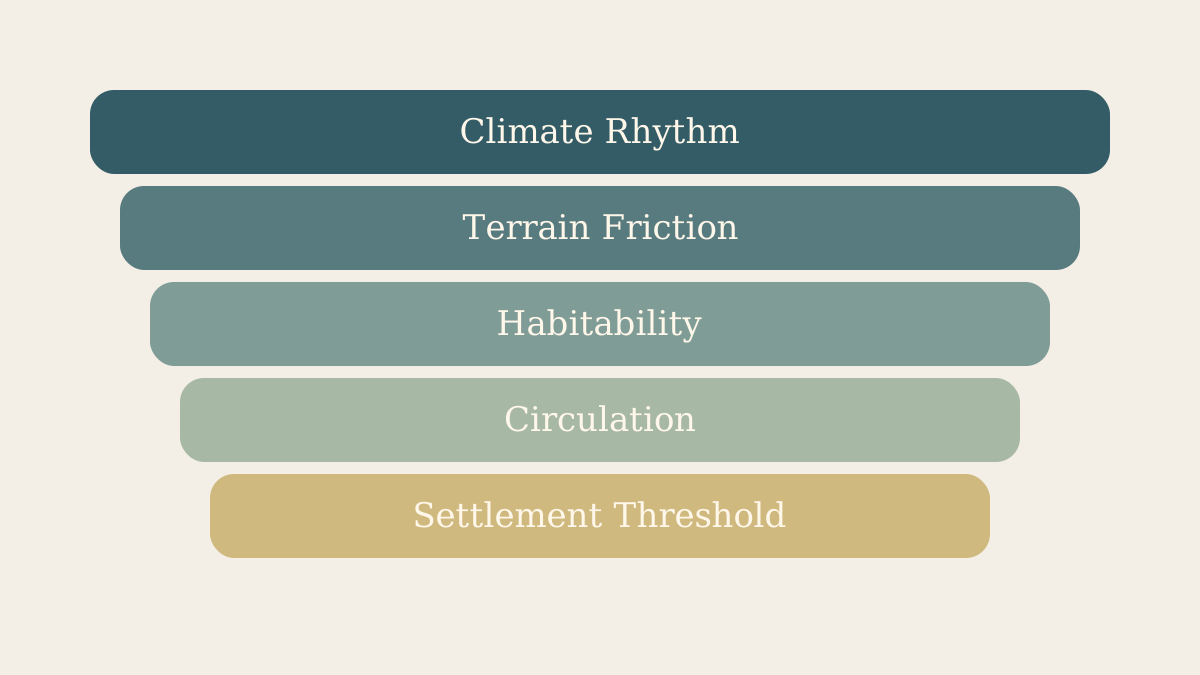
Worlds usually become incoherent when later layers pretend the earlier limits do not exist. The world constraint stack fixes that by forcing climate rhythm, terrain friction, habitability, circulation, and settlement thresholds into one readable order.
The framework is not about making worlds more deterministic. It is about identifying the pressures that every later layer must negotiate repeatedly. Once those pressures are explicit, ecology, trade, fortification, and institutions stop floating as decorative additions.
| Axis | Question | Signal |
|---|---|---|
| Climate rhythm | What repeating seasonal or cyclical windows govern labor, travel, and storage? | Flood cycles, monsoon timing, winter lock, drought interval, harvest pulse |
| Terrain friction | Where does movement slow, funnel, or become expensive? | Passes, marsh belts, escarpments, glacial edges, desert transit cost |
| Habitability | Where do water, shelter, soil, and survivable temperature overlap reliably enough for density? | Basins, deltas, lee zones, irrigable strips, thermal refuges |
| Circulation | Which routes keep matter, labor, and information moving despite those earlier limits? | Corridors, ferry chains, relay settlements, depot belts, protected crossings |
| Settlement threshold | Where can durable storage, hierarchy, and institutional load accumulate? | Market hubs, fortified nodes, capitals, warehouse towns, core-zone belts |
The stack is most useful when a draft world has plenty of detail but still cannot explain why people, leverage, and storage stabilize where they do.
Start with repeating environmental windows. A world with monsoon pulses, freeze periods, or tidal work cycles is already structuring labor and movement before any institution appears.
The stack is not trying to make culture, politics, or invention disappear into geography. Its purpose is narrower and more useful: to establish the inherited field that later actors have to negotiate. Climate rhythm shapes timing, terrain sets friction, habitability sets the basic density envelope, circulation determines whether separated pockets can stay connected, and settlement thresholds decide where specialization and durable institutions can actually accumulate.
Once that field is visible, later layers become easier to judge. A powerful state, magical corridor, or dense urban belt may still emerge, but it now has to explain how it overcame or rewrote the inherited stack. That is what gives the world a sense of causality rather than just variety.
Use the world constraint stack when a setting has one of three problems: its maps look balanced despite severe environmental asymmetry, its cities appear where throughput cannot support them, or its institutions behave as if climate and terrain only matter in flavor text.
The fastest diagnostic move is to name which layer the draft is currently skipping. If a capital exists without a clear settlement threshold, or a frontier expands without a workable circulation layer, the world is describing outcomes before it has justified the inherited field underneath them.
The main misuse is to stop at the lower layers and never move back upward. The stack is not finished once terrain and climate are named. It becomes valuable only when those lower layers are translated into circulation and settlement consequences that later political or cultural design can answer. Another misuse is to treat every region as if it shares the same threshold values. Real worlds become interesting precisely because the stack overlaps differently from basin to basin, coast to coast, and frontier to frontier.
Use this when the stack needs to become a concrete regional map of terrain, settlement, resources, and infrastructure.
Climate Rhythm ModelOpen this when the first layer is still vague and the world needs explicit recurring environmental timing.
Migration Corridor ModelOpen this when repeated movement under pressure is reshaping identity, frontier density, or political load.
The reusable lesson is that worlds do not become coherent by adding more categories. They become coherent when every later category can be shown as an answer to an earlier limit. The stack makes that inheritance explicit enough to test.
Read what should come before it, what relation role matters next, and where this page should hand you off after the local graph is clear.
Start with Terrain Settlement Gradient and then return here once the surrounding concept stack is clear.
These entries make the current idea more explicit and more reusable. Start with Regional Systems Matrix when you want the clearest next role.
Move into explicit mechanisms once this framework has clarified the structure you need to explain.
5 handoff nodes stay inside World Foundations. 2 handoff nodes share World.
Detail pages now expose the branch and scale of their surrounding graph before showing raw prerequisite and relation shelves, so continuation can stay taxonomy-led instead of adjacency-led.
Explain what the world is materially built from before politics, balance, or style are discussed.
Start in Worlds, read the anchor framework, open one regional model, validate with a complete study, then finish with a world assembly guide pass.
Explain how resources, goods, labor, information, and force circulate, stall, buffer, and break.
Start from the resource-flow loop, trace storage and throughput models, compare one logistics study, then run a flow audit worksheet.
Use this scale when the region is the main leverage unit for settlement, extraction, governance, or conflict.
Use this scale when the whole world model or planetary constraint pattern should stay visible at once.
Use this scale when routes, relays, buffers, and linked nodes matter more than territorial bulk.
Use prerequisites when you want the shortest path into the assumptions this page depends on.
A framework for reading how terrain friction and access gradients shape where settlement density can sustainably accumulate.
A model for mapping how water, temperature, soil renewal, shelter, and disturbance tolerance create uneven ecological carrying capacity across a world.
These groups explain why each neighboring node matters, whether it stabilizes the concept, operationalizes it, proves it, or pushes the lane further.
Use operationalizing relations when you want the current abstraction rendered as a cleaner model, loop, or structural device.
A planning frame for mapping how geography, settlement, resources, and transit form a region's structural identity.
A model for how repeating weather and seasonal windows structure labor, harvest timing, travel reliability, and crisis pacing across a world.
Use applied relations when the next useful move is to see the current pattern survive inside a study or assembled world.
A model for how repeated displacement, opportunity seeking, and frontier movement consolidate into durable corridors that reshape identity, labor, and political load.
Use extension relations when the next move is not prerequisite or proof, but a deeper neighboring step in the same graph lane.
An overarching framework for assembling worlds from substrate, circulation, institutions, capability, and historical residue so complete settings can be compared through the same structural layers.
These entries still matter, but they currently rely on generic adjacency instead of typed continuation semantics.
A framework for reading how terrain friction and access gradients shape where settlement density can sustainably accumulate.
A model for mapping how water, temperature, soil renewal, shelter, and disturbance tolerance create uneven ecological carrying capacity across a world.
Frameworks are broad structural lenses. Use them to decide what to compare, map, or diagnose before committing to a more explicit mechanism.
A framework tells you what variables and contrasts matter. It is less about behavior and more about what deserves structured attention.
Open a framework when a world or system still feels under-framed and you need a reusable way to inspect the problem space.
Once the pattern is visible, the next step is usually a model that explains the mechanism more explicitly.
Keep these collapsed until you want to turn the page into an active reading exercise.
What does this framework help me compare that I could not compare clearly before?
Which parts of my world or system become more legible when I use this lens?
What model or study should I read next once the frame is clear?
These routes are tuned to the kind of entry you are currently reading, so you can leave this page with one deliberate next move.
Move into explicit mechanisms once this framework has clarified the structure you need to explain.
Cross-layer moveReturn to the worlds module when this framework should be applied to a full worldbuilding layer.
Cross-layer moveUse Guides when you want this framework embedded in a workflow with outputs and checkpoints.