Preparing the current spcent route.
The page shell is online. Shared content and route data are still being assembled.
A game study of how heat radius, labor sacrifice, storage timing, and moral policy turn Frostpunk into a compact model of survival governance under extreme climatic pressure.
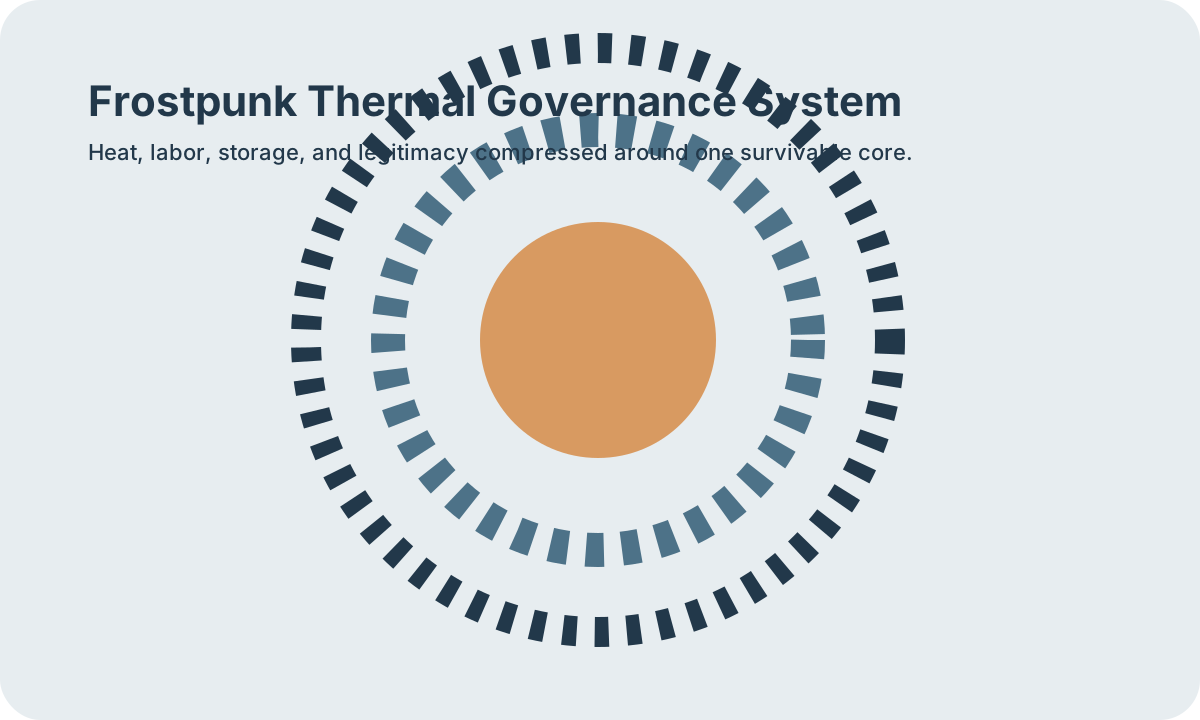
Frostpunk is structurally rich because it compresses climate, labor, housing, morality, and storage into one survival engine centered on heat.
Heat is not only a resource bar. It is a spatial governance problem. The city survives by deciding who stays warm, how labor is allocated, which stockpiles are protected, and how much political legitimacy can be consumed before the social order breaks.
Provides the ecological logic for why small differences in thermal protection produce major differences in survivability.
Reinforcement-Balancing PairShows how labor expansion, heating demand, and policy coercion reinforce one another until balancing drag appears.
Administrative LoadClarifies why a city under extreme climatic stress becomes harder to govern even when its institutions become more coercive.
The strongest pattern is thermal concentration. The generator creates a core that is survivable, but the whole settlement cannot remain equally protected as work sites, housing rings, and extraction nodes expand outward.
That turns policy into spatial triage. Moral order and material order are linked because every labor decision is also a heating decision, and every heating decision is also a legitimacy decision.
| Axis | Question | Signal |
|---|---|---|
| Heat core | What must remain protected for the city to keep functioning? | Generator radius, clinic reliability, dense housing, stable work proximity |
| Labor edge | Where does survival depend on sending people into higher-risk thermal zones? | Remote extraction, storm exposure, overtime, transport lag, insulation shortfall |
| Storage clock | How long can the city absorb resource and weather mismatch? | Coal stockpiles, food reserves, triage policy, heating cycles, ration depth |
| Moral strain | When does survival governance begin to consume its own legitimacy? | Emergency laws, child labor, discipline chains, faith order, protest suppression |
The reusable lesson is that survival cities feel coherent when climate stress, logistics, and governance all tighten around the same central constraint.
Frostpunk works structurally because heat, storage, labor, and legitimacy are one fused operating problem rather than separate systems.
Read what should come before it, what relation role matters next, and where this page should hand you off after the local graph is clear.
Start with Habitat Carrying Gradient and then return here once the surrounding concept stack is clear.
Use Habitat Carrying Gradient or the linked nodes below when you want to compare this page against neighboring parts of the graph.
Use Guides when the study should feed into a worksheet or structured revision sequence.
No handoff nodes currently stay inside Capability Regimes. No handoff nodes currently share Urban.
Detail pages now expose the branch and scale of their surrounding graph before showing raw prerequisite and relation shelves, so continuation can stay taxonomy-led instead of adjacency-led.
Explain how resources, goods, labor, information, and force circulate, stall, buffer, and break.
Start from the resource-flow loop, trace storage and throughput models, compare one logistics study, then run a flow audit worksheet.
Explain how legitimacy, coercion, administrative reach, frontier bargaining, and elite control are structured.
Start with the pressure map, locate legitimacy and capture mechanisms, validate against a frontier or state case, then run a governance stress test.
Turn all major programs into creator-operable workflows rather than leaving them as analysis-only content.
Start in Guides with the workflow framework, choose the role route, open the supporting program branches only as needed, and leave with a worksheet or review artifact.
Use this scale when the strongest explanation depends on several levels staying visible together.
Use this scale when routes, relays, buffers, and linked nodes matter more than territorial bulk.
Use this scale when the region is the main leverage unit for settlement, extraction, governance, or conflict.
Use prerequisites when you want the shortest path into the assumptions this page depends on.
A model for mapping how water, temperature, soil renewal, shelter, and disturbance tolerance create uneven ecological carrying capacity across a world.
A loop model for pairing each compounding process with the balancing drag, delay, or exposure that stops it from becoming unbounded.
This entry still relies on generic related links. That works as a fallback, but typed relation roles would make continuation clearer.
A model for mapping how water, temperature, soil renewal, shelter, and disturbance tolerance create uneven ecological carrying capacity across a world.
The cumulative burden of governing, coordinating, recording, supplying, and enforcing order across a territory or institution.
A loop model for pairing each compounding process with the balancing drag, delay, or exposure that stops it from becoming unbounded.
A location where flow is buffered, accumulated, protected, measured, or redirected strongly enough to change who can control the wider system.
Studies apply Spcent's lenses to complete cases. Read them to see whether geography, surplus, corridors, and pressure patterns still make sense when placed inside one setting.
The goal is not to retain setting trivia. The goal is to extract reusable patterns and structural habits you can reapply elsewhere.
Studies are strongest when you already know the frameworks and models underneath them, so you can recognize the structural moves being made.
After reading a study, identify which layer of your own draft needs work and go back there with one concrete change in mind.
Keep these collapsed until you want to turn the page into an active reading exercise.
What are the decisive regions, corridors, or chokepoints in this case?
What keeps the studied world stable, and what makes it brittle?
Which model or framework do I need next if I want to reproduce this pattern in my own project?
These routes are tuned to the kind of entry you are currently reading, so you can leave this page with one deliberate next move.
Use Guides when the study should feed into a worksheet or structured revision sequence.
Cross-layer moveReturn to the worlds module when the case highlights a weak worldbuilding layer in your own draft.
Cross-layer moveOpen models when the case reveals a mechanism you want to isolate and reuse directly.