Preparing the current spcent route.
The page shell is online. Shared content and route data are still being assembled.
A border that does not fully close movement but changes crossing cost unevenly by actor, cargo type, season, or political condition.
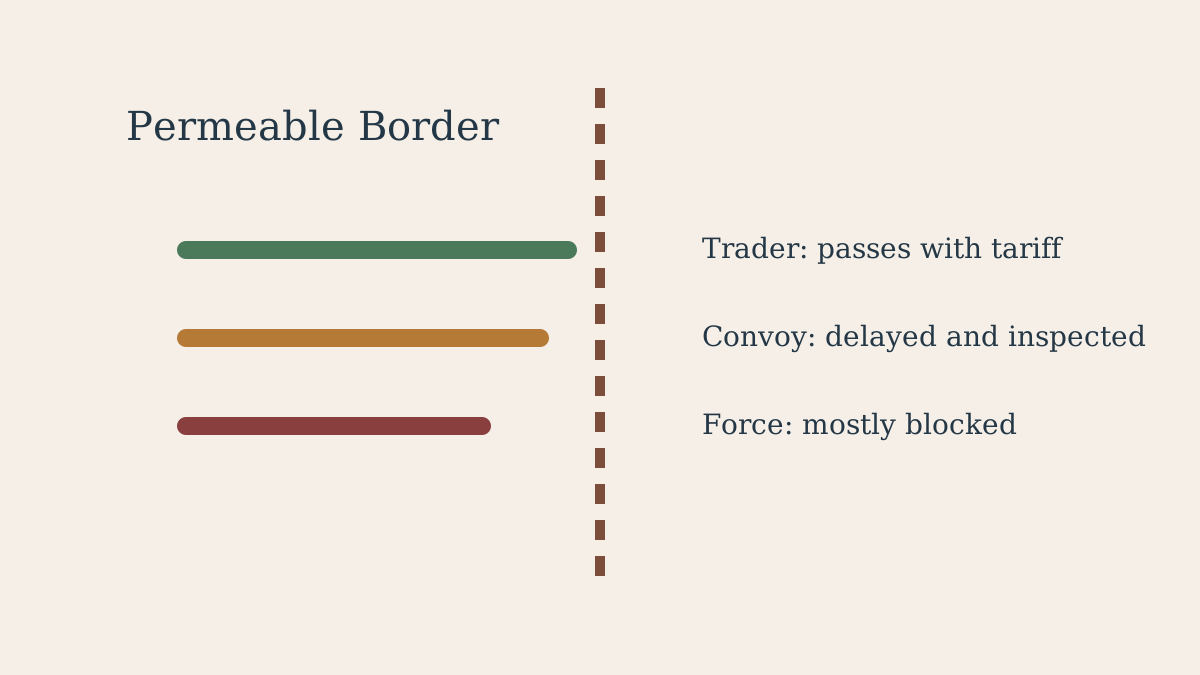
A permeable border is a border whose crossing cost varies by who is moving, what is moving, and under what conditions the move is attempted. It is neither fully open nor fully closed.
Most real frontiers work this way. Merchants may pass with tariffs, migrants through unofficial gaps, couriers under treaty, and armies only at heavy cost. That unevenness shapes smuggling, logistics, diplomacy, and control far more precisely than a simple open-closed label.
Selective openness also creates its own route hierarchy. Once one class of actor can pass more easily than another, warehouses, escorts, brokers, and shadow routes start clustering around that asymmetry.
A permeable border is not just a weak border or a frontier the state forgot to patrol. It can be heavily governed while still remaining unevenly passable, because the system is sorting movement rather than banning all movement outright.
If the same frontier behaves differently for grain, gold, refugees, envoys, and reinforcement columns, treat it as a permeable border and model the crossing asymmetry directly. Permit systems, tolerated smuggling lanes, tariff gates, and seasonal access shifts are the clearest signals.
A caravan border that is open to licensed merchants, expensive for migrants, and effectively closed to army columns is behaving as a permeable border rather than as a simple line of closure.
The term matters because uneven crossing cost usually creates more realistic politics than total openness or total closure. Different actors are entering different borders even when they meet the same line. That asymmetry is what makes border systems structurally interesting. It turns one frontier into several different operating realities at once. The line stays singular, but the border behavior does not.
Turns the concept into a reusable model for cost, asymmetry, and rerouting.
Frontier Chokepoint LedgerShows where permeability concentrates into a small set of highly consequential crossings.
Synthetic Desert Port Relay EmpireApplies selective openness to a route-control system built around licensed crossings and relay permits.
Read what should come before it, what relation role matters next, and where this page should hand you off after the local graph is clear.
No prerequisite chain is currently required, which makes this page a valid graph entry point for the current topic.
Use Border Permeability Model or the linked nodes below when you want to compare this page against neighboring parts of the graph.
Many glossary abstractions become richer when viewed inside the spatial module.
2 handoff nodes stay inside Governance And Power. 2 handoff nodes share Regional.
Detail pages now expose the branch and scale of their surrounding graph before showing raw prerequisite and relation shelves, so continuation can stay taxonomy-led instead of adjacency-led.
Explain how legitimacy, coercion, administrative reach, frontier bargaining, and elite control are structured.
Start with the pressure map, locate legitimacy and capture mechanisms, validate against a frontier or state case, then run a governance stress test.
Explain how topology, region graphs, corridors, map abstraction, and scale determine movement and leverage.
Start in Spatial, reduce the map into region graph and corridor logic, test topology under disruption, then return through a spatial design guide.
Use this scale when the region is the main leverage unit for settlement, extraction, governance, or conflict.
Use this scale when the strongest explanation depends on several levels staying visible together.
No prerequisite chain is currently required, so you can continue from here into relation paths or cross-layer handoff.
This page has no prerequisite chain yet. Treat it as a start node, then branch outward through typed relation paths or cross-layer handoff below.
This entry still relies on generic related links. That works as a fallback, but typed relation roles would make continuation clearer.
A model for comparing how borders change crossing cost, asymmetry, inspection burden, and rerouting behavior for different actors and flows.
A framework for tracking which passes, ports, narrows, and crossings decide political leverage at the edge of a system.
A framework for reading movement as stacked road, river, sea, border, and administrative layers whose overlaps decide gateway leverage, rerouting options, and operating reach.
Glossary entries define Spcent's shared vocabulary. They are conceptual anchors designed to stabilize how an abstraction is used across pages and modules.
A glossary term should lock down what a phrase means so later reading is not burdened by ambiguity.
When you know the concept but not yet the best framework or model, start here and then move outward through related nodes.
A useful definition points toward the frameworks, models, and studies that actually use the term in context.
Keep these collapsed until you want to turn the page into an active reading exercise.
What question becomes easier once this term is precisely defined?
Which entries in the graph are using this abstraction operationally rather than only naming it?
Do I need a framework, model, or study next to see this concept in action?
These routes are tuned to the kind of entry you are currently reading, so you can leave this page with one deliberate next move.
Many glossary abstractions become richer when viewed inside the spatial module.
Cross-layer moveMove into frameworks when you want a planning lens built on top of the term.
Cross-layer moveSearch across the graph to find every place the concept currently appears.