Pulling this page together.
Preparing content, navigation, and supporting references for this route.
Preparing content, navigation, and supporting references for this route.
A framework for reading how terrain friction and access gradients shape where settlement density can sustainably accumulate.
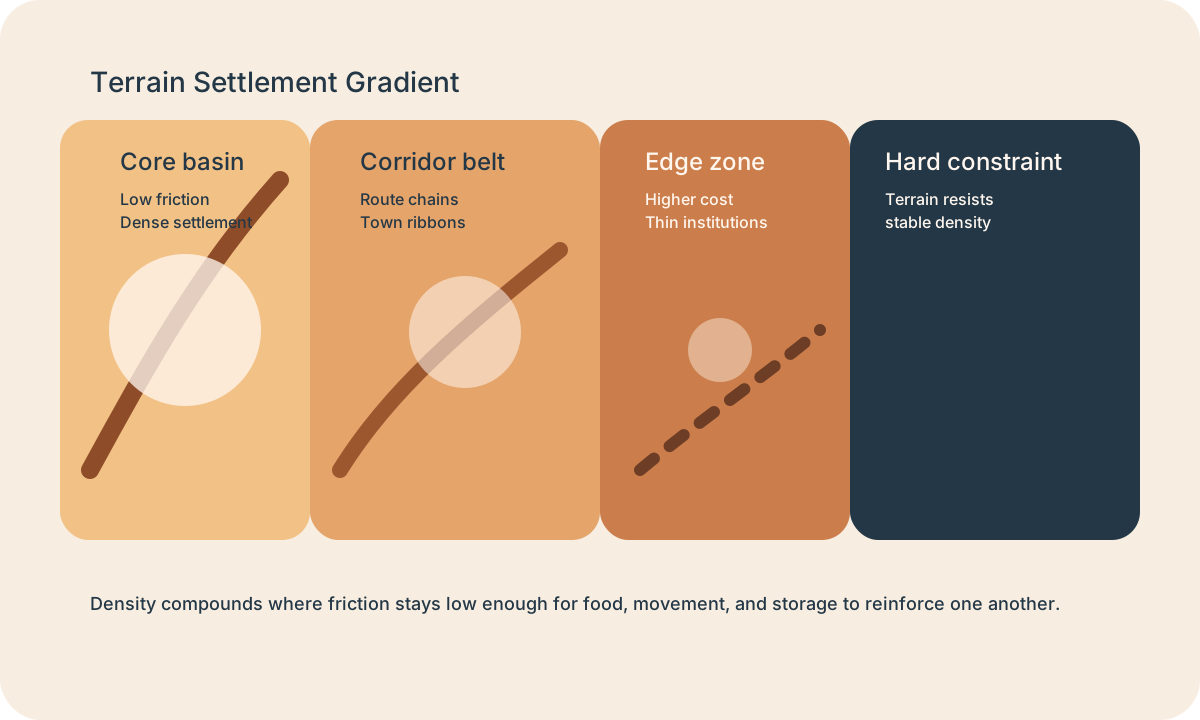
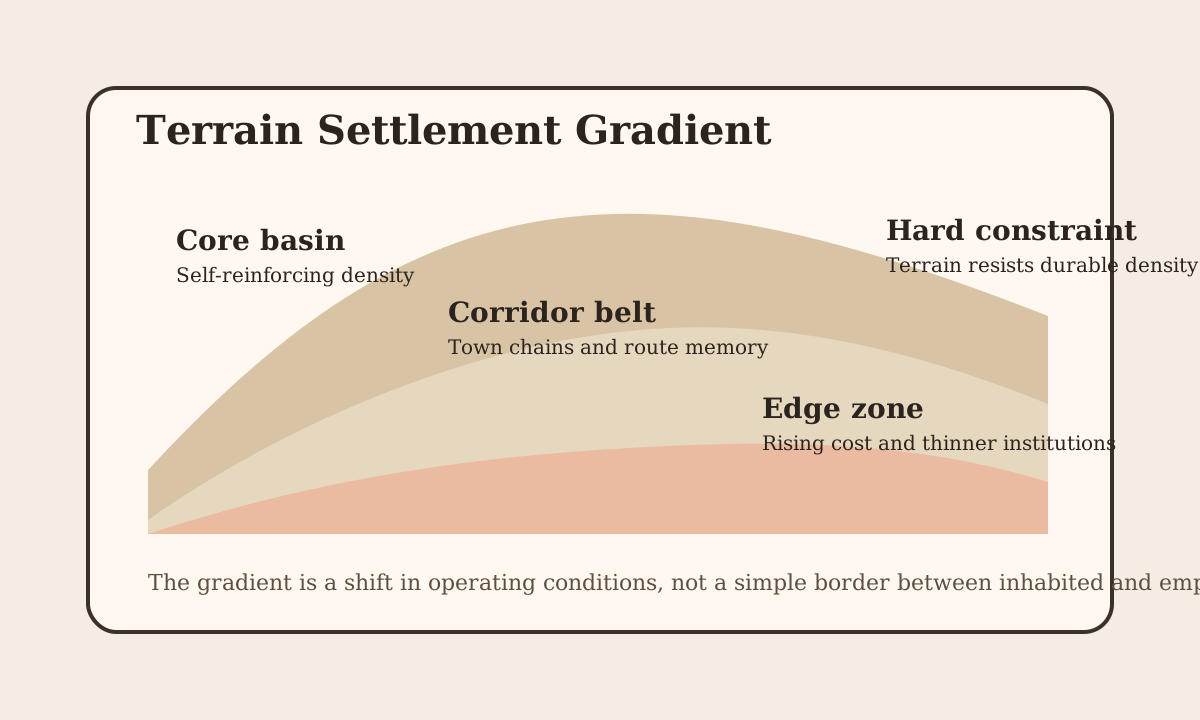
Worldbuilders often place cities as isolated points of interest. The gradient approach starts from terrain friction and asks how easy it is for people, surplus, and institutions to remain concentrated over time.
Settlement density usually follows a gradient rather than a binary map of inhabited versus empty land.
Start where food, water, storage, and route access can sustain concentration without constant subsidy.
Map the roads, valleys, and riverbanks where movement remains reliable enough to chain towns together.
Identify where settlement cost rises faster than surplus and institutions become thinner and more brittle.
Reserve the true hard-constraint zone for terrain that resists durable density altogether.
| Axis | Question | Signal |
|---|---|---|
| Core basin | Where can density compound with low movement cost? | River plains, sheltered basins, fertile coastal strips |
| Corridor belt | Where does movement stay reliable enough to support chains of towns? | Road valleys, riverbanks, caravan routes, pass-linked roads |
| Edge zone | Where does cost rise faster than surplus? | Broken uplands, marsh rims, seasonal frontier belts |
| Hard constraint zone | Where does terrain resist stable density altogether? | High ridges, deserts, ice margins, flood-unstable flats |
The framework is more than a reminder that mountains are harder to settle than plains. Its real use is to explain why density changes gradually across a region instead of switching cleanly from city space to empty space. Food reliability, water access, route continuity, storage depth, and defense cost usually decline unevenly. The gradient captures that unevenness and turns it into a readable settlement logic.
This matters because settlement usually becomes incoherent when every location is treated as a one-off design decision. The gradient reintroduces continuity. A dense basin should shade into corridor towns, then into thinner edge settlements, and only finally into truly hard-constraint terrain. When those transitions are explicit, a map starts feeling governed by repeatable conditions instead of by author placement.
This framework is useful before naming cities. It helps explain why capitals sit where they do, why roads harden into corridors, and why peripheral space remains politically expensive.
The gradient should not be used as a rigid destiny map. Exceptional nodes can still appear in difficult terrain if they control a pass, a mineral intake, a ritual site, or a protected harbor that compensates for ordinary friction. The framework is there to force the exception to name its support mechanism. Once that support is visible, an unusual city feels strategically earned instead of arbitrarily placed.
The most common mistake is to place major cities inside edge or hard-constraint zones without showing compensating corridor leverage, protected storage, or exceptional capability. A second mistake is to flatten the corridor belt so thoroughly that it behaves like either full urban density or decorative sparsity, even though in practice it should contain the towns, depots, and relay settlements that connect the core to the edge.
The framework also prevents a subtler error: calling a place marginal because it is rugged while simultaneously asking it to support dense, stable, low-cost administration. If the world wants that contradiction, it needs to name the mechanism that overcomes it rather than leaving the issue inside flavor text.