Pulling this page together.
Preparing content, navigation, and supporting references for this route.
Preparing content, navigation, and supporting references for this route.
A framework for mapping how flow, capture, legitimacy, coalition strain, and force sustainment combine into one escalating system rather than separate mechanics.
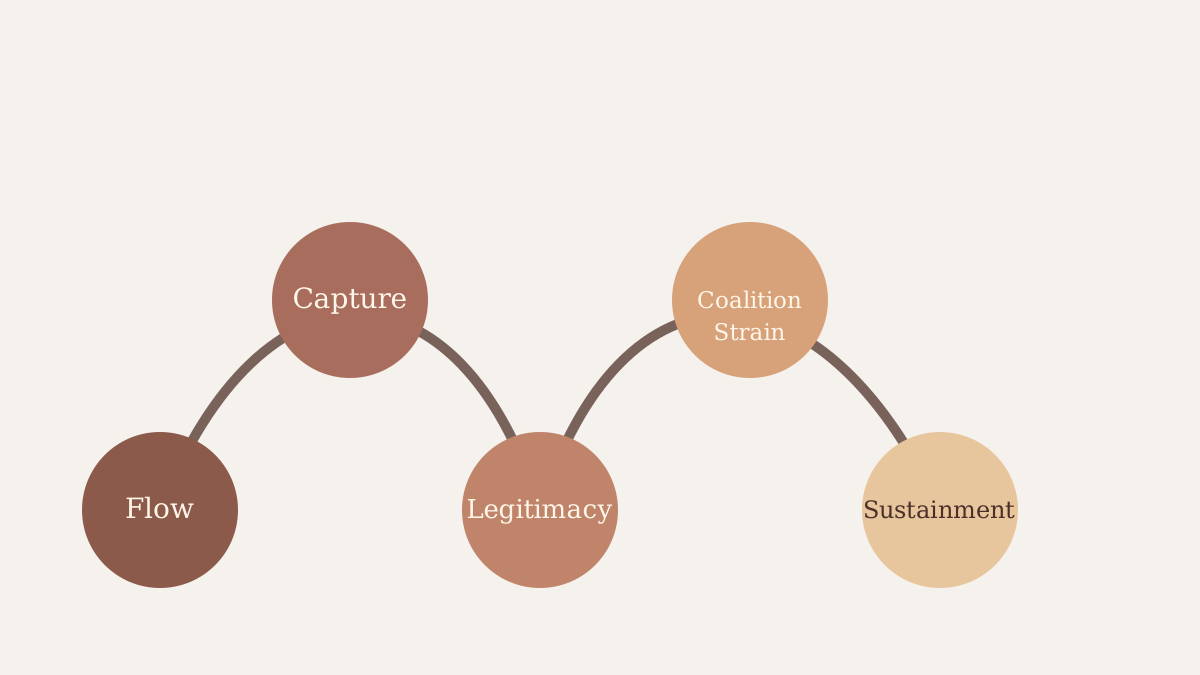
Most weak system analysis isolates mechanics that actually belong to one pressure architecture. Flow determines what moves. Capture determines what can be governed. Legitimacy determines what can be extracted without constant collapse. Coalition strain determines who keeps cooperating. Sustainment determines how long force can remain real.
The framework's job is to hold those surfaces together long enough to see why a system stabilizes, drifts, or escalates. It is useful when a world or game already has many mechanics, but they still do not explain one another.
Start with what actually circulates: grain, fuel, manpower, information, or coercive force. No pressure architecture exists without a moving substrate.
Ask where diffuse flow becomes countable, taxable, hoardable, or redirectable by an actor or institution.
Check what makes continued extraction tolerable, justifiable, or contested rather than assuming capture automatically becomes rule.
Identify where allied actors stop sharing risk, reward, or interpretation of the system's pain.
Finish by testing whether force, administration, and response can still be kept active under accumulated strain.
| Axis | Question | Signal |
|---|---|---|
| Flow | What movement must stay alive for the system to function at all? | Supply chain, labor pulse, information rhythm, convoy timing, route continuity |
| Capture | Where does movement become governable leverage? | Tax nodes, depots, brokerage rights, customs gates, ration systems |
| Legitimacy | Why do actors continue to accept the capture regime? | Ritual authority, legal claim, negotiated privilege, emergency tolerance, ideology |
| Coalition strain | Which aligned actors start diverging first under pressure? | Elite split, regional bargaining, mercenary drift, urban-rural divide, frontier resentment |
| Sustainment | How long can the system keep enforcing itself once strain becomes visible? | Reserve depth, reinforcement lag, command delay, transport attrition, revenue fatigue |
The same architecture reads differently depending on which surface starts moving first and which ones only amplify after a delay.
Use this when route delay, storage loss, or supply thinning starts degrading capture reliability before actors even name the problem politically.
The framework becomes useful when pressure is treated as a sequence rather than as a pile of simultaneous problems. Flow disruption changes what can be captured. Capture strain changes what can still look legitimate. Legitimacy loss changes coalition behavior. Coalition strain makes sustainment more expensive and slower. Sustainment failure then loops back into renewed flow stress. Once that chain is visible, escalation becomes much easier to explain cleanly.
This matters because many settings already contain all five surfaces but still narrate each crisis as isolated. The architecture forces the analyst to ask which pressure moved first, which one lagged, and which one only became visible after earlier conditions had already shifted.
Use this framework when a world or design problem produces the same confusion repeatedly: one team is talking about logistics, another about morale, another about tax legitimacy, and none of them can explain why collapse or escalation happens in a specific sequence.
The pressure architecture does not replace narrower models. It sequences them. Once you know which surface is moving first, you can drop into a more specific loop, ledger, or faction model without losing the whole-system picture.
Start by naming one concrete operating field rather than one abstract polity. Pick the grain corridor, imperial road network, dock-and-tax basin, or patrol frontier that the system cannot afford to lose. Then walk the five pressure surfaces in order instead of jumping straight to visible crisis. What is still moving? Where does it become capturable? What still makes that capture tolerable? Which aligned actors begin disputing cost or reward first? How long can coercion, repair, and response keep up once the dispute is active?
The useful discipline is to stop the pass as soon as one surface clearly starts moving the next one. If flow disruption is already making capture unreliable, do not narrate a legitimacy crisis as if it came from nowhere. If coalition strain only appears after revenue and reserve timing have drifted, do not flatten the sequence into generic betrayal language. The framework is strongest when it identifies the first moving surface and the first delayed amplifier.
Once the order is visible, route into the narrower tool that best matches the unstable layer. Use Legitimacy-Capture Coupling when the regime still extracts but no longer commands consent. Use Alliance Fracture Model when the binding problem is coalition bargaining. Use Combat Sustainment Loop when pressure becomes visible through repeated force expenditure rather than through tax or ideology alone.
The most common mistake is to jump straight to morale, legitimacy, or betrayal without first checking whether the material flow and capture layer had already moved. Systems often look ideological at the surface while still being driven by earlier logistical or fiscal stress underneath. The framework prevents that inversion by keeping the pressure order explicit.
One misread is to treat the architecture as a checklist of equal-weight mechanics. It is not. The point is to locate sequence and amplification. Another misread is to assume every crisis must pass through all five surfaces in identical order. Some systems break through capture and legitimacy before coalition strain matters; others move from flow directly into sustainment because the coercive layer is already thin. The framework gives you a disciplined order of inspection, not a rigid script.
Another frequent mistake is to confuse visible violence with primary pressure. A mutiny, riot, or border war may be the first dramatic signal while still being only the late expression of earlier capture drift, administrative backlog, or reserve exhaustion. If the analysis starts at the loudest surface instead of the earliest moving one, the whole diagnosis becomes theatrically plausible but structurally weak.
Imagine a river state whose court, merchant guilds, and provincial flotilla commanders all depend on one canal-tax spine. At first the stress looks political because governors start bargaining harder and river towns delay remittances. But the earlier moving surface is flow: silted channels and lock delays reduce regular throughput. Capture then becomes less reliable because customs tallies arrive late and convoy volume turns spiky. Only after that does legitimacy start eroding as merchants see extraction staying constant while service quality falls. Coalition strain appears when provincial flotilla commanders begin protecting local routes instead of the common river schedule. Sustainment finally becomes visible once dredging crews, escorts, and reserve grain can no longer be dispatched at the old cadence.
The point of the example is not the specific river state. It is the order. The crisis feels political at the surface, but the architecture reveals why political fracture was delayed material pressure rather than an independent origin point.
Use this when material capture is visible but the real question is why actors still accept or resist the regime.
Alliance Fracture ModelUse this when the system's crisis is arriving through coalition drift rather than direct material shortage.
Combat Sustainment LoopUse this when pressure becomes visible through force projection, reserve exhaustion, and route attrition.
Polycentric Empire Stability ModelOpen this when the pressure architecture is no longer single-center and the real question is how several strong regional nodes bargain under rising strain.
The reusable lesson is that pressure becomes systemic when several surfaces begin amplifying one another. A design gets stronger when it can name which surface is primary, which is delayed, and which only becomes visible after the others have already shifted. That sequence is usually what separates convincing escalation from a draft that merely piles crises on top of one another. It also clarifies where intervention would need to happen first.