Preparing the current spcent route.
The page shell is online. Shared content and route data are still being assembled.
A model for how unequal exposure, diverging incentives, legitimacy disputes, and delayed losses turn a working coalition into a brittle one.
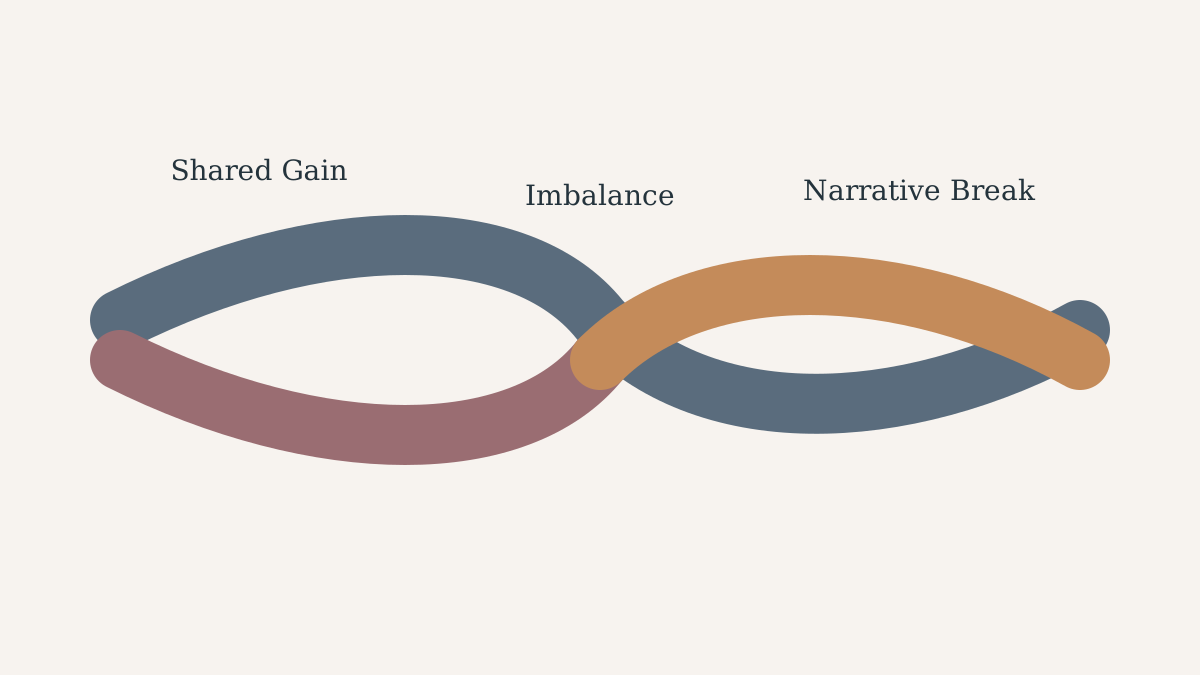
Alliances feel stable when partners are still interpreting the same system through similar risk and reward. Fracture begins when exposure, timing, or legitimacy stops being shared evenly. One ally starts paying more, another starts doubting the bargain, and a third decides delay is better than solidarity.
The model is useful because many faction systems explain why actors unite, but not why that same coalition later becomes brittle without any one dramatic betrayal.
| Axis | Question | Signal |
|---|---|---|
| Unequal exposure | Who suffers earlier or more visibly from the shared system cost? | Frontier losses, convoy burden, customs drag, manpower bleed, harvest disruption |
| Reward divergence | Who feels underpaid relative to contribution? | Spoil imbalance, tax privilege, territorial disappointment, elite access, market exclusion |
| Legitimacy split | Do allies still agree on why the bargain is justified? | Succession dispute, ideological mismatch, regional grievance, ritual refusal, legal ambiguity |
| Delay strategy | Who benefits by slowing commitment while others keep paying? | Late mobilization, defensive withholding, passive bargaining, proxy reliance, private hoarding |
Coalitions rarely jump from loyal to hostile instantly. Use the toggle to see how drift builds.
Costs and rewards are uneven, but still close enough that members interpret their sacrifice as temporary and recoverable.
The model is useful because most alliances do not fail through one sudden revelation. They fail through accumulating asymmetry. One actor bleeds more manpower, another captures more reward, and a third delays commitment until the coalition's shared story becomes implausible. Betrayal may arrive later, but pre-fracture usually begins as uneven interpretation of the same burden.
Use the model when a coalition still exists formally, but every operational conversation is already becoming a bargaining conversation. If logistics, revenue, honor, and defense are being interpreted differently by each partner, the system is probably in pre-fracture even before open defection appears.
The fastest test is to ask who can afford to wait. Actors that gain leverage by delaying mobilization or withholding risk are often already drifting out of the shared bargain even if no one has defected openly. Once delay becomes profitable, the coalition is usually relying on narrative inertia more than on real alignment.
Use this when allies are no longer agreeing on why burdens remain justified or who deserves the extracted reward.
Control Surface MatrixUse this when the first problem is differentiating what each coalition member actually controls rather than what it merely claims.
Westeros Feudal Fracture SystemUse this as an applied case for layered loyalty, uneven exposure, and delayed coalition breakdown.
The reusable lesson is that alliances break through sequence, not only climax. If a world can identify who pays earliest, who feels underrewarded, and who stops believing the bargain, coalition collapse becomes legible before open war begins. It also makes diplomacy scenes sharper, because delay, hedging, and selective commitment stop reading like personality color and start reading like structural fracture signals. That is usually where believable coalition drama starts. The alliance is already breaking before the banners change.
Read what should come before it, what relation role matters next, and where this page should hand you off after the local graph is clear.
Start with Coercive Reach and then return here once the surrounding concept stack is clear.
These entries clarify the footing underneath the current node before you move outward again. Start with Control Surface Matrix when you want the clearest next role.
Return to broader lenses when this model is too specific for the question you are asking.
5 handoff nodes stay inside Governance And Power. 4 handoff nodes share Cross Scale.
Detail pages now expose the branch and scale of their surrounding graph before showing raw prerequisite and relation shelves, so continuation can stay taxonomy-led instead of adjacency-led.
Explain how legitimacy, coercion, administrative reach, frontier bargaining, and elite control are structured.
Start with the pressure map, locate legitimacy and capture mechanisms, validate against a frontier or state case, then run a governance stress test.
Explain campaigns, sustainment, force projection, defensive depth, and operational windows as structural systems.
Start with sustainment and projection models, identify the theater cycle, validate through an operational case, then run an operations stress test.
Explain how resources, goods, labor, information, and force circulate, stall, buffer, and break.
Start from the resource-flow loop, trace storage and throughput models, compare one logistics study, then run a flow audit worksheet.
Use this scale when the strongest explanation depends on several levels staying visible together.
Use this scale when the region is the main leverage unit for settlement, extraction, governance, or conflict.
Use prerequisites when you want the shortest path into the assumptions this page depends on.
The practical distance and depth over which an actor can reliably enforce compliance through force, threat, escort, or punitive response.
The cumulative burden of governing, coordinating, recording, supplying, and enforcing order across a territory or institution.
These groups explain why each neighboring node matters, whether it stabilizes the concept, operationalizes it, proves it, or pushes the lane further.
Use foundation relations when this node depends on a concept, term, or framing layer that should be explicit before you branch further.
A model for comparing what different factions actually control across territory, movement, institutions, storage, and legitimacy rather than by abstract power labels.
Use operationalizing relations when you want the current abstraction rendered as a cleaner model, loop, or structural device.
A model for how material capture becomes durable rule only when extraction, justification, and visible order remain coupled strongly enough to be tolerated.
Use applied relations when the next useful move is to see the current pattern survive inside a study or assembled world.
A fiction study of how corridor distance, seasonal agriculture, dynastic delegation, and frontier asymmetry make Westeros a realm that can unify formally while fracturing operationally.
These entries still matter, but they currently rely on generic adjacency instead of typed continuation semantics.
A framework for mapping how flow, capture, legitimacy, coalition strain, and force sustainment combine into one escalating system rather than separate mechanics.
The practical distance and depth over which an actor can reliably enforce compliance through force, threat, escort, or punitive response.
A systems study of how estuaries, port warehousing, and toll control create a state that is wealthy, connective, and strategically exposed.
Models formalize behavior. Use them when you need a concrete chain, loop, stress scenario, or layered mechanism that can be tested and reused.
A model should explain how something behaves over time or under pressure, not just identify a broad topic area.
When a setting feels plausible at rest but still behaves vaguely, models provide the explicit structure needed to test it.
A strong workflow often moves from broad lens to formal model to applied case reading.
Keep these collapsed until you want to turn the page into an active reading exercise.
What mechanism is this model making explicit?
Where does this model break or become most interesting under stress?
Which study would verify whether this model survives in a complete setting?
These routes are tuned to the kind of entry you are currently reading, so you can leave this page with one deliberate next move.
Return to broader lenses when this model is too specific for the question you are asking.
Cross-layer moveMove through the systems module when you want to navigate models by design intent.
Cross-layer moveVerify the model inside applied cases where multiple structures interact at once.