Preparing the current spcent route.
The page shell is online. Shared content and route data are still being assembled.
A model for how material capture becomes durable rule only when extraction, justification, and visible order remain coupled strongly enough to be tolerated.
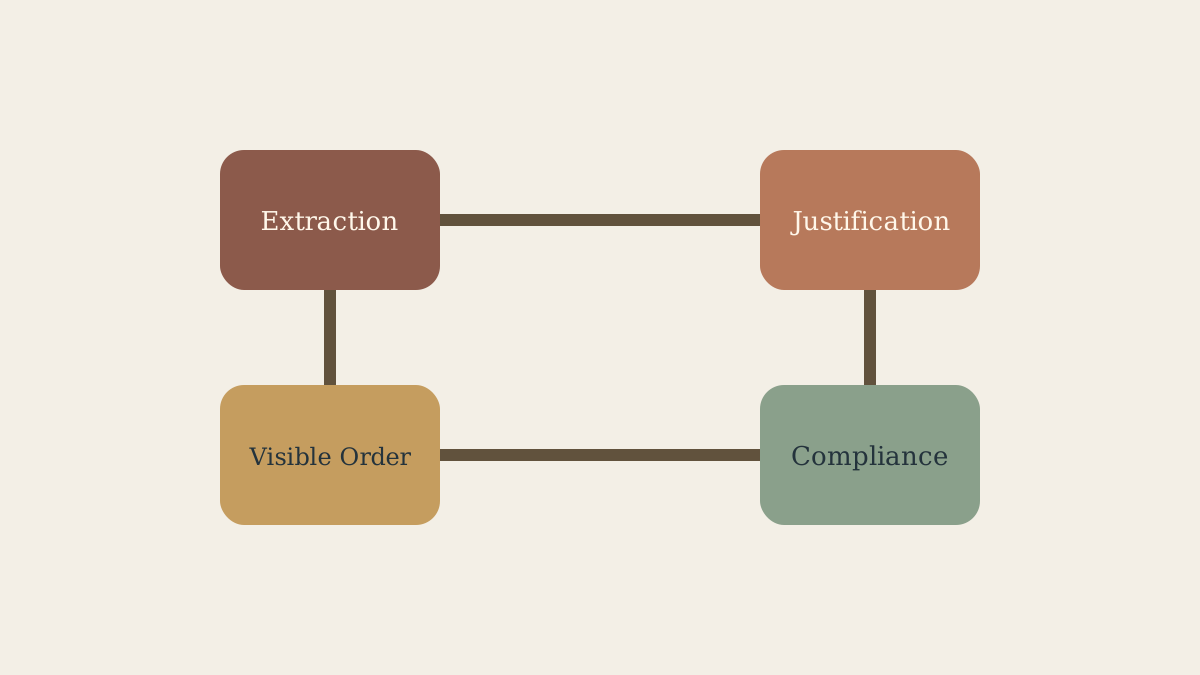
Capture alone does not create stable rule. A regime can extract grain, taxes, or labor for a time through coercion, but durable governability depends on whether extraction stays coupled to a believable order: security, ritual authority, legal continuity, redistribution, or at least predictable restraint.
The model is useful when a world can explain who takes value, but not why subjects, allies, or subordinate elites continue accepting that bargain instead of defecting, hiding output, or shifting loyalties.
| Axis | Question | Signal |
|---|---|---|
| Extraction visibility | How clearly do actors feel the burden being imposed? | Tax grain, levies, tolls, ration cuts, requisition, debt pressure |
| Justification frame | What story or rule claims that burden is acceptable? | Dynastic right, ritual order, military necessity, legal continuity, reciprocal protection |
| Visible order return | What does the regime visibly provide in exchange? | Road safety, famine buffering, arbitration, border defense, market stability |
| Compliance elasticity | How quickly does acceptance break once one of the other links fails? | Smuggling, tax evasion, elite defection, local autonomy, riot, quiet noncompliance |
The model matters because actors rarely tolerate burden in the abstract. They tolerate it when the burden remains legible inside a wider order that still appears to return security, predictability, or status. The return does not have to be fair, but it has to be visible enough that compliance feels cheaper than defection. Once that return vanishes, extraction quickly starts looking like naked predation.
The key failure pattern is decoupling. A regime keeps extracting, but its justification frays, or it still claims legitimacy while order visibly deteriorates. Once the burden and the story no longer match, compliance turns expensive and alliances become more conditional.
Ask three questions in order: who feels the burden most clearly, what story says that burden is acceptable, and what visible order still comes back in exchange? If one of those answers is weak, the regime may still function, but it is already paying a rising cost for compliance. The model becomes useful when that cost can be placed before open revolt appears.
Use this when you first need to explain how diffuse output becomes taxable or brokered leverage.
Alliance Fracture ModelUse this when legitimacy splits are now beginning to destabilize the coalition that enforces capture.
Administrative LoadUse this when the real issue is whether the regime can keep processing, counting, and enforcing at the scale it claims.
The reusable lesson is that stable rule depends on keeping burden, story, and visible order coupled tightly enough to remain plausible. Once those links loosen, extraction becomes more expensive and political fragmentation accelerates. The model is especially useful when a regime still looks orderly from the center but peripheral actors have already stopped experiencing burden and reward as part of the same bargain. That mismatch is often the decisive warning sign.
Read what should come before it, what relation role matters next, and where this page should hand you off after the local graph is clear.
Start with Surplus and then return here once the surrounding concept stack is clear.
These entries clarify the footing underneath the current node before you move outward again. Start with Surplus Capture Ladder when you want the clearest next role.
Return to broader lenses when this model is too specific for the question you are asking.
3 handoff nodes stay inside Governance And Power. 5 handoff nodes share Cross Scale.
Detail pages now expose the branch and scale of their surrounding graph before showing raw prerequisite and relation shelves, so continuation can stay taxonomy-led instead of adjacency-led.
Explain how resources, goods, labor, information, and force circulate, stall, buffer, and break.
Start from the resource-flow loop, trace storage and throughput models, compare one logistics study, then run a flow audit worksheet.
Explain how legitimacy, coercion, administrative reach, frontier bargaining, and elite control are structured.
Start with the pressure map, locate legitimacy and capture mechanisms, validate against a frontier or state case, then run a governance stress test.
Explain campaigns, sustainment, force projection, defensive depth, and operational windows as structural systems.
Start with sustainment and projection models, identify the theater cycle, validate through an operational case, then run an operations stress test.
Use this scale when the strongest explanation depends on several levels staying visible together.
Use this scale when the region is the main leverage unit for settlement, extraction, governance, or conflict.
Use this scale when the whole world model or planetary constraint pattern should stay visible at once.
Use prerequisites when you want the shortest path into the assumptions this page depends on.
Output that remains after immediate subsistence and maintenance needs are covered, making storage, exchange, taxation, or concentrated reinvestment possible.
The cumulative burden of governing, coordinating, recording, supplying, and enforcing order across a territory or institution.
These groups explain why each neighboring node matters, whether it stabilizes the concept, operationalizes it, proves it, or pushes the lane further.
Use foundation relations when this node depends on a concept, term, or framing layer that should be explicit before you branch further.
A model for how raw surplus becomes taxable, storable, and politically controllable through successive layers of capture.
The cumulative burden of governing, coordinating, recording, supplying, and enforcing order across a territory or institution.
Use applied relations when the next useful move is to see the current pattern survive inside a study or assembled world.
A systems study of how extreme environmental scarcity, mono-resource dependence, and interstellar transport control turn Arrakis into a concentrated power machine.
Use extension relations when the next move is not prerequisite or proof, but a deeper neighboring step in the same graph lane.
A model for how unequal exposure, diverging incentives, legitimacy disputes, and delayed losses turn a working coalition into a brittle one.
These entries still matter, but they currently rely on generic adjacency instead of typed continuation semantics.
A framework for mapping how flow, capture, legitimacy, coalition strain, and force sustainment combine into one escalating system rather than separate mechanics.
A model for comparing what different factions actually control across territory, movement, institutions, storage, and legitimacy rather than by abstract power labels.
Models formalize behavior. Use them when you need a concrete chain, loop, stress scenario, or layered mechanism that can be tested and reused.
A model should explain how something behaves over time or under pressure, not just identify a broad topic area.
When a setting feels plausible at rest but still behaves vaguely, models provide the explicit structure needed to test it.
A strong workflow often moves from broad lens to formal model to applied case reading.
Keep these collapsed until you want to turn the page into an active reading exercise.
What mechanism is this model making explicit?
Where does this model break or become most interesting under stress?
Which study would verify whether this model survives in a complete setting?
These routes are tuned to the kind of entry you are currently reading, so you can leave this page with one deliberate next move.
Return to broader lenses when this model is too specific for the question you are asking.
Cross-layer moveMove through the systems module when you want to navigate models by design intent.
Cross-layer moveVerify the model inside applied cases where multiple structures interact at once.