Preparing the current spcent route.
The page shell is online. Shared content and route data are still being assembled.
A civilization study of how fragmented crowns, frontier violence, uneven institutions, and residual nonhuman landscapes shape the Northern Kingdoms.
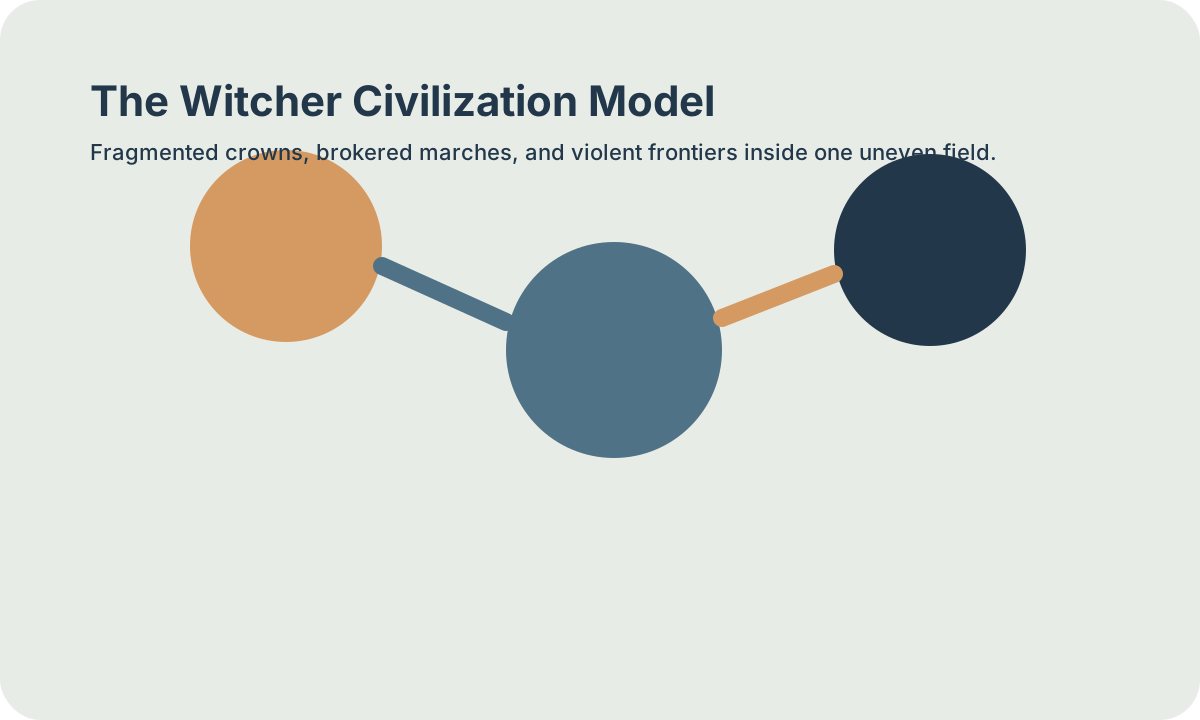
The Witcher setting is most coherent when read as a borderland civilization field rather than as a set of isolated kingdoms. Political authority is layered, contested, and regionally uneven.
Formal crowns exist, but their reach is filtered through forests, marches, river corridors, noble intermediaries, military disruption, and surviving nonhuman zones.
Frames the setting as a system of expansion pressure, administrative weakness, and recurrent frontier strain.
Terrain Settlement GradientExplains why dense agrarian cores and dangerous low-control regions coexist inside the same political space.
Frontier Chokepoint LedgerClarifies why bridges, passes, and border strongholds matter more than abstract linear frontiers.
The setting repeatedly shows a mismatch between nominal sovereignty and operational control. Capitals can issue commands, but corridor insecurity, elite bargaining, and frontier violence distort what rule looks like on the ground.
That is why the world feels politically unstable without collapsing into total chaos. Enough institutions survive to keep taxation, diplomacy, and war recognizable, but not enough to eliminate regional asymmetry.
| Axis | Question | Signal |
|---|---|---|
| Core sovereignty | Where does rule operate most directly? | Tax collection, courts, standing forces, dense settlement, road maintenance |
| Brokered sovereignty | Where is power mediated by local elites or military necessity? | Noble bargaining, delegated rule, fortified market towns, shifting loyalties |
| Frontier sovereignty | Where does rule become intermittent and violent? | Raid exposure, monster zones, disrupted trade, contested ethnicity, military corridor dependence |
The setting works because power thins gradually rather than switching cleanly from civilization to wilderness. Core crowns, brokered local orders, and violent frontier conditions overlap instead of replacing one another. That overlap gives the world political texture: rule is present, but expensive; institutions exist, but not everywhere at the same depth.
The useful lesson is that fantasy states feel more credible when they are treated as uneven operating systems rather than as solid map colors. Roads, river crossings, noble intermediaries, and dangerous outer zones should each change how sovereignty actually feels on the ground. The Witcher is valuable because it keeps that unevenness active without losing overall coherence.
The reusable lesson is that many fantasy settings become more believable when crowns are treated as uneven operating systems rather than omnipresent map colors.
The Witcher works structurally because it keeps sovereignty expensive, local, and corridor-dependent. Civilization exists, but it never becomes frictionless. That is why borders, monsters, roads, and local lords all feel like parts of the same world rather than separate genre layers. The setting's realism comes from persistent operating cost, not from perfect state reach. The crowns rule, but they rule through expensive corridors, bargains, and local exceptions. Authority exists, but it is always paying to remain present. Rule is real, yet never cheap. The world feels lived in because every layer of order still leaks at the edges. Power remains visible, but never total. That unfinished quality is what keeps the setting believable. Every road still carries uncertainty, toll, danger, and local negotiation.
Read what should come before it, what relation role matters next, and where this page should hand you off after the local graph is clear.
Start with Civilization Pressure Map and then return here once the surrounding concept stack is clear.
Use Civilization Pressure Map or the linked nodes below when you want to compare this page against neighboring parts of the graph.
Use Guides when the study should feed into a worksheet or structured revision sequence.
2 handoff nodes stay inside Governance And Power. 3 handoff nodes share Regional.
Detail pages now expose the branch and scale of their surrounding graph before showing raw prerequisite and relation shelves, so continuation can stay taxonomy-led instead of adjacency-led.
Explain how legitimacy, coercion, administrative reach, frontier bargaining, and elite control are structured.
Start with the pressure map, locate legitimacy and capture mechanisms, validate against a frontier or state case, then run a governance stress test.
Explain what the world is materially built from before politics, balance, or style are discussed.
Start in Worlds, read the anchor framework, open one regional model, validate with a complete study, then finish with a world assembly guide pass.
Use this scale when the region is the main leverage unit for settlement, extraction, governance, or conflict.
Use this scale when the strongest explanation depends on several levels staying visible together.
Use prerequisites when you want the shortest path into the assumptions this page depends on.
A framework for tracking expansion, consolidation, frontier friction, and institutional fatigue across a civilizational space.
A framework for reading how terrain friction and access gradients shape where settlement density can sustainably accumulate.
This entry still relies on generic related links. That works as a fallback, but typed relation roles would make continuation clearer.
A framework for tracking expansion, consolidation, frontier friction, and institutional fatigue across a civilizational space.
A framework for reading how terrain friction and access gradients shape where settlement density can sustainably accumulate.
A framework for tracking which passes, ports, narrows, and crossings decide political leverage at the edge of a system.
A sample systems study showing how basin agriculture, defensive ridges, and narrow passes produce a dense but brittle civilization pattern.
Studies apply Spcent's lenses to complete cases. Read them to see whether geography, surplus, corridors, and pressure patterns still make sense when placed inside one setting.
The goal is not to retain setting trivia. The goal is to extract reusable patterns and structural habits you can reapply elsewhere.
Studies are strongest when you already know the frameworks and models underneath them, so you can recognize the structural moves being made.
After reading a study, identify which layer of your own draft needs work and go back there with one concrete change in mind.
Keep these collapsed until you want to turn the page into an active reading exercise.
What are the decisive regions, corridors, or chokepoints in this case?
What keeps the studied world stable, and what makes it brittle?
Which model or framework do I need next if I want to reproduce this pattern in my own project?
These routes are tuned to the kind of entry you are currently reading, so you can leave this page with one deliberate next move.
Use Guides when the study should feed into a worksheet or structured revision sequence.
Cross-layer moveReturn to the worlds module when the case highlights a weak worldbuilding layer in your own draft.
Cross-layer moveOpen models when the case reveals a mechanism you want to isolate and reuse directly.