Preparing the current spcent route.
The page shell is online. Shared content and route data are still being assembled.
A structural study of how river systems, grain logistics, corridor warfare, and administrative concentration shape Three Kingdoms-style strategy worlds.
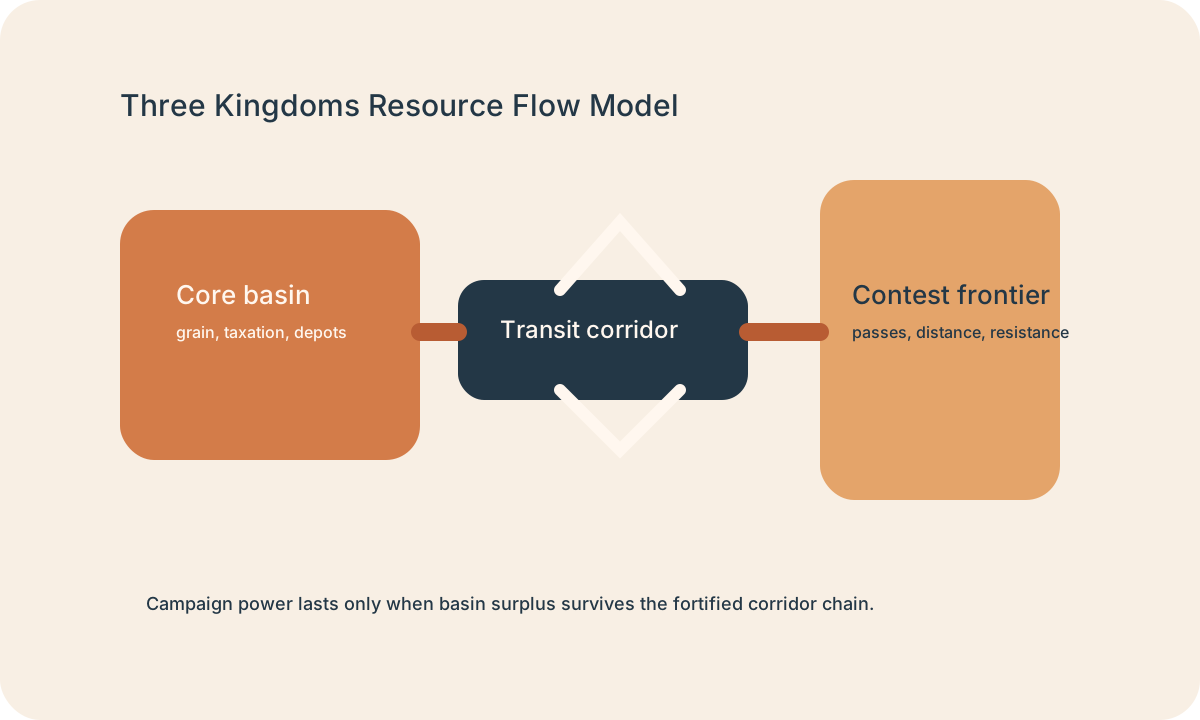
Three Kingdoms-style worlds are not defined only by famous generals or faction rivalries. They are defined by whether grain, troops, and command can move through river valleys, fortified corridors, and densely governed cores faster than rivals can disrupt them.
This makes them ideal studies in resource flow under military pressure. Campaigns succeed when logistics, corridor timing, and administrative concentration align.
Dense agriculture and administration create the warehouse depth that campaigns feed on.
Rivers, roads, and fortified gates convert basin surplus into operational reach and campaign timing.
Distance, passes, and fragmented control increase drag until expansion stops feeling cheap.
Provides the regional frame for comparing dense river basins, contested passes, and thin frontier belts.
Resource Flow LoopExplains how grain, transport, storage, and redistribution become the real substrate of campaign power.
Settlement Corridor StackClarifies why repeated movement lines harden into campaign corridors and strategic cities.
The key pattern is that military and administrative geography overlap but not perfectly. Fertile regions generate the surplus that campaigns need, while passes and river gates decide whether that surplus can be turned into operational reach.
This creates a strategic world where battles matter, but corridor control matters longer. A commander wins decisively only when movement, supply, and political consolidation can keep up with the battlefield result.
| Axis | Question | Signal |
|---|---|---|
| Core basin | Where is campaign capacity generated? | Dense agriculture, taxation centers, warehouse depth, trained administration |
| Transit corridor | How does capacity become reach? | River movement, road chains, fortified crossings, relay cities, escort demand |
| Contest frontier | Where does expansion become expensive? | Long lines, local resistance, supply drag, difficult passes, fragmented control |
The reusable lesson is that strategy worlds feel deep when warfare is constrained by the same circulation logic that produces wealth and stability.
Three Kingdoms works structurally because it ties political ambition to movement capacity. Territory matters, but only insofar as it changes the flow of grain, troops, and command.
Read what should come before it, what relation role matters next, and where this page should hand you off after the local graph is clear.
Start with Regional Systems Matrix and then return here once the surrounding concept stack is clear.
Use Regional Systems Matrix or the linked nodes below when you want to compare this page against neighboring parts of the graph.
Use Guides when the study should feed into a worksheet or structured revision sequence.
1 handoff nodes stay inside Flow And Logistics. 2 handoff nodes share Regional.
Detail pages now expose the branch and scale of their surrounding graph before showing raw prerequisite and relation shelves, so continuation can stay taxonomy-led instead of adjacency-led.
Explain what the world is materially built from before politics, balance, or style are discussed.
Start in Worlds, read the anchor framework, open one regional model, validate with a complete study, then finish with a world assembly guide pass.
Explain how resources, goods, labor, information, and force circulate, stall, buffer, and break.
Start from the resource-flow loop, trace storage and throughput models, compare one logistics study, then run a flow audit worksheet.
Explain how legitimacy, coercion, administrative reach, frontier bargaining, and elite control are structured.
Start with the pressure map, locate legitimacy and capture mechanisms, validate against a frontier or state case, then run a governance stress test.
Use this scale when the region is the main leverage unit for settlement, extraction, governance, or conflict.
Use this scale when the strongest explanation depends on several levels staying visible together.
Use this scale when routes, relays, buffers, and linked nodes matter more than territorial bulk.
Use prerequisites when you want the shortest path into the assumptions this page depends on.
A planning frame for mapping how geography, settlement, resources, and transit form a region's structural identity.
A model for how extraction, transport, storage, transformation, and redistribution create stability or fragility in a world system.
This entry still relies on generic related links. That works as a fallback, but typed relation roles would make continuation clearer.
A planning frame for mapping how geography, settlement, resources, and transit form a region's structural identity.
A model for how extraction, transport, storage, transformation, and redistribution create stability or fragility in a world system.
A layered model for understanding how roads, rivers, passes, and market towns align into durable spatial corridors.
A framework for tracking expansion, consolidation, frontier friction, and institutional fatigue across a civilizational space.
Studies apply Spcent's lenses to complete cases. Read them to see whether geography, surplus, corridors, and pressure patterns still make sense when placed inside one setting.
The goal is not to retain setting trivia. The goal is to extract reusable patterns and structural habits you can reapply elsewhere.
Studies are strongest when you already know the frameworks and models underneath them, so you can recognize the structural moves being made.
After reading a study, identify which layer of your own draft needs work and go back there with one concrete change in mind.
Keep these collapsed until you want to turn the page into an active reading exercise.
What are the decisive regions, corridors, or chokepoints in this case?
What keeps the studied world stable, and what makes it brittle?
Which model or framework do I need next if I want to reproduce this pattern in my own project?
These routes are tuned to the kind of entry you are currently reading, so you can leave this page with one deliberate next move.
Use Guides when the study should feed into a worksheet or structured revision sequence.
Cross-layer moveReturn to the worlds module when the case highlights a weak worldbuilding layer in your own draft.
Cross-layer moveOpen models when the case reveals a mechanism you want to isolate and reuse directly.