Preparing the current spcent route.
The page shell is online. Shared content and route data are still being assembled.
A fiction study of how corridor distance, seasonal agriculture, dynastic delegation, and frontier asymmetry make Westeros a realm that can unify formally while fracturing operationally.
Westeros is not best read as a single kingdom with colorful regional variation. It is a long corridor realm whose nominal unity repeatedly outruns its operational reach.
Distance, seasonal storage, dynastic delegation, and frontier asymmetry all matter more than crown symbolism alone. The center can claim the whole map, but it cannot govern every zone with the same cost profile.
Clarifies why royal authority, noble houses, military retainers, and regional customs each control different layers of the realm.
Institutional Residue MapShows how old roads, castles, oaths, and border memories keep shaping later politics even when rulers change.
Frontier BeltProvides the cleanest lens for understanding why the Wall, the Iron Islands, and the Dornish edge behave differently from the agrarian core.
The strongest pattern is delegated cohesion. The realm stays legible because great houses translate royal order into regional administration, taxation, and military obligation. That same delegation also creates the main fracture lines.
When succession weakens, harvests fail, or corridor security breaks, regional power immediately reappears as the true operating structure. Unity survives best in law and ceremony, not always in material control.
| Axis | Question | Signal |
|---|---|---|
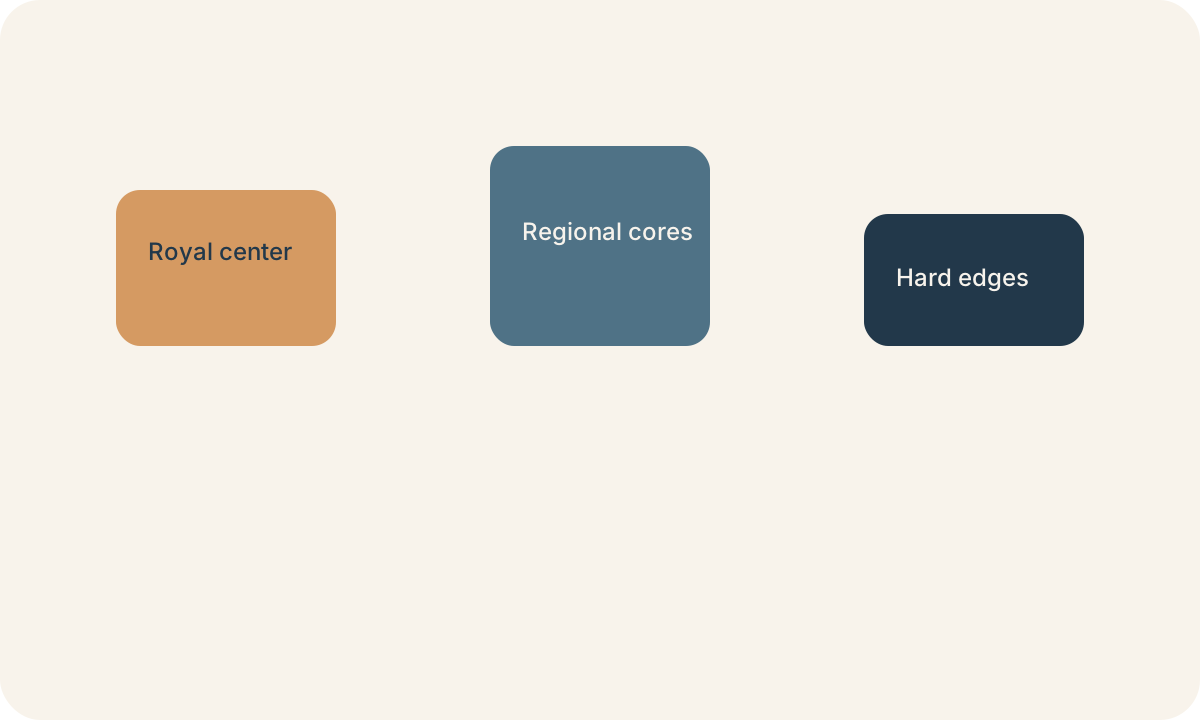
| Royal center | What can the crown coordinate directly? | Capital bureaucracy, court alliances, road command, symbolic legitimacy, tax claims |
| Regional core | Where do great houses govern with low enough local friction to be durable? | Castle networks, agrarian surplus, bannermen, hereditary offices, fortified seats |
| March zone | Where does rule depend on military posture and negotiated loyalty? | Border keeps, raid corridors, oath instability, thin settlement, escort demand |
| Hard edge | Where does formal unity become most expensive to enforce? | Maritime raiding, frozen frontier, desert resistance, chronic distance, weak storage depth |
The reusable lesson is that feudal worlds feel believable when central sovereignty is real but unevenly translated through corridor distance, seasonal agriculture, and delegated local control.
Westeros works structurally because its fractures are not random betrayal alone. They emerge from a realm whose symbolic unity is always stronger than its cheapest form of practical governance.
Read what should come before it, what relation role matters next, and where this page should hand you off after the local graph is clear.
Start with Control Surface Matrix and then return here once the surrounding concept stack is clear.
Use Control Surface Matrix or the linked nodes below when you want to compare this page against neighboring parts of the graph.
Use Guides when the study should feed into a worksheet or structured revision sequence.
2 handoff nodes stay inside Governance And Power. 3 handoff nodes share Regional.
Detail pages now expose the branch and scale of their surrounding graph before showing raw prerequisite and relation shelves, so continuation can stay taxonomy-led instead of adjacency-led.
Explain how legitimacy, coercion, administrative reach, frontier bargaining, and elite control are structured.
Start with the pressure map, locate legitimacy and capture mechanisms, validate against a frontier or state case, then run a governance stress test.
Explain campaigns, sustainment, force projection, defensive depth, and operational windows as structural systems.
Start with sustainment and projection models, identify the theater cycle, validate through an operational case, then run an operations stress test.
Explain what the world is materially built from before politics, balance, or style are discussed.
Start in Worlds, read the anchor framework, open one regional model, validate with a complete study, then finish with a world assembly guide pass.
Use this scale when the region is the main leverage unit for settlement, extraction, governance, or conflict.
Use this scale when the strongest explanation depends on several levels staying visible together.
Use prerequisites when you want the shortest path into the assumptions this page depends on.
A model for comparing what different factions actually control across territory, movement, institutions, storage, and legitimacy rather than by abstract power labels.
A model for tracing which roads, archives, forts, cadasters, cults, and legal habits survive from earlier eras and continue to structure the present.
This entry still relies on generic related links. That works as a fallback, but typed relation roles would make continuation clearer.
A model for comparing what different factions actually control across territory, movement, institutions, storage, and legitimacy rather than by abstract power labels.
A broad transition band where direct control, corridor security, settlement density, and competing claims remain structurally unstable.
A model for tracing which roads, archives, forts, cadasters, cults, and legal habits survive from earlier eras and continue to structure the present.
A framework for reading how terrain friction and access gradients shape where settlement density can sustainably accumulate.
Studies apply Spcent's lenses to complete cases. Read them to see whether geography, surplus, corridors, and pressure patterns still make sense when placed inside one setting.
The goal is not to retain setting trivia. The goal is to extract reusable patterns and structural habits you can reapply elsewhere.
Studies are strongest when you already know the frameworks and models underneath them, so you can recognize the structural moves being made.
After reading a study, identify which layer of your own draft needs work and go back there with one concrete change in mind.
Keep these collapsed until you want to turn the page into an active reading exercise.
What are the decisive regions, corridors, or chokepoints in this case?
What keeps the studied world stable, and what makes it brittle?
Which model or framework do I need next if I want to reproduce this pattern in my own project?
These routes are tuned to the kind of entry you are currently reading, so you can leave this page with one deliberate next move.
Use Guides when the study should feed into a worksheet or structured revision sequence.
Cross-layer moveReturn to the worlds module when the case highlights a weak worldbuilding layer in your own draft.
Cross-layer moveOpen models when the case reveals a mechanism you want to isolate and reuse directly.