Pulling this page together.
Preparing content, navigation, and supporting references for this route.
Preparing content, navigation, and supporting references for this route.
An advanced science-fiction study of how infrastructure advantage, communication compression, and selective peripheral integration can stabilize rule at long distance without evenly occupying every region.
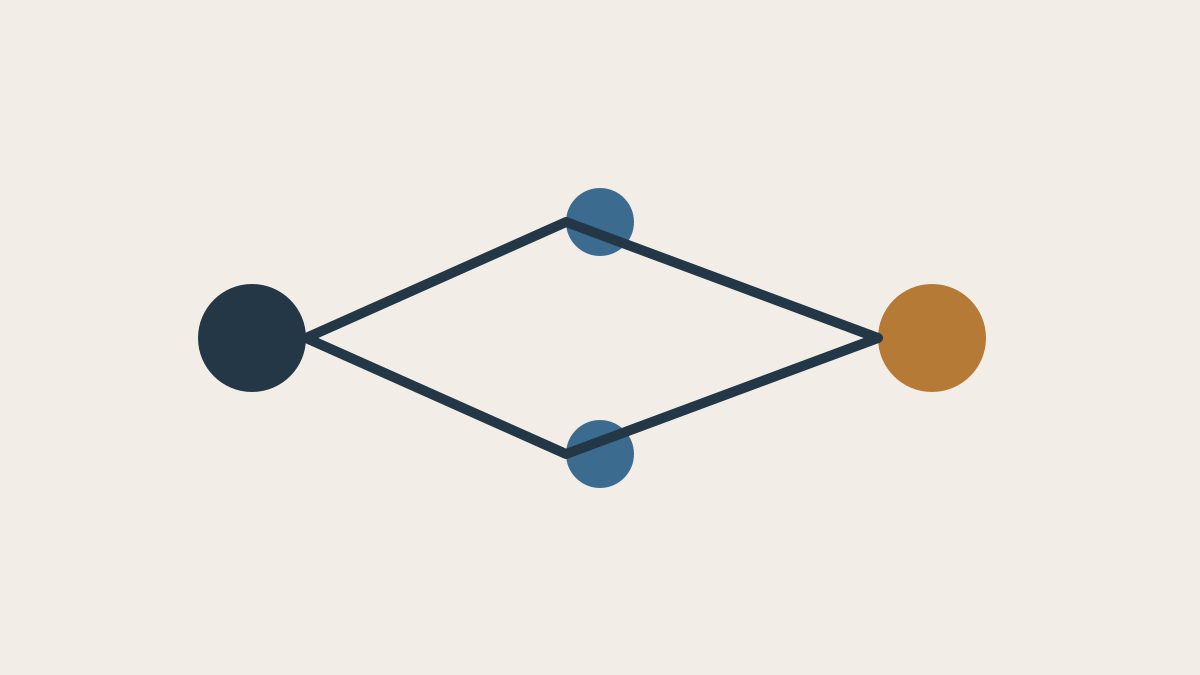
Foundation is a strong advanced case because it shows a successor order stabilizing from infrastructural and coordination advantage rather than from symmetrical territorial occupation. The key leverage lies in changing how communication, production knowledge, and peripheral dependence are organized.
That makes the case more than a collapse story. It is also a study of reassembly and infrastructure rewrite.
Use this first when you need to locate which pressure surface the successor order is actually stabilizing before you compare peripheral control patterns.
Infrastructure Rewrite RegimeFrames the case as a shift in the dominant substrate of coordination and control.
Polycentric Empire Stability ModelExplains how a successor order bargains with and reorganizes strong peripheral nodes instead of flattening them immediately.
Historical Transformation FrameworkPlaces the case within a larger shift from decaying imperial reproduction to successor-system assembly.
Compared with direct territorial empires, Foundation's control model is selective and substrate-heavy. It does not need to administer every peripheral layer equally at the outset. It needs enough infrastructural leverage and enough perceived inevitability that peripheral systems begin organizing themselves around the successor order.
| Axis | Question | Signal |
|---|---|---|
| Substrate advantage | What infrastructure or technical stack makes coordination newly asymmetric? | Knowledge monopolies, superior production, faster routing, harder-to-replace technical systems |
| Selective integration | Which peripheral actors are made dependent rather than directly conquered? | Client systems, brokered alliances, technical servicing, trade locks, standardized platforms |
| Successor legitimacy | Why do peripheral regions treat the new order as preferable or inevitable? | Stability promise, repair capability, predictability, elite buy-in, corridor restoration |
The same successor order looks durable or thin depending on whether the replacement layer is monopolized, contested, or becoming reproducible elsewhere.
Peripheral actors still need repair, routing, and coordination services they cannot cheaply replace, so alignment follows technical dependence.
The case works because the successor order does not try to fill every region with equal administrative density. Instead it changes the infrastructure and coordination terms on which peripheral actors must operate. Once enough systems depend on the new substrate for repair, communication, or reliable exchange, political alignment begins to follow technical dependence rather than preceding it.
This makes the setting useful beyond its specific fiction. It shows how uneven control can still be durable when the center dominates the replacement layer that everyone else needs to keep functioning.
Start by resisting the temptation to read Foundation as simple farsightedness or civilizational prestige. The stronger reading is operational. What replacement layer does the successor order own? Which peripheral actors still need that layer to communicate, repair, trade, or coordinate? Which parts of the old imperial geography can now be left thin because dependence has already moved elsewhere?
Then compare the case against a denser territorial empire. The useful distinction is not soft control versus hard control. It is old substrate versus replacement substrate. The successor order wins because it controls the infrastructure and knowledge layer that peripheral actors cannot cheaply reproduce on their own, so influence arrives through dependence before it arrives through uniform administration.
Selective peripheral control only works while the new substrate keeps looking more reliable than the decaying alternatives. If infrastructure advantage narrows or peripheral actors develop viable independent substitutes, the same loose structure can turn from elegant leverage into thin overstretch.
This is also why the case should not be misread as proof that soft control is always cheaper. It is cheaper only when the center still owns the replacement layer that peripheral actors cannot casually rebuild. Once that monopoly weakens, local autonomy stops looking like delegated order and starts looking like irreversible drift.
One common misread is to think the case proves peripheral control can ignore logistics because infrastructure has become abstract. The opposite is true. The whole pattern works only because infrastructure, communication, and technical servicing remain concrete dependencies. Another misread is to treat the successor order as omnipresent. It is powerful precisely because it does not have to be equally present everywhere at the start. It only has to remain decisive at the layers everyone else is forced to use.
It is also easy to overread inevitability. Peripheral actors align not because the successor order is mystically destined to win, but because the replacement layer keeps delivering reliability, repair, and coordination more credibly than the decaying alternative. If that credibility slips, the same selective system becomes vulnerable to fragmentation.
This study is the useful companion to Polycentric Empire Stability Model because it shows the same bargaining problem from the side of substrate ownership. The model asks when a regional center becomes independently viable. Foundation answers by showing what happens when one successor order controls the replacement layer that other regions still cannot cheaply reproduce. That turns bargaining geometry into a concrete control pattern instead of leaving it at the level of abstract comparison.
Read the pair in sequence when the governance question is no longer whether the center is strong, but what exactly keeps the periphery from pricing out integration. The model names the stability tensions. The study shows how one order keeps winning those tensions through infrastructure dependence, repair credibility, and selective rather than uniform administrative density.
The reusable lesson is that successor orders can scale through substrate control before they scale through uniform administration. This case helps expert readers reason about long-distance control, peripheral bargaining, and reassembly after imperial decline. It is especially useful for worlds where the center looks light-touch on the surface but remains decisive because it controls the infrastructure layer that everyone else is still forced to use. That is what makes the loose order durable. The center wins by owning necessity before it owns every province.