Preparing the current spcent route.
The page shell is online. Shared content and route data are still being assembled.
A systems study of how logistics, sovereignty, industrial specialization, and route security make EVE Online's economy behave like a territorial network rather than a simple market.
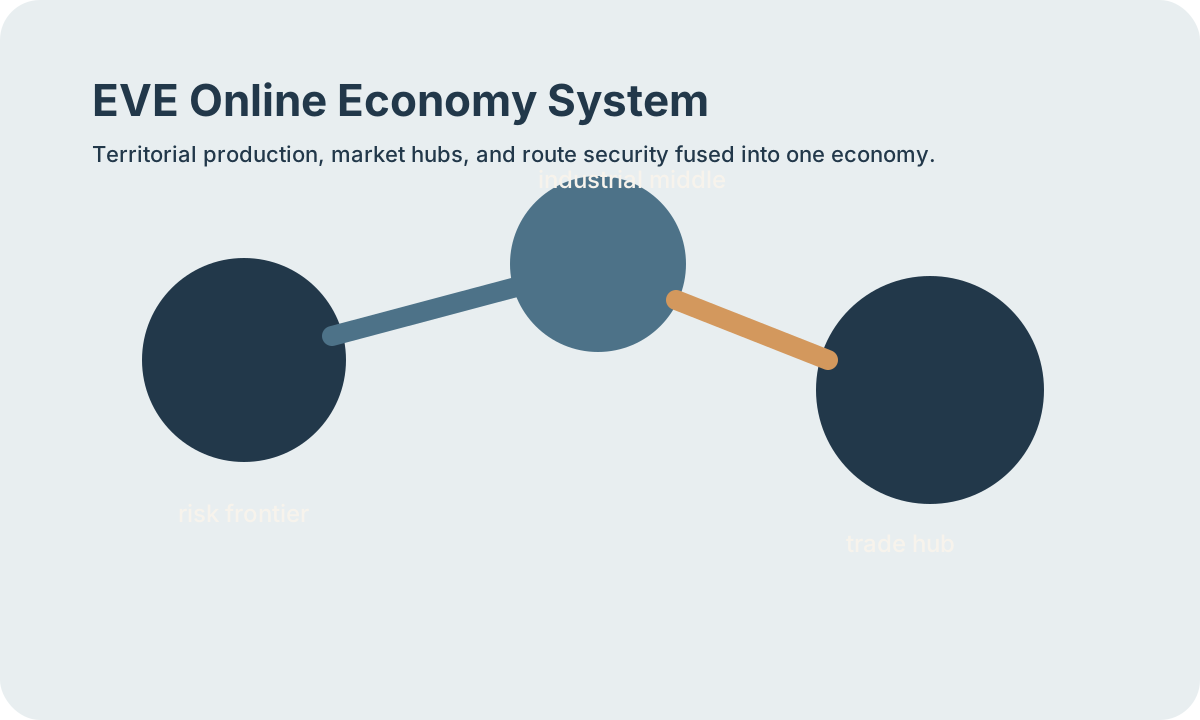
EVE Online is not just a player market with spaceships attached. It is a territorial economy in which geography, transport risk, sovereignty, and industrial concentration all shape what a market can actually do.
Value is created in different security environments, refined through uneven industrial chains, and moved through route networks where chokepoints and interdiction are permanently relevant.
Provides the cleanest frame for tracing value from extraction through hauling, storage, industry, and redistribution.
Surplus Capture LadderExplains how alliances and market hubs convert dispersed production into durable power.
Topology Stress TestClarifies why route denial, congestion, and gateway control reshape the whole economy rather than only local fights.
The strongest pattern is unequal security geography. Different spaces support different profit profiles, but they also impose different exposure, hauling cost, and coordination burden.
That keeps the economy structural. Industrial strength is not only about production efficiency. It is about whether an organization can defend corridors, maintain logistics discipline, and absorb disruption long enough to hold market position.
| Axis | Question | Signal |
|---|---|---|
| Protected exchange | Where is pricing most legible and liquid? | Large trade hubs, dense brokerage, low disruption tolerance, high throughput concentration |
| Industrial middle | Where is value transformed and buffered? | Refining chains, staged hauling, storage nodes, alliance logistics |
| Risk frontier | Where does profit depend on territorial exposure? | Extraction danger, gate control, escort requirements, sovereignty defense |
The reusable lesson is that an economy becomes strategically deep when markets, logistics, and territory obey one another's constraints.
EVE works structurally because price signals, alliance power, and war logistics are all moving through the same graph.
Read what should come before it, what relation role matters next, and where this page should hand you off after the local graph is clear.
Start with Resource Flow Loop and then return here once the surrounding concept stack is clear.
Use Resource Flow Loop or the linked nodes below when you want to compare this page against neighboring parts of the graph.
Use Guides when the study should feed into a worksheet or structured revision sequence.
2 handoff nodes stay inside Flow And Logistics. 2 handoff nodes share Network.
Detail pages now expose the branch and scale of their surrounding graph before showing raw prerequisite and relation shelves, so continuation can stay taxonomy-led instead of adjacency-led.
Explain how resources, goods, labor, information, and force circulate, stall, buffer, and break.
Start from the resource-flow loop, trace storage and throughput models, compare one logistics study, then run a flow audit worksheet.
Explain how topology, region graphs, corridors, map abstraction, and scale determine movement and leverage.
Start in Spatial, reduce the map into region graph and corridor logic, test topology under disruption, then return through a spatial design guide.
Use this scale when the strongest explanation depends on several levels staying visible together.
Use this scale when routes, relays, buffers, and linked nodes matter more than territorial bulk.
Use prerequisites when you want the shortest path into the assumptions this page depends on.
A model for how extraction, transport, storage, transformation, and redistribution create stability or fragility in a world system.
A model for testing how a spatial layout behaves under congestion, disruption, seasonal shifts, and asymmetric pressure.
This entry still relies on generic related links. That works as a fallback, but typed relation roles would make continuation clearer.
A model for how extraction, transport, storage, transformation, and redistribution create stability or fragility in a world system.
A model for how raw surplus becomes taxable, storable, and politically controllable through successive layers of capture.
A spatial abstraction that represents regions as connected nodes so adjacency, flow, and chokepoints can be reasoned about systematically.
A model for testing how a spatial layout behaves under congestion, disruption, seasonal shifts, and asymmetric pressure.
Studies apply Spcent's lenses to complete cases. Read them to see whether geography, surplus, corridors, and pressure patterns still make sense when placed inside one setting.
The goal is not to retain setting trivia. The goal is to extract reusable patterns and structural habits you can reapply elsewhere.
Studies are strongest when you already know the frameworks and models underneath them, so you can recognize the structural moves being made.
After reading a study, identify which layer of your own draft needs work and go back there with one concrete change in mind.
Keep these collapsed until you want to turn the page into an active reading exercise.
What are the decisive regions, corridors, or chokepoints in this case?
What keeps the studied world stable, and what makes it brittle?
Which model or framework do I need next if I want to reproduce this pattern in my own project?
These routes are tuned to the kind of entry you are currently reading, so you can leave this page with one deliberate next move.
Use Guides when the study should feed into a worksheet or structured revision sequence.
Cross-layer moveReturn to the worlds module when the case highlights a weak worldbuilding layer in your own draft.
Cross-layer moveOpen models when the case reveals a mechanism you want to isolate and reuse directly.