Preparing the current spcent route.
The page shell is online. Shared content and route data are still being assembled.
A model for preserving corridor structure, territorial reach, and movement cost when a world is discretized into hexes.
Hex space works well when the lattice preserves the world's real corridor logic instead of flattening it into uniform adjacency.
The point of discretization is not to erase geography. It is to compress geography into a playable or legible unit system while keeping the decisive differences between river corridors, open plains, defended crossings, and hard edges intact.
That means a hex lattice should inherit the world first and simplify it second. If the lattice is designed before the corridor system, settlement rhythm, and movement costs are understood, the grid may become tidy while the world itself becomes strategically empty.
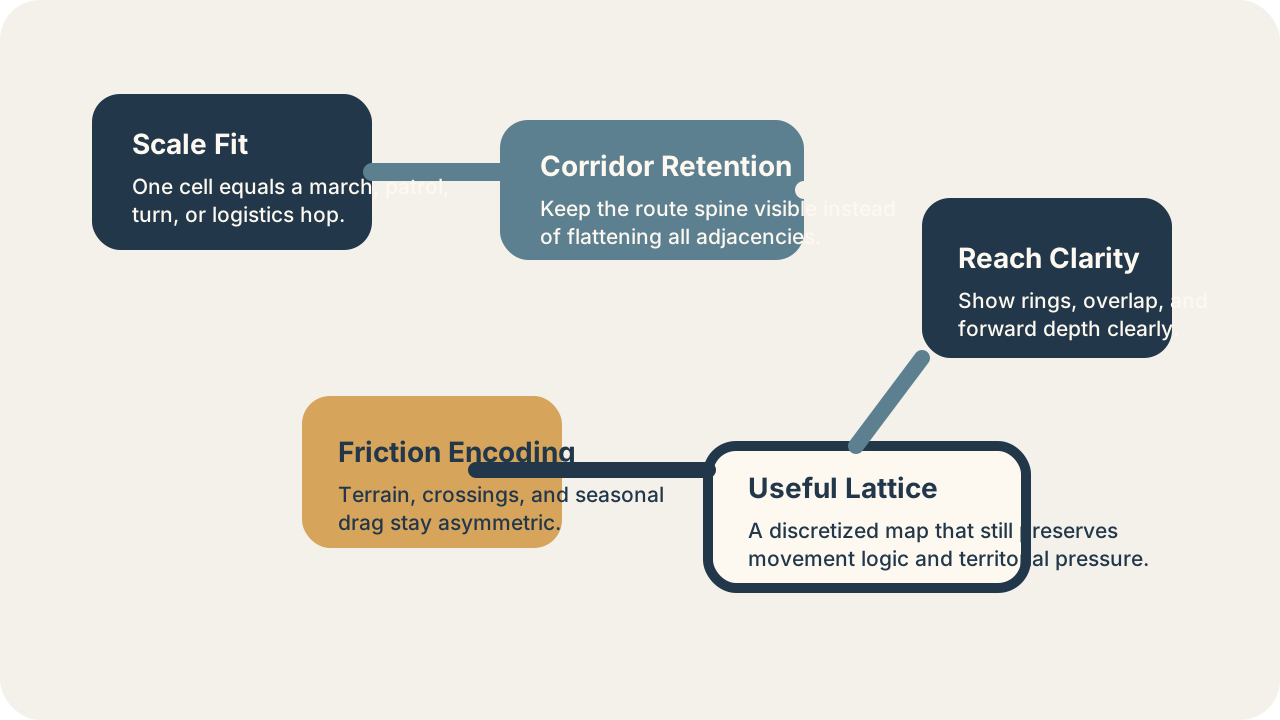
Tie one hex to a real movement or administration budget such as a march day, patrol ring, convoy hop, or district workload.
Make rivers, roads, and pass chains legible inside the lattice so major corridors remain more than just a string of equivalent neighbors.
Encode terrain drag, crossings, and seasonal shifts so some directions are still cheaper, safer, or more durable than others.
Use the lattice to reveal how influence, escort depth, and border pressure expand outward rather than merely counting distance.
| Axis | Question | Signal |
|---|---|---|
| Scale fit | What real distance or time does one hex represent? | Campaign turn, march day, patrol radius, supply hop |
| Corridor retention | How is the main route spine kept visible inside the lattice? | Weighted movement lanes, terrain bands, road-linked hex chains |
| Reach clarity | How does the lattice make influence readable? | Ring distance, zone overlap, border tension, forward depth |
| Friction encoding | How are asymmetries kept alive? | Terrain penalties, river crossings, chokepoint hexes, seasonal cost shifts |
The lattice becomes useful when it helps the reader compare territory without hiding why territory differs. A basin core should still look easier to traverse and supply than a march of thin roads, scattered depots, and costly river crossings.
This is also why lattice quality is not measured by symmetry alone. A good lattice lets players or readers quickly understand where movement bunches, where defense compounds, and where expansion stops being cheap. If those judgments disappear, the model has failed even if the map still looks orderly.
Explains the movement spine the lattice must preserve if it is to remain strategically meaningful.
Route HierarchyHelps distinguish primary lanes from feeder and fallback movement paths inside the hex field.
Regional Systems MatrixProvides the regional substrate whose density and infrastructure the lattice is simplifying.
The reusable lesson is that discretization should clarify strategic structure rather than replace it. Hexes work when they make corridor pressure, frontier depth, and movement friction easier to read.
Use this model whenever a world needs spatial compression for gameplay, simulation, or planning, but still has to preserve the deeper differences between core zones, relay chains, and hard territorial edges.
Read what should come before it, what relation role matters next, and where this page should hand you off after the local graph is clear.
Start with Corridor and then return here once the surrounding concept stack is clear.
Use Corridor or the linked nodes below when you want to compare this page against neighboring parts of the graph.
Return to broader lenses when this model is too specific for the question you are asking.
3 handoff nodes stay inside Spatial Structures. 1 handoff nodes share Regional.
Detail pages now expose the branch and scale of their surrounding graph before showing raw prerequisite and relation shelves, so continuation can stay taxonomy-led instead of adjacency-led.
Explain how topology, region graphs, corridors, map abstraction, and scale determine movement and leverage.
Start in Spatial, reduce the map into region graph and corridor logic, test topology under disruption, then return through a spatial design guide.
Explain what the world is materially built from before politics, balance, or style are discussed.
Start in Worlds, read the anchor framework, open one regional model, validate with a complete study, then finish with a world assembly guide pass.
Use this scale when routes, relays, buffers, and linked nodes matter more than territorial bulk.
Use this scale when the region is the main leverage unit for settlement, extraction, governance, or conflict.
Use prerequisites when you want the shortest path into the assumptions this page depends on.
A durable movement spine where terrain, settlement, exchange, and repeated transit align strongly enough to guide long-run circulation.
The ranked structure by which some routes function as primary spines while others act as feeder, secondary, seasonal, or fallback paths.
This entry still relies on generic related links. That works as a fallback, but typed relation roles would make continuation clearer.
A durable movement spine where terrain, settlement, exchange, and repeated transit align strongly enough to guide long-run circulation.
The ranked structure by which some routes function as primary spines while others act as feeder, secondary, seasonal, or fallback paths.
A model for comparing how many viable substitutes exist between important nodes and how quickly a topology collapses when one edge is lost.
A planning frame for mapping how geography, settlement, resources, and transit form a region's structural identity.
Models formalize behavior. Use them when you need a concrete chain, loop, stress scenario, or layered mechanism that can be tested and reused.
A model should explain how something behaves over time or under pressure, not just identify a broad topic area.
When a setting feels plausible at rest but still behaves vaguely, models provide the explicit structure needed to test it.
A strong workflow often moves from broad lens to formal model to applied case reading.
Keep these collapsed until you want to turn the page into an active reading exercise.
What mechanism is this model making explicit?
Where does this model break or become most interesting under stress?
Which study would verify whether this model survives in a complete setting?
These routes are tuned to the kind of entry you are currently reading, so you can leave this page with one deliberate next move.
Return to broader lenses when this model is too specific for the question you are asking.
Cross-layer moveMove through the systems module when you want to navigate models by design intent.
Cross-layer moveVerify the model inside applied cases where multiple structures interact at once.