Preparing the current spcent route.
The page shell is online. Shared content and route data are still being assembled.
A model for comparing how many viable substitutes exist between important nodes and how quickly a topology collapses when one edge is lost.
Two maps can look equally connected while behaving very differently under stress. The topological redundancy matrix compares how many substitutes really exist and how costly they are.
A substitute route only matters if it preserves enough capacity, timing, and safety to keep the same relation alive. A long seasonal detour is not equivalent to a permanent protected corridor, even if both can be drawn as alternative edges on a map.
This model therefore treats redundancy as graded rather than binary. It is less interested in abstract connectivity than in whether a topology can keep functioning when one critical edge is cut, flooded, blockaded, or politically denied.
Locate the crossing, pass, harbor, or corridor whose loss would most sharply reorder movement.
Measure detour length, carrying capacity, security, and seasonal availability rather than counting paths equally.
Ask whether the reroute preserves the same relation or only a weaker, slower, or shorter-lived version of it.
| Axis | Question | Signal |
|---|---|---|
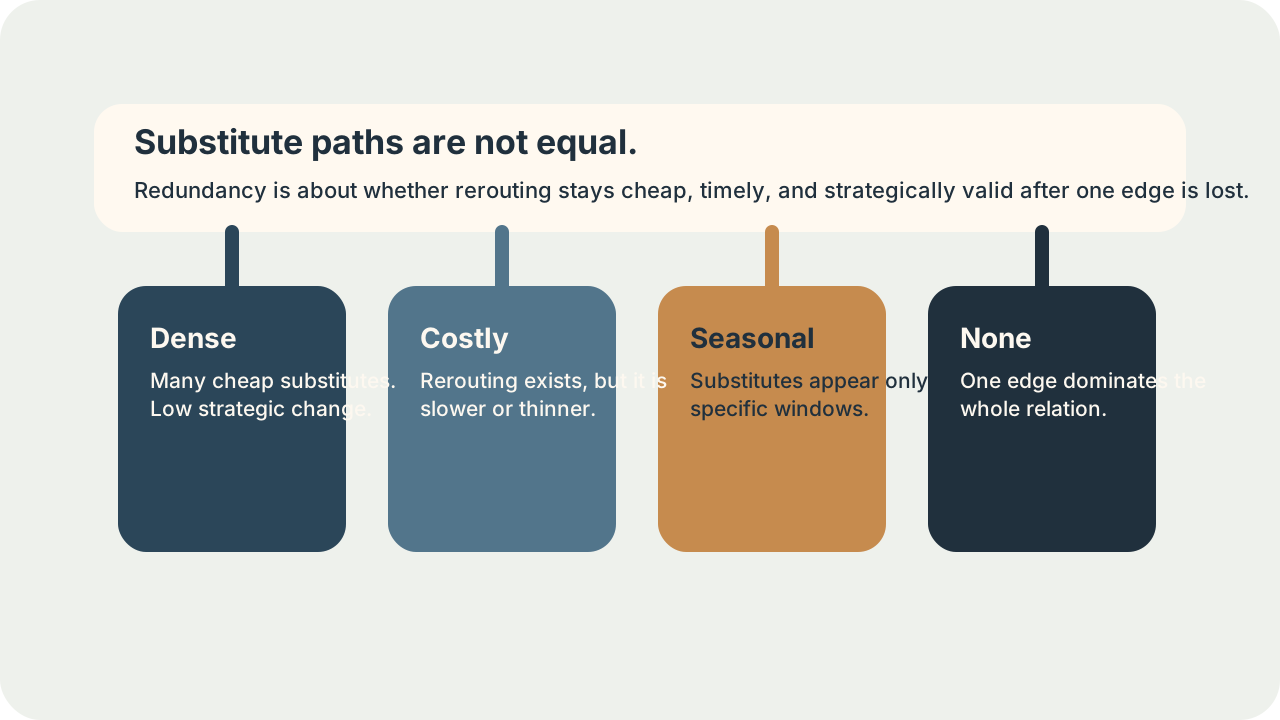
| Dense substitute | Can traffic reroute cheaply with little strategic change? | Multiple parallel edges, short detours, stable alternative nodes |
| Costly substitute | Is rerouting possible but materially worse? | Long detours, slower passage, thinner depots, weaker protection |
| Seasonal substitute | Does substitution only exist in certain windows? | Dry-season tracks, navigable periods, temporary bridges, weather windows |
| No substitute | Does one edge dominate the whole relation? | Single pass, one estuary gate, isolated crossing, collapse under closure |
Dense substitute networks create resilience because failure shifts movement sideways without changing the wider strategic picture much. Costly and seasonal substitutes are different: they preserve motion in principle but rewrite price, timing, escort demand, and exposure.
The most dangerous case is when an edge looks optional on the map but behaves as singular in practice. That mismatch is where topologies feel most deceptive, because the surface suggests flexibility while the system underneath is one closure away from collapse.
Provides the base network abstraction whose substitute paths can be compared.
Route HierarchyShows whether substitutes live on the same tier or only on much weaker feeder routes.
Topology Stress TestTests whether the matrix's predicted substitute quality holds under actual disruption scenarios.
The reusable lesson is that topologies should be judged by substitution quality, not just by the number of visible connections. This makes the matrix useful for maps, logistics systems, defense plans, and world regions alike.
Use it when you need to know whether disruption changes route choice a little or rewrites the whole strategic theater.
Read what should come before it, what relation role matters next, and where this page should hand you off after the local graph is clear.
Start with Region Graph and then return here once the surrounding concept stack is clear.
Use Region Graph or the linked nodes below when you want to compare this page against neighboring parts of the graph.
Return to broader lenses when this model is too specific for the question you are asking.
4 handoff nodes stay inside Spatial Structures. 3 handoff nodes share Network.
Detail pages now expose the branch and scale of their surrounding graph before showing raw prerequisite and relation shelves, so continuation can stay taxonomy-led instead of adjacency-led.
Explain how topology, region graphs, corridors, map abstraction, and scale determine movement and leverage.
Start in Spatial, reduce the map into region graph and corridor logic, test topology under disruption, then return through a spatial design guide.
Use this scale when routes, relays, buffers, and linked nodes matter more than territorial bulk.
Use this scale when the strongest explanation depends on several levels staying visible together.
Use prerequisites when you want the shortest path into the assumptions this page depends on.
A spatial abstraction that represents regions as connected nodes so adjacency, flow, and chokepoints can be reasoned about systematically.
The ranked structure by which some routes function as primary spines while others act as feeder, secondary, seasonal, or fallback paths.
This entry still relies on generic related links. That works as a fallback, but typed relation roles would make continuation clearer.
A spatial abstraction that represents regions as connected nodes so adjacency, flow, and chokepoints can be reasoned about systematically.
The ranked structure by which some routes function as primary spines while others act as feeder, secondary, seasonal, or fallback paths.
A model for testing how a spatial layout behaves under congestion, disruption, seasonal shifts, and asymmetric pressure.
A durable movement spine where terrain, settlement, exchange, and repeated transit align strongly enough to guide long-run circulation.
Models formalize behavior. Use them when you need a concrete chain, loop, stress scenario, or layered mechanism that can be tested and reused.
A model should explain how something behaves over time or under pressure, not just identify a broad topic area.
When a setting feels plausible at rest but still behaves vaguely, models provide the explicit structure needed to test it.
A strong workflow often moves from broad lens to formal model to applied case reading.
Keep these collapsed until you want to turn the page into an active reading exercise.
What mechanism is this model making explicit?
Where does this model break or become most interesting under stress?
Which study would verify whether this model survives in a complete setting?
These routes are tuned to the kind of entry you are currently reading, so you can leave this page with one deliberate next move.
Return to broader lenses when this model is too specific for the question you are asking.
Cross-layer moveMove through the systems module when you want to navigate models by design intent.
Cross-layer moveVerify the model inside applied cases where multiple structures interact at once.