Preparing the current spcent route.
The page shell is online. Shared content and route data are still being assembled.
The repeatable rule set that determines how a capability, institution, or ecological process actually functions at scale under real cost and timing constraints.
An operating regime is the repeatable pattern by which something works in practice, not only in principle.
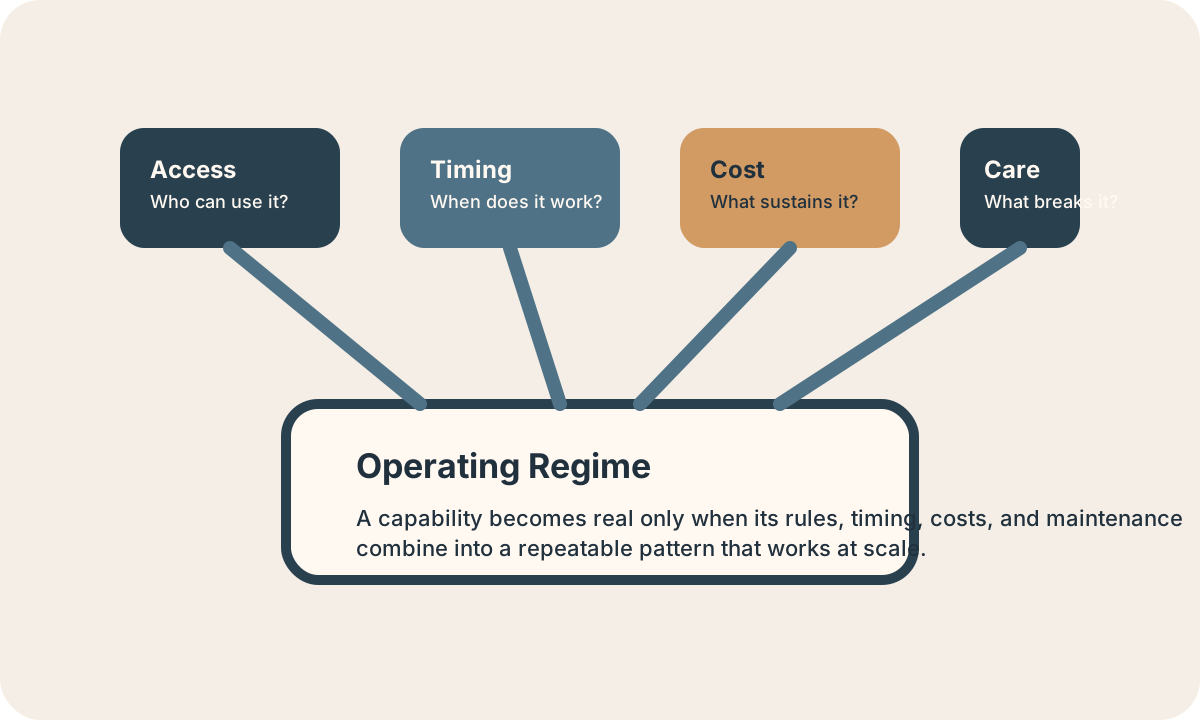
It captures access rules, scaling costs, timing windows, maintenance burdens, and failure conditions. Without this concept, systems look possible on paper but remain structurally vague in use.
| Axis | Question | Signal |
|---|---|---|
| Access | Who can use or control the capability? | Monopoly, licensing, ritual gatekeeping, training requirement |
| Timing | When does it operate effectively? | Seasonal windows, recharge cycles, administrative cadence, response delay |
| Cost | What keeps it running at scale? | Fuel, labor, upkeep, sacrifice, political sponsorship |
| Failure | What causes degradation or collapse? | Maintenance debt, overuse, scarcity, sabotage, drift from operating limits |
The term matters because capabilities are often described too abstractly. A society may be said to have magic, bureaucracy, cavalry, or irrigation, but that tells you very little until you know the operating regime that governs access, reliability, and scale.
Once the regime is clear, downstream design gets easier. You can tell whether a capability is rare or infrastructural, whether it centralizes power or diffuses it, and whether breakdown comes from one dramatic failure or from accumulated operating drag.
An operating regime is not a lore note about what is possible in theory. The term is useful only when the repeated access rules, maintenance demands, timing windows, and failure conditions are clear enough to shape everyday behavior.
Shows how tools become infrastructural only under a stable operating regime of inputs, maintenance, and training.
Magic Operating RegimeProvides the clearest direct example of capability becoming real only when source, cost, and scope are bounded.
Reinforcement-Balancing PairExplains why operating regimes stay legible when growth has defined drag and breakdown points.
If you can explain who gets access, what it costs per cycle, how quickly it can be refreshed, and what usually makes it fail, you probably have an operating regime rather than a decorative idea.
If you cannot answer those questions, the concept is still probably in lore space. That does not make it useless, but it means the capability has not yet become structurally dependable enough to shape the world around it.
A telegraph network, magical ward system, or irrigation bureaucracy becomes an operating regime once crews, upkeep, authority, and failure timing are stable enough that other institutions can depend on it repeatedly.
Read what should come before it, what relation role matters next, and where this page should hand you off after the local graph is clear.
Start with Throughput and then return here once the surrounding concept stack is clear.
Use Technology Diffusion Regime or the linked nodes below when you want to compare this page against neighboring parts of the graph.
Many glossary abstractions become richer when viewed inside the spatial module.
2 handoff nodes stay inside Capability Regimes. 2 handoff nodes share Cross Scale.
Detail pages now expose the branch and scale of their surrounding graph before showing raw prerequisite and relation shelves, so continuation can stay taxonomy-led instead of adjacency-led.
Explain how technology, magic, infrastructure, communication, and transformation capacity rewrite baseline constraints.
Start with the operating regime, price the capability through diffusion or monopoly models, compare a regime-rewrite case, then run a capability sanity check.
Explain how resources, goods, labor, information, and force circulate, stall, buffer, and break.
Start from the resource-flow loop, trace storage and throughput models, compare one logistics study, then run a flow audit worksheet.
Turn all major programs into creator-operable workflows rather than leaving them as analysis-only content.
Start in Guides with the workflow framework, choose the role route, open the supporting program branches only as needed, and leave with a worksheet or review artifact.
Use this scale when the strongest explanation depends on several levels staying visible together.
Use this scale when routes, relays, buffers, and linked nodes matter more than territorial bulk.
Use prerequisites when you want the shortest path into the assumptions this page depends on.
The amount of material, people, information, or force that can pass through a route, system, or institution within a given time without breakdown.
This entry still relies on generic related links. That works as a fallback, but typed relation roles would make continuation clearer.
A model for how tools, infrastructure, training, maintenance, and standardization determine whether a technology stays elite or rewrites everyday world structure.
A model for how magical capability is sourced, gated, trained, costed, and monopolized so it behaves like a real operating layer instead of selective plot permission.
A loop model for pairing each compounding process with the balancing drag, delay, or exposure that stops it from becoming unbounded.
Glossary entries define Spcent's shared vocabulary. They are conceptual anchors designed to stabilize how an abstraction is used across pages and modules.
A glossary term should lock down what a phrase means so later reading is not burdened by ambiguity.
When you know the concept but not yet the best framework or model, start here and then move outward through related nodes.
A useful definition points toward the frameworks, models, and studies that actually use the term in context.
Keep these collapsed until you want to turn the page into an active reading exercise.
What question becomes easier once this term is precisely defined?
Which entries in the graph are using this abstraction operationally rather than only naming it?
Do I need a framework, model, or study next to see this concept in action?
These routes are tuned to the kind of entry you are currently reading, so you can leave this page with one deliberate next move.
Many glossary abstractions become richer when viewed inside the spatial module.
Cross-layer moveMove into frameworks when you want a planning lens built on top of the term.
Cross-layer moveSearch across the graph to find every place the concept currently appears.