Pulling this page together.
Preparing content, navigation, and supporting references for this route.
Preparing content, navigation, and supporting references for this route.
A historical study of how canals, river grain movement, market towns, monetization, and bureaucratic storage turned Song China into a dense commercial-administrative system.
Song China is structurally valuable because it combines dense agrarian production with unusually deep commercial circulation and bureaucratic coordination.
Canals, rivers, storage depots, monetized exchange, and literate administration all reinforce one another. The result is not just a wealthy state, but a high-throughput civilizational machine whose stability depends on keeping circulation legible.
Provides the clearest lens for understanding how canal disruption, storage delay, and concentration points could reshape the wider order.
Flow Architecture FrameworkKeeps the case legible as one circulation architecture rather than as disconnected commercial and bureaucratic details.
Storage NodeExplains why granaries, river depots, and tax warehouses were not passive buffers but active instruments of coordination.
Route HierarchyClarifies how trunk waterways, feeder canals, and market-town chains created unequal but governable movement tiers.
The strongest pattern is state-commercial coupling. Administration depends on markets, and markets depend on predictable administrative order. Neither side fully dominates the other because both are moving through the same route and storage system.
That gives Song China a different feel from purely militarized agrarian empires. Capacity is built not only by conquest, but by keeping transaction density, transport reliability, and food security synchronized.
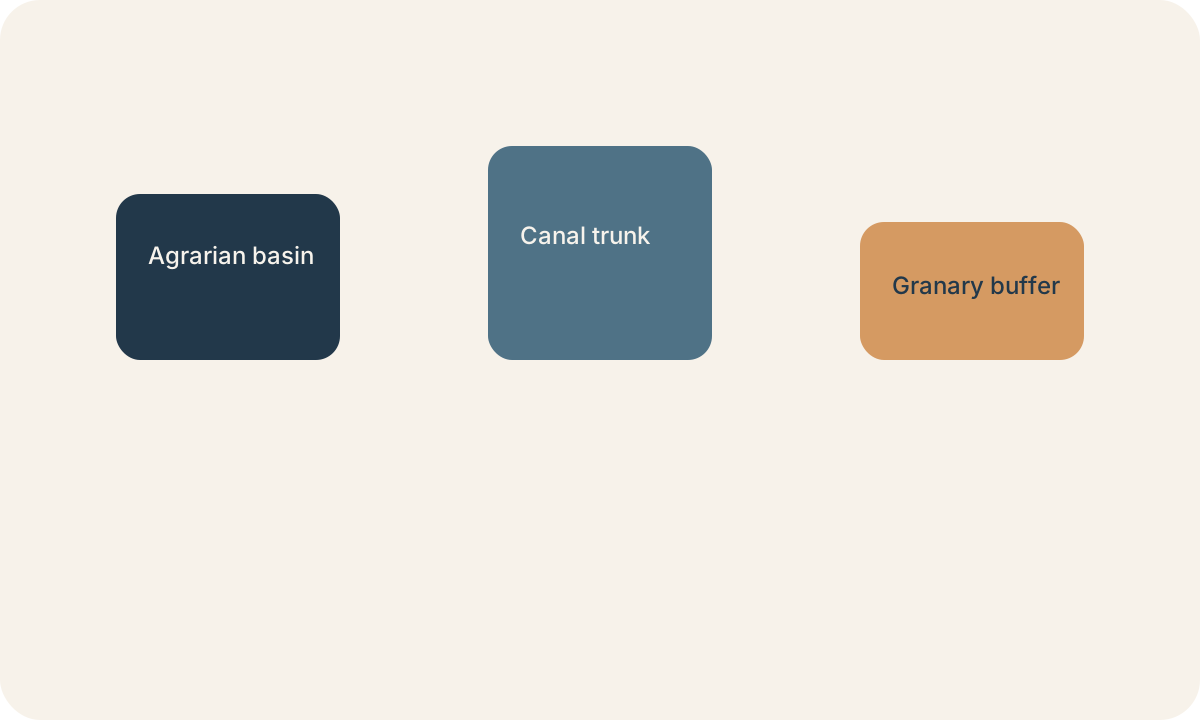
| Axis | Question | Signal |
|---|---|---|
| Agrarian basin | Where is the primary surplus produced? | Irrigated grain, dense villages, tax counting, labor concentration, flood control |
| Canal trunk | How does surplus reach the wider system? | Main waterways, grain convoys, lock timing, state maintenance, toll oversight |
| Market relay | Where does value diversify beyond grain? | Market towns, monetized exchange, craft specialization, merchant brokerage, warehouse finance |
| Administrative buffer | What keeps shocks from becoming immediate regime crisis? | Granaries, ledger systems, inspection offices, reserve movement, bureaucratic rerouting |
This study is the useful proof companion to Circulation Fragility Index because it shows a system that looks commercially deep and materially rich, yet still depends on narrow canal trunks, storage discipline, and bureaucratic rerouting to keep that density governable. The model names the fragility geometry. Song shows what that geometry looks like when the system is prosperous enough to hide its own dependence.
Read the pair in sequence when the economy looks too successful to be fragile at first glance. The model helps score the exposure. The study then shows how route concentration, granary buffering, and market-town relay still decide whether commercial density remains resilient or becomes brittle under delay and blockage.
One common misread is to treat Song commerce as proof that higher throughput automatically means lower fragility. The stronger reading is the opposite: high throughput can make fragility harder to notice because so much value is moving successfully before disruption hits. Another misread is to separate market density from administrative buffering. In this case the system works because canal movement, granaries, and bureaucratic rerouting still belong to one circulation skeleton.
It is also easy to read the case as proof that monetization by itself solves logistics. It does not. Money and markets help only while the route hierarchy, storage discipline, and rerouting capacity remain strong enough to keep abundance from collapsing into interruption stress.
The reusable lesson is that high-density commercial worlds become believable when administration, markets, and storage all depend on the same circulation skeleton.
Song China works structurally because transport, monetization, and bureaucratic depth are one system rather than parallel historical facts. That makes it the right flagship proof case when the flow question is not only how value moves, but how a visibly prosperous circulation order can still be fragile at its narrowest routes, depots, and timing gates.